Desertcart purchases this item on your behalf and handles shipping, customs, and support to Slovakia.
🔧 Fix it fast, fix it flawless—Bondic’s UV magic in your pocket!
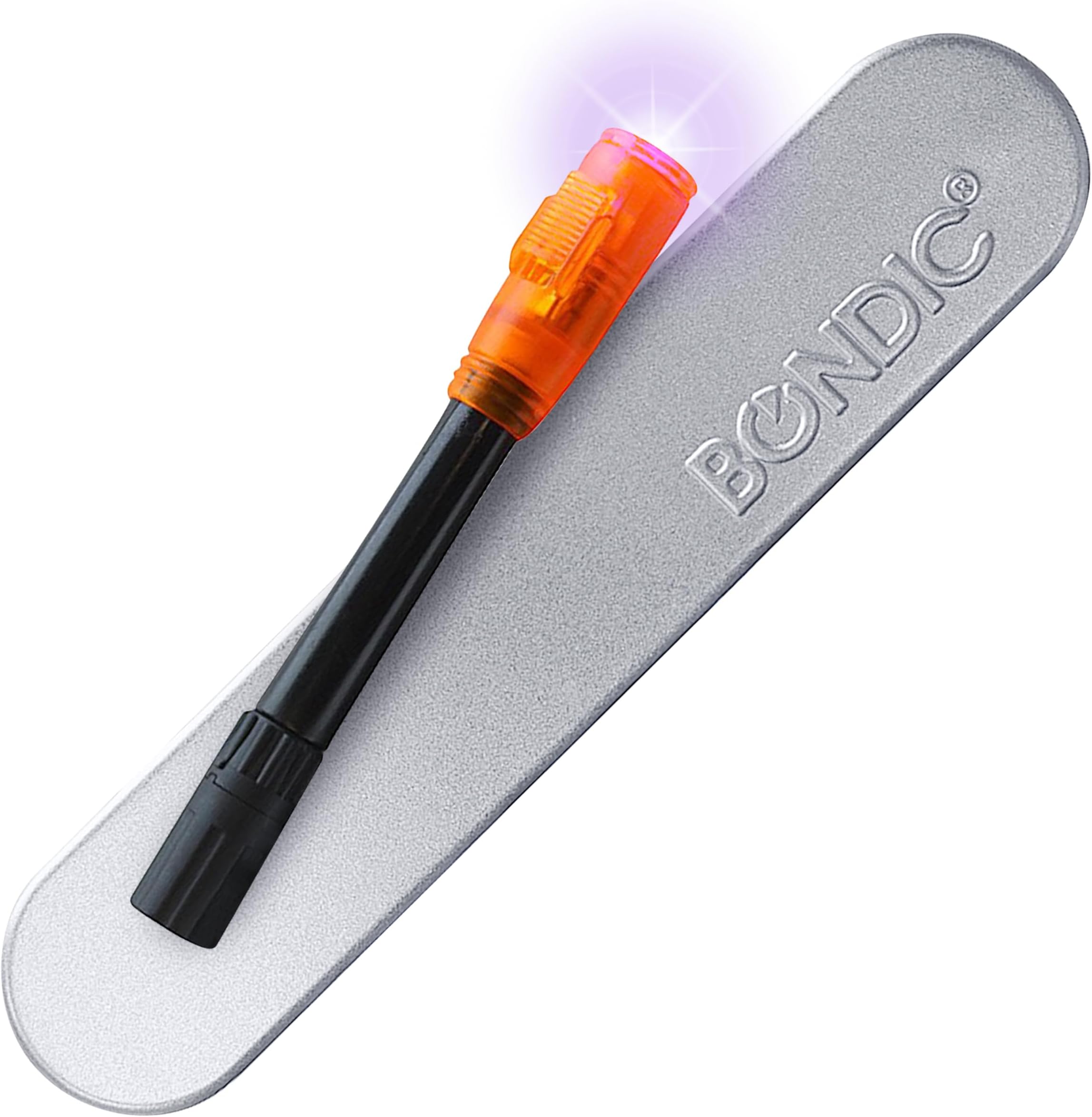
Bondic UV Liquid Plastic Welder is a revolutionary adhesive kit that bonds multiple materials instantly with UV light curing in just 4 seconds. Unlike traditional glues, it stays liquid until activated, allowing precise shaping and mess-free application. The waterproof, heat-resistant, and paintable resin ensures durable, invisible repairs. Packaged in a sleek metal case with a UV LED light and applicator, it’s the perfect portable solution for professional-quality fixes on plastics, metals, wood, and more.


| ASIN | B00QU5M4MG |
| Best Sellers Rank | #90,011 in Tools & Home Improvement ( See Top 100 in Tools & Home Improvement ) #324 in Hardware Sealers |
| Brand | BONDIC |
| Brand Name | BONDIC |
| Color | No Color |
| Compatible Material | Ceramic, Leather, Metal, Plastic, Rubber, Wood |
| Container Type | Tube |
| Customer Reviews | 4.0 out of 5 stars 8,312 Reviews |
| Full Cure Time | 4 seconds |
| Global Trade Identification Number | 00687077335428 |
| Included Components | Bondic LED UV Liquid Plastic Welding Adhesive Complete Starter Kit |
| Item Form | Liquid |
| Item Package Quantity | 1 |
| Item Type Name | Bondic LED UV Liquid Plastic Welding Adhesive Complete Starter Kit |
| Item Weight | 2.86 g |
| Manufacturer | BONDIC |
| Material | Liquid Plastic |
| Material Type | Liquid Plastic |
| Model | BONDICBOGOBULK |
| Other Special Features of the Product | Waterproof |
| Part Number | BONDICBOGOBULK |
| Special Feature | Waterproof |
| Specific Uses For Product | Commercial/Residential, General Purpose |
| UPC | 687077335428 636156077766 |
| Unit Count | 1 Count |
| Viscosity Level | Low |
| Volume | 4 ml |
| Warranty Description | Warranty |
| Water Resistance Level | Waterproof |
M**R
Maybe not a Panacea, but great stuff none-the-less!
Bondic is Great! Lets start with this statement: Bondic is Great! And then lets get some disclaimers out of the way... 1) Bondic will not replace superglue or epoxy in every situation. 2) It is not as strong as quality epoxy, and as it is not a true adhesive, it will not work well unless there are edges or texture for it to grab -this is why they recommend roughing the surface prior to application-. 3) It is NOT ideal for repairing clean breaks as it is not a true adhesive like super-glue and if it does not have edges and texture to grab onto it will not hold well. Also, if your material is opaque, getting the Bondic in the middle of the crack to cure may prove very difficult, as it has to be hit with Ultraviolet light in order to cure. 4) It still doesn't stick to polypropylene, nothing commercially available really does, but with the right texture it's as good or better than anything else you can buy in the store. So, what is this Bondic stuff all about? Bondic is an instant-UV-cure filler material with some adhesive properties. What this means in practice is that Bondic combines the best features of a liquid adhesive like superglue, a paste adhesive like epoxy and a filler like caulk. In it's un-cured state Bondic is a relatively thin, clear liquid that flows easily into tight spaces and forms around odd shapes (like you get in cracks and breaks in splintered plastic), but with just enough viscosity to not run all over the place, it looks and behaves very much like gel-style super glues when first squeezed out. That all changes when you hit it with the Ultraviolet LED, and it (nearly) instantly becomes a durable, clear polymer! you can fill large gaps by building up layers of the stuff, and you can sand and cut the cured material like it were soft plastic, which it essentially is. On materials with a rough, porous surface the bond strength seems quite high, but on smooth non-porous surfaces it will flake off quite readily. you also need to be aware that Bondic won't do a good job of holding your pieces in place until it gets hit with the UV, and you will need to be able to hold your working pieces in place. I've used it to tack some things onto unfinished fiberglass (a rough, and porous material) with excellent results, and have used it in place of electrical tape and heat-shrink tubing to insulate wire junctions, I have fixed a tail-light lens, sealed a leaky wire-passthrough in a "waterproof" speaker, stuck a hanger wire onto a small lamp housing, and more! I haven't tested the claim that it "works underwater" but based on the technology involved it probably does, you just have to be sure all the water has been pushed OUT of your intended joint before you cure. One caution: Bondic is cured by Ultraviolet light, and if you are working outside on a sunny day you can expect the rays of the sun to begin to cure your project AND cause build-up on the applicator nozzle in a few minutes. Shade your work area if you want to avoid this happening. Overall Bondic is a very nice addition to my toolbox and junk drawer, and is useful in a wide variety of small repair and construction projects. It's a little expensive, and could be considered a "novelty" as everything it does can be accomplished with other less expensive materials if you are patient, but it really is neat and functional stuff and although you might not wonder "how did I ever live without this?" you'll certainly hope it gets less expensive so you can use it with more abandon.
B**M
Pure, hard magic.
I'm a bit of a connoisseur of fine adhesives. Everybody has to have their "thing," right? Prior to discovering Bondic, I've had a multi-year love affair with 5-minute epoxy. The Devcon stuff. The good stuff. But a colleague showed the YouTube adverts for Bondic and we all got curious... decided it was worth the $20 investment, just on the off chance it might work. And: holy guacamole. This stuff is amazing. It stays liquid for like, ever. Until you're ready for it to harden. Then you hit it with the UV light and BAM! Hard. In a flash. No waiting, no testing, no wondering "do I still have time to adjust the part? it looks a little crooked now..." I use it routinely for work tasks, for stuff around the house, for everything. It is NOT for adhering interior parts, so you need to be prepared that the adhesive, when cured, will be exposed. Not a big deal for me, but it just means that Bondic has a range of applications, and other applications are better served by other adhesives (e.g., 5-min epoxy... still love you baby...). I've sealed finicky hose connections in the garden, formed a custom connection with the washer drain hose in a home greywater system, repaired a busted shredder, ... And made countless other repairs thanks to this magical stuff. The one thing it really DIDN'T do for me? Fix the iphone cord. As another reviewer mentioned, it did ok for like a day and then the cord was busted again. Not a big deal... if you're spending $20 just to fix a $10 cord, then you might want to double check your calculations. But if you want a brand new, super cool, non-glue glue to have in your adhesion toolkit, DO NOT EVEN THINK TWICE! Buy this stuff. Trust me. And visit their website... it's rather whimsical and I had a few big belly laughs while watching their videos. (watching them "build" an iPhone case by spraying this stuff all over the corners of the phone almost made me tear up a bit...) Buy it! Support these guys! Hopefully some day we'll see them in the big box stores too.
K**L
UPDATED: re: Some leakage and the LED was dead
Wow...I'm disappointed. I really needed this thing to work. I was very impressed with the video. I read some reviews on here regarding fluid leakage from the pen, and I thought it can happen, but maybe their quality-control will step up. I received this unit and it was partially covered with the liquid material that leaked out - not a lot. But it isn't the type of stuff you want on your skin, and there's no way around it unless you open the package with a cloth or paper towel handy. Also, the pen body is much more flexible than I would have thought. It's like a stiff black plastic drinking straw with threads that don't seal that well. Okay, not a big deal. But the LED wouldn't light. There are two ways of activating it - sliding a switch down that presses one of the LED leads to make contact with the battery, or by squeezing the soft battery case to do the same thing. Nothing. I don't know if the LED is defective or the battery was dead. I suspect the latter. I had an application for which this item would have been perfect. But I can't use it and have to send it back. Very disappointed. ***************************************************** ********************* UPDATE ************************** ******************************************************* I began my return process with Amazon, but in the meantime, the seller noticed my review and promptly sent a replacement, unsolicited by me. The replacement arrived today and the LED light was fully functional. I didn't notice any leakage around the pen, but I might still expect some, given the material it's made from. The item works as advertised, though I will say that the resulting cured product is a bit more flexible than it appears in the video. It isn't glue, but if you've had any experience with actual metal welding, you will have more success - you need to make a good solid mechanical connection for good strength. I updated my review from one to four stars - for the product itself. It isn't the cat's pajamas as it appeared, but it's pretty good. The seller is outstanding - and I very much appreciate their efforts to satisfy this customer.
P**N
"Would that it were.."
Real plastic welding, that is. Straight off the top: magical thinking. I purchased Bondic to try to save time and effort to seal a fuel tank which I had repaired years ago after trying every adhesive available and seeing them all fail. I was pretty sure Bondic would too, but no one had covered it in any depth as far as a range of materials go. It was that type of flexible thermolplastic or PVC which I was fairly certain would resist any technique other than true plastic welding (using a scrap of base material as a filler), which is time consuming and difficult. I decided to do a video in case a prospective customer wanted to see for him (or her)self without my usual TL/DR written review, but felt the whole story might be interesting as well. In short, I wanted to provide the review I would like to have read before I tried Bondic, and offer other thoughts on the product and its other uses. (I have also discovered, as may you, that reading the reviews here is a great way to learn applications in which Bondic will be more successful And, after completing this review, I thought I might add applications for Bondic that are worthy of note; hang in and later you may see a few surprises.) So: No, it didn't work for me. And yes, I admit to being disappointed, it's such a cool idea. But, you have to understand the concept here- Bondic is not an adhesive, or despite claims, provide "welding", it's more like caulk. Or perhaps more accurately, a surface-only patching compound, since the liquid has no adhesive properties until it can be cured by the included UV LED. Which is good and bad; good in that you won't stick your fingers together or make a permanent mess, but bad because none all but the most perfect of situations can be repaired with any greater results than can be resolved by a traditional product- especially if it's a surface chip or a butt joint. I just tried it on a saucer, and realizing the UV light could not possibly be used to cure the majority of the fluid, I just "burned" the squeeze-out and so far it seems to be an OK, if simply cosmetic repair, It is always my hope that I will discover the miracle adhesive that bonds that previously un-bondable material- usually a slippery plastic that defies cyanoacrylate or anything at all. When I saw Bondic I was momentarily excited, but as I learned more, age and cynicism kicked in and I realized that while offering the new (to me) technique of UV curing, the fact that Bondic is marketed as "not glue, but actual welding" really increased my suspicions. I am a welder, and believing in a more realistic definition of what can really be called welding, realized at once there is little about Bondic that could be considered true welding. A former associate used to refer to the technique used by non-skilled people operating welding equipment which consisted of building up layers of filler material in the hopes some of it would adhere and join the metal as "blobularization". Or, in different words, a cold solder, which is essentially what Bondic offers for a majority of situations. Don't get me wrong; it holds things together, but it's not usually as attractive or as strong as the correct process may be. The manufacturer is not deceptive about it although a tiny bit vague. The instructions and ad copy describe the Bondic process truthfully, but you just should realize it is not welding. One definition says welding is: "causing two parts of a base material (primarily metal) to become molten under high temperature and fuse, usually with the aid of filler material." So, I knew it was probably not going to work for the application I needed- re-sealing the leaking center joint of a thermoplastic fuel tank. I had already successfully heat welded the crack once, using a scrap of like material for filler, and it help up well for a few years but I though I would give this new wrinkle a try before a new crack caused a new leak. Before I tried the real repair, I did a small test on a small section of the tank that was not leaking. I performed used all the prep as recommended, applied the product, cured, waited a few minutes and tested it. While it resisted light pushing and prodding, with a sharp edge under the end of the bead, not to be crude but it simply pulled off like a scab that it essentially was. Nevertheless, I thought it might be more graphic to shoot a little video, especially for those who do not need this much info- but this time while I made the repair on the actual area. It had to be edited heavily, but be assured I followed both manufacturers' instructions (such as they are) and best procedure for both welding and any plastic repair I have ever performed. I applied a thin bead along the seam with Bondic, the crack seemed too small for a 3-pass method, and not only using 3 times the material, it would technically be three times more likely to fail. It flowed nicely, ran into the seam and my roughening; looked great. As seen in the video, I pressurized the tank and put soap on the seam to pinpoint - and illustrate the leak. But because the compound would not interact with the base material- a resilient thermoplastic- what I ended up with was blobularization. And sadly, the entire lovely bead popped right off with only a little persuasion, it appeared fuel had just been vibrating and resting on the backside was enough to seep under the bead and compromise it. At least I was able to clean it up and re-weld the seam in the original, tedious fashion, and to be fair, I applied another coat of Bondic just for a little more protection- this is the part of the machine that rests on the ground (hence the original failure) so it may well protect the seam a little longer. . I suspect if one were able to completely surround a crack or a hole as illustrated by Bondic's use of a copper pipe repair (gotta test that one) a measure of success could be expected, but this is usually not a convenient or realistic approach to a repair, except perhaps for temporary emergencies. I found several plastics that didn't need repair in the first place would accept a bead that could not be removed, but am still awaiting for the ideal test piece. I know this kit will be a welcome addition and a lifesaver at some point, it is unique and the ease of use offsets quite a few other limitations, but it is not the magic bullet. It's an attractively designed little package, right down to the foam-lined tin storage case, the way the LED case snaps into the dispenser pen.. but that alone was a warning. Ever seen a cleverly packaged repair product that was in common use and worked really well? I haven't. And BTW, be sure you don't accidentally expose the needle-tip applicator to the LED. It pulls out and can be cleaned, as long as you have a #75 drill bit handy! ------------- I recently relocated some blinds that were mounted with stout brackets into the drywall, not only did I not have any patching compound to fill the holes, even if I had I was in a really big hurry. So I happened to think of Bondic- now, here's one app you won't see advertised! But after cleaning up the surface ever so slightly, I was able to work a drop or two into each hole, cure and paint immediately. In most cases one or two passes were all it took. I was able to massage the liquid a bit to match the texture, the fill is solid and after painting, almost undetectable. I had pretty much given up on re-ordering, but stuff like this shows it might not be a bad idea to leave some around for the unexpected. More from the understaffed and ill-equipped Bondic Volunteer Research Lab: I have a pair of Ray-Bans that have been repaired so many times the bottom frame of one side is almost completely missing. So much so the bottom edge of lens would sit on my nose. Fearlessly reaching once again for the remaining Bondic, I made a bead at each end of the old frame, then slowly built it up across the gap. It blended and fused perfectly, and the shades are now wearable once again. The bead was of course clear plastic, so a little touch-up with a black Sharpie and I am good to go. At this point the product reminds me of its homophonic automotive world counterpart, "Bondo".
E**Y
Excellent product, works as advertised, but not a cure all
Update: New information posted at the top of review: Adjusted this down to one star. Used the product once, put it back in its case, and there it sat in my desk, untouched. I take it out today to use it again, about a month later, and the reservoir has a crack in it. Now the resin leaks out it if I try to use it. It is a great product, but the construction is obviously made of flimsy material. Great idea, poorly executed. I wish I could get a refund. ******* This is an excellent product. I have been waiting for something like this for a long time. I have a family with young children and that means a seemingly never ending stream of broken plastic toys. It works exactly as advertised. I don't know if I would trust it for a high strength repair, but that is only because I have made a few small delicate repairs so far and I am too afraid to pull-test them. I first used it to fix some minor pieces of broken jewelry that had no real monetary value, but they had sentimental value. I recommend doing this first in order to get a "feel" for the product. I like that you have to squeeze the liquid chamber just slightly in order to get some of it out. So far I don't see any real problem with leaks. After a few minor repairs, I tried it on the main reason for buying: a Christmas ornament that was very treasured. The ornament consisted of Dumbo spraying water into the air. Well the glass water spout had come apart from the Dumbo trunk. Normal glue would not bond, I tried. This did an excellent job of repairing and it seems to be holding very well. I would not use this in place of a normal repair that only requires super glue and I don't feel like I can trust it to something that requires the strength of epoxy. It is a nice product for niche repairs that are in between those two products. Pros: - I like that you can turn the LED on with the switch for constant on or just squeeze that end of the device for momentary on. - Nice little metal case is a convenient way to carry it around. - Bonding liquid is a good consistency so that it is not messy unless you squeeze the tube too hard. - Works as advertised. Cons: (only minor issues) - It is easy to unscrew the cap to the reservoir, which also contains the cap to the applicator. Making the applicator cap a different color would be helpful. - I don't think you will get much out of the reservoir before needing a refill. I recommend picking your repairs carefully. The only issues I have are minor: The clear liquid can make it difficult to see how much you have already layered out there when curing.
R**N
you will be very happy with this product
As long as you don't expect this to do what it was not designed to do, you will be very happy with this product. The Bondic team makes it very clear that this is NOT a glue. This is rather a plastic (and other materials) welding kit. It is also, to a small degree, an insulator (think in terms of voltage insulation). Let me give you an example of where this really shined for my needs. My microwave, which is rather new, started to fall apart 1 day out of warranty, I kid you not, 1 year and 1 day. Specifically the door handle just started to crack and flake off, and it absolutely was not abused, just normal use. I checked with the factory and the only way to fix it was to replace the entire door which that part alone was about 60% of the cost of the whole thing. Anyway, the parts that fell off were located in a way which you could not glue it without it looking really terrible. The parts really needed to be manipulated to fit. Instant glue (crazy glue or ca) would not allow this and they were situated in such a way that you could not clamp them or even rubberband than in place while a slow acting glue or epoxy would cure. Since it is a built in microwave, I did not want this looking half a**ed and I was ready to just replace the whole thing. Then I saw Bondic and figured I would spend the twenty some odd dollars as a last resort before handing out another $500. I was able to apply this to the parts, get them fitted properly and hold them in place till I was happy with the fit and then hit them with the UV light. It worked perfectly! I was then able to build up a new part that was threaded and structurally required with some JB Weld to finish re attaching the handle and allowing it to cure properly. Bondic just saved me $480! I want to add that the microwave was badly designed (on purpose?) because you can't replace small parts without buying much larger parts that are not needed and...I called them and told them how the materials they used just started disintegrating by themselves and I wondered if they would be willing to perhaps discount the door assembly. They said no, they would not be willing to do anything, seeing as this warranty had expired the day before and then without hesitation they asked for a credit card number so they may send me a new microwave... At full cost! Again, true story. I would tell you the name of these folks but I don't think it fair to ken more if I do, understand? Also, I had need to contact the good people at Bondic and they are an outstanding group of people and a great company to deal with, I can't tell you how pleased I am with this product and these people. I recommend them 110%! I know this has been a long review but maybe it can help explain just where this product comes into its own, if you think about it I'm sure you may have a need for this as well.
D**N
Big Win on Blown Glass: Read Below for Tips on Delicate Items
My friends call me a bit of a glue freak. This despite bringing me things to fix that they cannot. Usually I'm able to put it back together using epoxy glue or polyurethane glue or whatever. But I was stymied by a blown glass dragonfly. One of the four wings had broken off. When I examined it with a magnifier, I could see that a small, wedge-shaped piece was missing where the wing root took a 90 degree turn to join the wing. Epoxy glue requires matching surfaces, so it wouldn't. The dragonfly sat broken on a shelf for 8 years, until I saw a Bondic video. The unique thing about Bondic is that you can build up material with it, and that material is structurally strong. Even better, this only takes a few seconds. For the Dragonfly, I dropped a blob on the wing root, cured it with the UV light, then did it again. After three blobs, I had recreated about 80% of the missing wedge piece. Then I applied another blob, stuck the wing into that and cured it. While the wing was now reattached, it was barely connected to the wing root. So I applied three thin layers of Bondic over the joint, curing each one. The final result is perfect, and no thicker than the original glass. SEE ATTACHED PHOTO. This ability to easily build up material and cure it within a few seconds is what makes Bondic unique. If you need a specific shape, you can cut or sand the cured material as necessary. In my case, the Bondic flowed into the natural shape of the blown glass, so no shaping was necessary. Please note, the layers need to be thin. The directions recommend 1.0-1.5mm, but I made them even thinner. There's no need to rush, since each layer takes only 4 second to cure with the UV light! My second repair was a glass swan. The edge of the wing had broken off. This required adhesive along a long, thin surface of clear glass. Impossible with glue, but straightforward with Bondic. For this repair, a third hand was very useful, but again, only required for 4 seconds! So the hints for delicate items are: . * Build up material in advance when necessary. For the dragonfly, I applied three blobs . to the the wing root before applying one more to adhere the wing. . * Cure everything thoroughly with the UV. After layering Bondic all over the repair on the . dragonfly wing, I noticed that there was still some tacky stuff there. One more pass with . UV light and that was gone (hardened). . * Thin layers work best. Since you can cure a layer in 4 seconds, there's no need to rush. I'm totally happy, and looking forward to getting very creative with this in the future.
F**N
MAGIC, I TELL YA!
Since the that first day in the dentists chair, watching the dentist use Ultra-Violet activated bonding agent - I have been on the lookout for a way to have that capability. So, when I saw a TV ad for Bondic my eyes lit up like a kid on Christmas morning. Short answer: This stuff is Magic. Works better than I had even dreamed! Additionally, my wife, who is an Elementary School Art teacher - immediately saw applications for it. In the short time I have had it... I have glued the frame on a magnifying glass that was beyond normal repair, fixed the plastic lid on my wife's expensive make-up case... repaired some dog-chewed phone charging cables, and just last night I fixed something whose repair had eluded me for 20 years... the brass handle on my fireplace tool. It REFUSED to stay tight - it would wobble and then loosen up no matter WHAT I tried. Believe me, in 20 years I tried a lot. Just a quick, light strip perpendicular to the threads, Zap it with the UV, and I had to use considerable force to screw the handle back on. The threads immediately gripped tight... I can still remove the handle with force, but is goes back on tight. Magic, I tell you. I had to build a fire just to use it. <G> Pros: the ability to clean it up before setting it is an unsung Pro. No frantic time worries about super glue setting up, no concerns about getting glue where I didn't want it. I am a perfectionist - I found that I could apply the glue, take cue-tips and paper towels to clean up the bond - with NO TIME PRESSURE or melting of the plastic ... and then, when it satisfies me, Zap it and it is hard as a rock. Cons, Tips: The only failure I have had is when I attached a magnet to another magnet. The surfaces were slick chrome, and the directions warned about roughing up the surfaces. They are correct - the bond failed under pressure. Personal con: the hardest things for me to do is use just enough. I had to get out of the "If a little bit does a little bit of good, then a lot will do a LOT of good" mentality. The only thing a lot does is waste glue. The only other con is the instructions: what there was is written in 16 languages and hard to follow. Tip: The tool works best when taken apart. The UV head pulls easily out of the orange holder, and the glue tube pulls out of the orange holder as well. I found I had a lot more control with the tube in one hand and the light in the other. The "Lock On" function of the light is handy also. You will be amazed... can't say enough good about this product. But I am gonna need some more glue... <G>
C**N
Bondic colla UV
Conoscevo già questo prodotto e devo dire che non ha eguali per flessibilità di impiego. Una volta polimerizzato (bastano pochi secondi) potete facilmente carteggiarlo per dargli la forma definitiva. Eccezionale per piccole ricostruzioni su abs e plastiche in genere: ottimo anche per fori e filettature lente e da rifare. Costa un po' ma è un prodotto che risolve in modo eccellente le situazioni di bricolage che altre colle possono solo "arrangiare"
A**ー
接着液がなくなりそう
思ったより、手軽で良く接着します。あっちこっちと接着して回り接着液がなくなりそうです。
Y**L
ne tiens pas
tous les objets collés avec ce produit ne tiennent pas malgré l'utilisation correcte du produit, je suis très déçue vu le prix
E**Y
Wasn't sure why I wanted this but it's proving very useful
Saw this demonstrated on a craft programme on shopping TV. The demonstrations of it's use were somewhat underwhelming but I found the concept interesting and thought I might find uses for it, so bought one. So far it has proved very effective for sticking tiny (Ø3x1mm) rare earth magnets into paper and card craft constructions. More impressive was building a replacement hinge pin for a broken Fiskars Paper Trimmer (made from clear plastic). I'd tried various glues to stick the hinge pin back but the stresses of snapping it back into place were too much and it always broke off again. The pin was about 3mm in diameter and 8mm long so I decided to try building one in situ with Bondic. It was important to make sure all traces of glue were removed from the plastic then I applied Bondic layer by layer curing as I went until I had a pin of roughly the right proportions. It didn't look very pretty (you can sand or file the cured plastic if required) but to my delight it snapped into place on the cutter which is now working as good as new. A replacement cutter would have been £26 so the Bondic has more than paid for itself with this one repair. The curing process is so fast - literally seconds to achieve full strength - makes it a pleasure to work with. I'm optimistic I'll find other uses for Bondic in the future. The unit comes in an "aluminium" case.... first time I've seen magnets stick to aluminium! Even if it is brushed steel, the case is quite nice and keeps the light away from the unit.
R**N
[Bondic] has made me into a pseudo "super dad"
I was skeptical, having read both the positive and negative reviews. I did get the sense from many of the negative reviews though that there was a distinct possibility the person reviewing simply ... well ... wasn't doing it right. And I'm glad I went on that assumption. It works! The Bondic was purchased to repair a broken piece of my laptop bezel where the charge cable plugs in. I knew my laptop was on the verge of a major repair if I didn't do something soon, as the charge cable was very "jiggly" and I feared the soldering joints on the motherboard would give way if I didn't repair the bezel around it. Bondic filled the space perfectly, without having to take the laptop apart. It went as solid as plastic within a few seconds of being exposed to the light, and I feel like I've successfully avoided a repair that would have cost $150+. From there, the Bondic has been used around the house for various repair jobs here and there, and what I truly love about it is that it has made me into a pseudo "super dad" - I'm able to fix small issues with toys and electronics with no waiting. "Sure kids, bring it here, I'll use Bondic" - and it has worked well. I've fixed the buttons on my son's MP3 player, I've fixed broken toys for my youngest, and more... all without them having to wait for the old "Well, I'll try to glue it for you tonight, but we'll have to wait until morning to see if it holds." Now I'm fixing things quickly, easily, and effectively. I've added refills to my wishlist. This thing is great!
Trustpilot
1 month ago
3 days ago