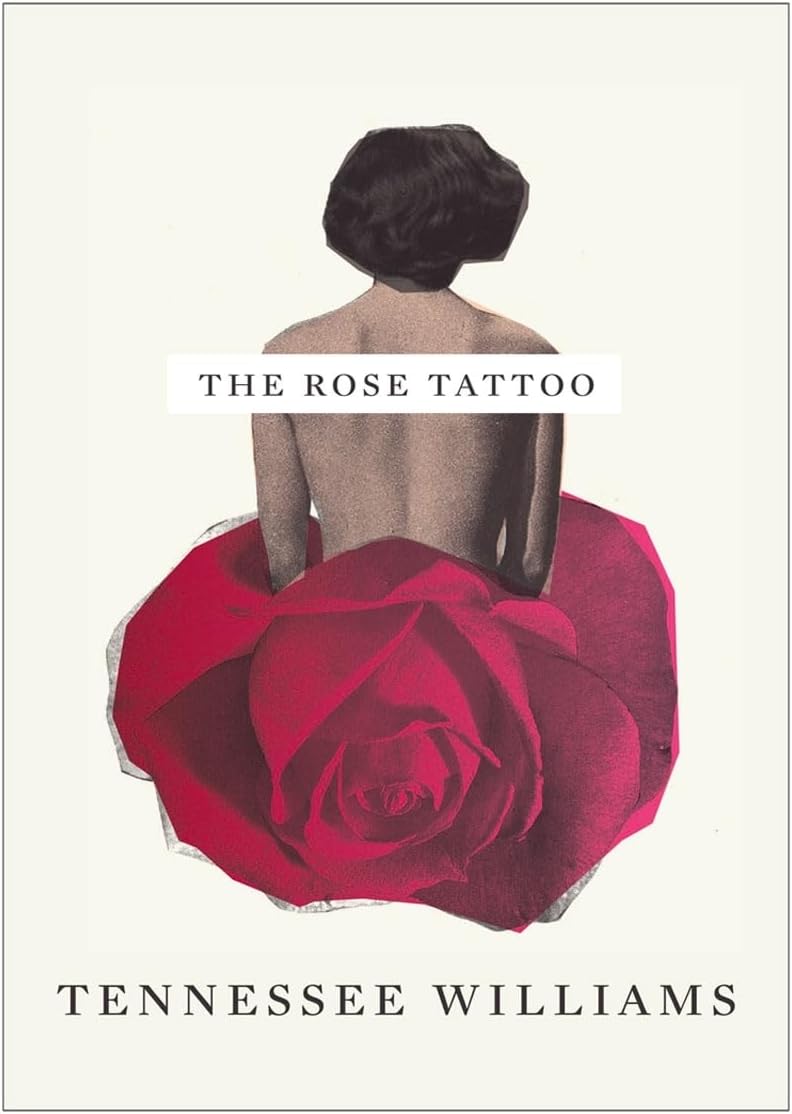
The Rose Tattoo
Product ID: 107239088
🏆Tony & Academy Award-winning play
📚First trade paperback edition
🕰️Includes original intro & rare essays
Desertcart purchases this item on your behalf and handles shipping, customs, and support to Slovakia.
🏆 Own the award-winning play that redefined passion and resilience.
The Rose Tattoo is a celebrated Tennessee Williams play, now available in its first trade paperback edition featuring a new introduction by John Patrick Shanley, the original foreword, the foundational one-act play, and an expert essay. Winner of Tony and Academy Awards, this emotionally rich drama explores love, grief, and cultural identity within a Sicilian immigrant community.
| Best Sellers Rank | #918,894 in Books ( See Top 100 in Books ) #753 in American Dramas & Plays |
| Customer Reviews | 4.3 out of 5 stars 73 Reviews |
D**Y
Five Stars
excellent writing
R**N
The Rose Tattoo
Tennessee Williams is most often remembered as a lyrical writer of tragedy and lurid violence and as the author of three classic plays: "The Glass Menagerie", "A Streetcar Named Desire", and "Cat on a Hot Tin Roof". Williams wrote many other plays in different styles. Among the best of his works is this romance, "The Rose Tattoo", a play which is too-little known today. Cheryl Crawford directed the play when it opened on Broadway in 1951 starring Maureen Stapleton and Eli Wallach. The play, Stapleton, and Wallach each won Tony Awards. In 1955, Williams wrote the screenplay for the film version of "The Rose Tattoo" which became famous for the Academy Award winning performance of Anna Magnani. Williams wrote an introduction, "The Timeless World of a Play" to "The Rose Tattoo" in which he said: "Whether or not we admit it to ourselves, we are all haunted by a tragic sense of impermanence." He argued that a play gave the opportunity to suspend time by allowing its audience to share in human emotion and change as spectators and so to understand oneself and one another better, if only for a moment. This short, difficult essay is an apt introduction to the play. The three-act play is set around 1950 in an unnamed town on the Gulf Coast between New Orleans and Mobile with a large population of Sicilian immigrants. The play tells the story of a middle-aged Sicilian immigrant woman, Serafina Delle Rose who passes from grief and despair to love and sexuality and to a second chance at life. In the opening scenes, Serafina is pregnant and married to a man named Rosario and the couple have a 12-year old daughter, Rosa. Rosario never appears in the play. He is killed almost immediately when he is smuggling contraband for the underworld under a truckload of bananas. Serafina, who works as a seamstress, is shaken to the extent that she loses the baby. She lives solely with the memory of Rosario and of his sexual prowess, symbolized by the rose tattoo on his chest. She comes to idealize her dead husband and fights fiercely to repress compelling evidence of his long-term infidelity. Most of the play is set in a single day three years after Rosario's death. Serafina continues to mourn his passing and loses interest in her friends and in other people. She becomes over-protective of Rosa, who is now an adolescent graduating from high school who has fallen in love with Jack, a young sailor. Serafina meets an uncouth but magnetically attractive young man, Alvaro, who also drives a truck for a living and who reminds her of her late husband. The sexual attraction is immediate. In long scenes between Rosa and Alvaro, Williams develops their relationship. Serafina comes to terms with the frailties of her husband and with love and romance. She is able to love herself and to release her daughter to her own life. The play is lengthy and takes concentration to read. It is full of symbolism, including the rose tattoo, religious icons, a watch, a randy goat, a flamboyant pink shirt and more. The Sicilian immigrant community is vividly drawn with eccentric characters including a herbal doctor and a witch. The play includes some Italian dialogue which is best read over quickly as its meaning is generally clear from the context. I found it helpful to watch the film version between readings of the play to help visualize the action. Magnani's portrayal of Serafina brings the character to life more than any reading could do. Although the film version is bowdlerized, the spirit of Williams' play comes through. John Lahr's biography "Tennessee Williams: Mad Pilgrimage of the Flesh" (2014) devotes substantial space to Williams' writing of "The Rose Tattoo" and to its biographical significance. Williams wrote several early drafts which were critiqued by Elia Kazan, who had already directed several of Williams' plays. Williams wrote and rewrote to adopt Kazan's suggestions into the final version of the play. When he had completed the final draft, Kazan, after hesitation, declined to direct the work, to Williams' great disappointment. In this instance, Williams was right to have faith in the worth of his play, as suggested by the Tony Award. Years later, in 1959, Kazan would back out from directing another Williams comedy, the far less successful play, "Period of Adjustment". Williams and Kazan never worked together again. "The Rose Tattoo" is a beautiful play about disappointment and grief and about the power of love and sexuality to redeem life. In addition to this individual version, the play is available in the first of the two Library of America volumes devoted to the plays of Tennessee Williams. Robin Friedman
G**R
Once Famous But Now Among The Lesser Known Titles By Williams
Opening on Broadway in 1951, THE ROSE TATTOO was a major success for playwright Tennessee Williams, winning Tony Awards for Best Play, Best Actor, Best Actress, and Best Scenic Design; it was subsequently filmed in 1955 and again proved a major success, receiving Academy Awards for Best Actress, Best Art Direction, and Best Cinematography--as well as five other nominations, including Best Picture. Even so, TATTOO is no longer considered among William's "essential" works, and although it has been revived now and then over the years the large cast and complex set makes stage productions few and far between. The story is set in an unspecified town along the Mississippi gulf coast (the characters reference Pass Christian and Biloxi as nearby), the play centers on Serafina Delle Rose, a passionate Sicilian woman, who lives with her husband in an Italian enclave; while her husband drives a truck, she works as a seamstress, and the two have a beautiful daughter named Rosa. But within a few minutes of the play's beginning, Serafina's husband is dead and she, pregnant, miscarries. She begins a downward spiral into a mixture of depression, religious hysteria, and superstition that threatens Rosa's happiness--and ultimately demands that Rosa live her own life in the same despair and isolation. Rosa rebells, but more significantly, Serafina makes the discovery that her late husband was unfaithful to her. She also meets Alvaro Mangiacavallo, who has an unexpected series of similarities to her late husband: he drives a truck, he is of the same body type, and he is of the same passionate nature. These events have the effect of exploding Sarafina out of her depression and back into the mainstream of life. Like most Williams plays, THE ROSE TATTOO is rich in visual and verbal symbolism and allegory; unlike many Williams plays, the play ends on a positive note, with Sarafina ultimately electing to embrace life. But in comparison to such masterworks as GLASS MENAGERIE, STREETCAR NAMED DESIRE, and CAT ON A HOT TIN ROOF, it seems loosely written, more of a prolonged character study than a cohesive, unified play. Recommended: lesser Tennessee Williams is almost always first rate in comparison with most other authors of his generation; even so, not quite among the first rank of the author's output. GFT, Amazon Reviewer
C**Y
Five Stars
brilliant
L**S
A Must-Read
The Rose Tattoo (1951) by Tennessee Williams is a wonderful play by the author. The play follows the story of the protagonist Serafina Delle Rose. She is an Italian woman and a seamstress who lives in a Sicilian community in Louisiana. She is pregnant and also has a daughter Rosa. She loves her husband Rosario to bits but Rosario is not what he seems. He is having an affair with a local woman Estelle and is a smuggler. After he is shot and killed by police, Serafina overhears some women who are neighbours discussing how they will break the news to her and her grief begins. Her own past pain, because though she loved Rosario with all her heart she knew his faults even though she was in denial, also comes in her negative feelings when three years later Rosa meets a guy she loves called Jack. I also think the negative feelings are because she fears if Jack died, Rosa would go through the same pain she did. So it’s protective but it’s also stopping her daughter from happiness and Serafina does not communicate very well her fears through whatever. Pride? Fear to be honest about it? An I’m the Mother and I don’t have to explain myself attitude. Whatever the reason or reasons, her communication skills with her daughter are lacking severely which is unfair to Rosa. Williams brings many topics into this story such as family dynamics, immigration, sexuality and romantic feelings, communication issues, finding your place in the world, grief and mental illness. I think it is an amazing play. I was engrossed in the characters and the plot from start to finish. The writing is gorgeously down-to-earth and the dialogue, which is especially the heart of a play, is amazing, spot-on and realistic. Williams didn’t stereotype the characters which was wonderful but not surprising either considering his boyfriend Frank Merlo was a Sicilian-American man from Louisiana and the play is based a lot on Merlo’s family history and background. The play is also dedicated to Merlo. Beautifully written. Amazing job. A must-read. I loved it! 🙂
R**4
Three Stars
was for a friend. could not comment.
C**A
Disappointing - in play format.
Thought I was getting a novel, but it's in play format.
K**T
Fine
Fine
M**N
Williams Classics
No bookshelf is complete without these works. Absolute classics, especially the excellent Camino Real, resonating today more loudly than when it was written.
Trustpilot
2 days ago
3 weeks ago