
Buy anything from 5,000+ international stores. One checkout price. No surprise fees. Join 2M+ shoppers on Desertcart.
Desertcart purchases this item on your behalf and handles shipping, customs, and support to Slovakia.
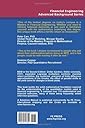
Reviews for โA Primer for the Mathematics of Financial Engineeringโ, First Edition: ``One of the hottest degrees on today's campus is a Masters in Financial Engineering. Whether you need to retrieve hallowed memories or just want to familiarize yourself with the mathematics underlying this degree, this unique book offers a terrific return on investment.โ --Peter Carr, PhD Global Head of Modeling, Morgan Stanley; Director of the Masters Program in Mathematical Finance, Courant Institute, NYU ``This is the book I always recommend to people who ask about their mathematics before doing an MFE, and a few people could do with reading it after as well." --Dominic Connor Director, P&D Quantitative Recruitment NEW TOPICS: Dollar duration, Dollar convexity, DV01; the effect of parallel shifts in the yield curve to changes in bond yields; bond portfolio immunization; arbitraging the Put-Call parity; percentage vs. log returns for individual assets and portfolios; optimum investment portfolios: maximum return portfolios and minimum variance portfolios; the numerical precision of finite difference approximations of the Greeks. New or expanded sections: new chapter on solving nonlinear problems; expanded Lagrange multipliers sections; streamlined Taylor series and Taylor expansion sections; Mathematical Appendix at the end of the book. This book builds the solid mathematical foundation required to understand the quantitative models used in financial engineering. It contains 175 exercises, many of these being frequently asked interview questions. A Solutions Manual including detailed solutions to every exercise in the Primer was published by FE Press. International shipping and Errata at www.fepress.org The First Edition of the Primer was warmly received by a large audience, including students and prospective students of financial engineering programs, academics teaching in such programs or in finance departments, and practitioners from the financial industry. The book proved to be very well suited for self-study, particularly with the addition of the Solutions Manual Financial applications (selected): Put-Call parity, bond mathematics, numerical computation of bond yields, Black-Scholes model, numerical estimation for Greeks, implied volatility, yield curves bootstrapping Mathematical topics (selected): numerical approximation of definite integrals; Taylor approximations and Taylor series expansions; finite difference approximations; Stirling's formula, polar coordinates; numerical methods for solving one dimensional problems; Newton's method for higher dimensional problems Review: Finally something understandable! - This is one of the best books that explain financial concepts in a math language. You will fully - and finally! - understand the concept of call-put parity arbitrage, rate bootstrapping, Black-Scholes in detail. I would have appreciated, in addition with the relevant exercises, other longer exercises/problems as in exams, and a chapter about credit risk within the same format. Review: Five Stars - Very Well Written
| Best Sellers Rank | 458,127 in Books ( See Top 100 in Books ) 349 in Job Hunting (Books) |
| Customer Reviews | 4.5 out of 5 stars 78 Reviews |
M**O
Finally something understandable!
This is one of the best books that explain financial concepts in a math language. You will fully - and finally! - understand the concept of call-put parity arbitrage, rate bootstrapping, Black-Scholes in detail. I would have appreciated, in addition with the relevant exercises, other longer exercises/problems as in exams, and a chapter about credit risk within the same format.
A**R
Five Stars
Very Well Written
I**C
Excelent!
Excelent!
S**O
a good summary
a good general review of all the topics that must know for financial engineering without dipping in details or explanations
A**R
The BEST book for preparing advanced financial engineering studies!
I bought this book before entering a top MFE program and found it is extremely helpful! It is not an undergraduate level calculus textbook as someone may think. This book emphasizes advanced calculus methods and math foundations with applications in the financial world. Thus, I would strongly recommend it to anyone who is interested in quantitative finance and needs to enhance their math knowledge towards that. Specifically, there are five main aspects that highlight the book's value: 1. It covers the most important calculus and math foundations for quantitative analysis in solving financial problems. It goes from basic calculus, numerical integration and probability concepts to Newton's method, Taylor's formula, finite difference & ODEs, multivariate calculus and Lagrange multipliers. All math theorems/proofs/formulas are very clear and easy to follow. 2. It provides plenty of examples of real-world financial applications, such as options, put-call parity, Greeks and hedging, Black-Scholes PDE, and interest rates, Bonds, portfolio optimization. These practical problems are very common in the financial industry, and many of them have been frequently asked as interview questions for quant finance jobs. 3. It also provides many straightforward pseudocodes for implementing some programming algorithms, such as Simpson's numerical integration, Black-Scholes's option pricing model, computing implied vol, Newton's method, etc. No matter what programming language you use, it is very easy to implement following the pseudocodes. You will find how efficient it is. 4. It provides extensive practice exercises. I almost finished all exercise problems, some of them are theoretical, requiring derivations and proofs, and some are practical, requiring computation and programming. Very challenging but intellectually stimulating. 5. The book is well-organized and very easy to follow. Every chapter covers a major math topic with financial applications/examples. No need to worry if you don't have a finance background since all finance terminologies are well explained. Math notations are consistent and easy to understand and remember. This book has been continuously ranked as one of the most famous quant finance books by QuantNet.com. If you ask about what math background is required for a Master in Financial Engineering/Mathematical Finance program, the answer is always: read this book. If you want to review/refine/enhance your math knowledge for entering a MFE program, read this book.
A**R
Value for money
Well thought out book, the basic concepts are clearly defined and discussed. It might help though to brush up on calculus before tackling the material in the book. Otherwise it is a good book for both graduate students and practitioners.
D**R
A Unique Blend of Finance Concepts and Mathematical Foundation: A Must Read for Students contemplating an MFE Degree
Are you contemplating an MFE and/or MS in Math/Computational Finance Degree and asking yourself whether you have the right background? I strongly believe that "A Primer for the Mathematics of Financial Engineering" by Prof. Dan Stefanica will take you through every step toward finding the Best answer. It will also help you start your journey as an MFE student with utmost confidence. This book is a must for all prospective students for an MFE (or equivalent) degree. What I like the most about this book is the way the chapters are structured. Every chapter consists of two main parts. The first part deals with the basic mathematical foundation and/or numerical techniques required to understand a given subtopic of quantitative finance. Once the mathematical/numerical basis is set up, Prof. Stefanica moves on to describing how it can be applied to comprehend a specific set of topics in quantitative finance in the second part of each chapter. Even if your math is not super strong to begin with, or you have not had much exposure to numerical techniques, you can easily master your skills while you are studying the first part of every chapter. And immediately following that, you see the application of the abstract mathematical concepts in the finance world. And then you can sharpen your skills much further by actually solving the stimulating questions/problems found at the end of each chapter. Another thing I love about this book is the set of pseudo-codes. After describing the numerical techniques, be it Simpson's rules for numerical integration or Secant method for solving 1-D nonlinear problems, the author provides pseudo-codes showing practical examples of their implementation. You can easily translate these pseudo-codes to your favorite language (C++, Matlab, etc.) and start producing results immediately. I hope you will enjoy studying the topics presented in this book... like I did. Good Luck!
Trustpilot
1 month ago
1 day ago