
🚐 Stay ahead of the road with solar-powered tire intelligence!
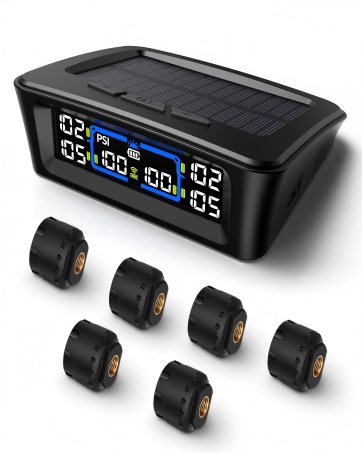
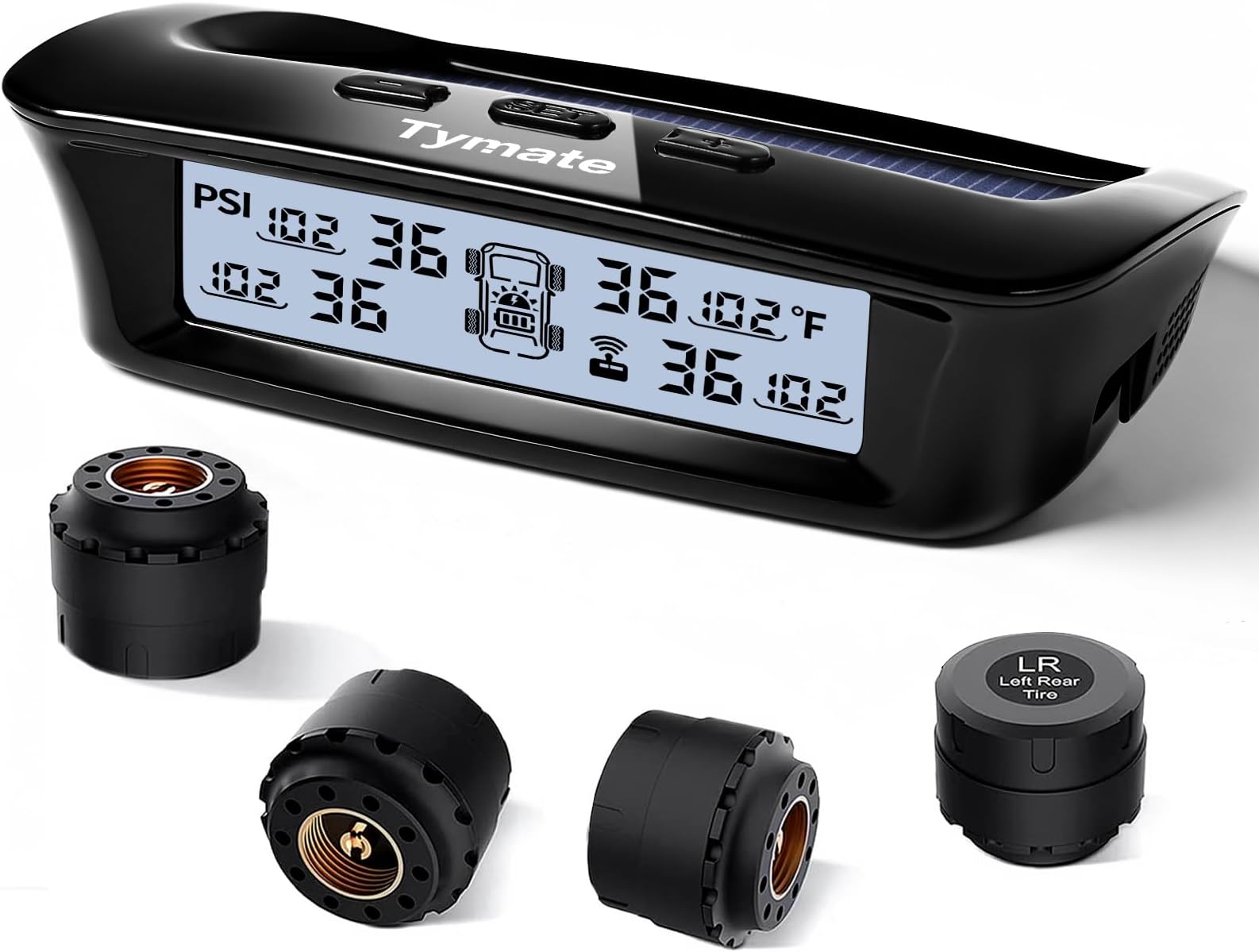
The Tymate M12-3 RV Tire Pressure Monitoring System features 4 external sensors with ±3 PSI accuracy, powered by durable solar lithium batteries and backup USB charging. It offers 5 customizable alarm modes, an auto-adjusting LCD display with sleep mode, and easy sensor position swapping—ensuring real-time, reliable tire data for safer, smarter RV journeys.


| ASIN | B07S7CP3PB |
| Batteries | 4 Lithium Metal batteries required. (included) |
| Best Sellers Rank | #42,213 in Automotive ( See Top 100 in Automotive ) #10 in Tire Pressure Monitoring System Tools |
| Brand | Tymate |
| Customer Reviews | 4.3 4.3 out of 5 stars (3,474) |
| Date First Available | May 24, 2019 |
| Item Weight | 10.9 ounces |
| Item model number | Tymate M12-3 black |
| Manufacturer | Tymate |
| Manufacturer Part Number | Tymate M12-3 black |
| Model | Tymate M12-3 black |
| Product Dimensions | 6.3 x 4.72 x 1.97 inches |
S**T
Easy to read; accurate; small; works well; looks good
Overall, this is a pretty decent item. I've only had it for 6 months now, but I really like it. It's especially nice because it's pretty accurate and costs ~$50-60 (wait for a deal) and I don't have to waste money going to get new sensors replaced for $100+ a TPMS sensor. Overall, it was worth the purchase as it's very convenient to see the current pressure/temperature for each wheel (if you don't have that with your vehicle already). This product works by replacing your cap for the air valve with a sensor and nut. Once the cap is off, you thread on the [locking] nut and then put on the sensor hand tight. You then "loosen" the nut which winds up using friction to keep the sensor tight in place so someone (without the included 1/2" offset wrench) cannot remove the sensor(s). It takes an extra 10-20 seconds to add air into each tire because of this mechanism, but it's not a big deal. The unit itself comes with adhesive to secure to whatever surface you want which is very helpful so it doesn't move around easily. It constantly charges via the sun. Something to note: I believe the unit turns on when it senses vibration (via closing a door or starting the engine)--but can be turned on (e.g., the display) by clicking any of the buttons. It will then show whatever data was last recorded from your previous trip, BUT once the car moves it takes about 5 seconds of the wheels rolling to update the data (automatically) to the currents stats. Just be aware of that. It doesn't bother me, personally. The description says it has an accuracy of +/- 3 psi. That's an absolute range of 6 psi--a lot of room for error for my liking. Despite that error being apparently similar to other items on Amazon, I have found with my trusted digital tire gauge that this unit reads +/- 1 psi most of the time. That's really good. There's a lot of settings on the device that you can customize to your liking. Other reviews have stated that once it starts beeping (i.e., the tire pressure drops below a set threshold), the beeping will not stop until the pressure is increased. That is FALSE. All you have to do is hit one of the buttons on the top and it stops the beeping. ***Due to the small space you have to tighten/loosen the "security/locking nut", you need the included 1/2" offset wrench (feels like just sheet metal or the type of wrench that comes with furniture). I have an assortment of tools and cannot find a tool that would suffice. Maybe a small open-end 1/2" wrench that is bent or an open-end crowfoot could do it. But a flare nut crowfoot or standard open-end wrench will not do it. I cannot find the included wrench anywhere; so if you lose it, it might not be fun. I WISH THEY WOULD INCLUDE 2 OF THESE WRENCHES IN THE PACKAGE.
G**B
Very useful tire pressure gauge - for the spare tire too
About a year and half ago I bought 2 of these TPMS units for 2 of my cars; although they had a different brand name (than Tymate) on them. They have been very useful since they work good and save you from not having to manually check the tire pressures every week or two. This Tymate unit is an updated version of the 2 I already have. They fixed a firmware bug (not an important bug) and put a regular backlight LCD monochrome display in it. The color display in the older units would be slightly affected by summer heat; a few segments would quit working until it cooled off. You could still read it though. With the regular LCD display that shouldn't be a problem. The best part of these units is you can buy a fifth sensor and put it on the spare tire. The head unit will show the pressure in the spare as well as the 4 main tires. The displays alternate. They don't mention that with the Tymate unit but I had a spare sensor from my first 2 units and it works with the Tymate also. The sensors on the main wheels immediately turn on and transmits pressure at 12 MPH but he sensor on the spare takes more time since it doesn't spin. You get a reading from the spare tire sensor often enough though that you can be sure of what pressure is in the tire. Maybe once every 10 miles or so it will get enough bumps to wake it from sleep. To add a sensor for the spare tire press the plus button until it goes into the register sensor mode; then push the plus or minus button to cycle through the different wheel positions until the spare tire icon on the head unit display flashes; then screw the spare sensor onto the spare tire and its ID number will show on the display when the air pressure in the tire turns it on. Then push and hold the middle set button to finish the registration process. That instruction is left out of the manual. The other thing to note with these sensors is it is not at all necessary to use the locknut with the sensors. Just put 'em on without the locknut and snug 'em up. They won't leak or come loose. It's a real pain messing with the locknuts and if you use the locknut on a valve stem of a wheel that has an OEM internal TPMS sensor it will corrode and get stuck. Those TPMS valve stems are aluminum and the brass nut will corrode to them fast from dissimilar metal corrosion. The aluminum threads will get stripped trying to get the locknut loose and ruin the internal TPMS sensor. Ask me how I know that. Even if your car, like my 2013 Prius, has a TPMS from the factory, it will only tell you at least one of your tires is 25 PSI or less. It won't tell you anything more than that, which really isn't very much information. It's a lot better being able to see exactly what is in every tire; including the spare. These things are so accurate; if you're driving a long distance on a sunny day you can tell if you're driving east or west just my looking at the TPMS display. The 2 tires in the sunlight will be a few degrees warmer than the 2 tires in the shade! The only downside (at least with my older 2 units) is the solar panel doesn't put out enough power to keep the battery charged indefinitely. I still have to plug in the USB about once a month to charge the battery to full. Maybe the Tymate won't need that.
B**B
Cheapskate's TPMS
I wanted a TPMS system for my new travel trailer. If you've ever had a blowout in a trailer and did not know it until you heard metal grinding you'll know why. This unit is much cheaper than some of the more mainstream brands so I thought I'd give it a shot. I've only used this once, but here are my impressions. It's cheap and it appears to work (with some qualifications). The manufacturer recommended I get the unit with the range extender. I did get it, but tried it out without the repeater. It did sort of work, but I had to move the display around on my dashboard to get all 4 tires to read out. And to me this uncovered one of the things I do not like about this unit (possibly the same problem other brands have). This unit will give you a readout whether or not it is actually receiving live data from the sensors. When I started driving, I saw 3 of my tire pressures and temperatures increase, but not my rear tire on the driver's side. It just read the original numbers. when I picked the display up and moved it to the left of the dashboard, it began giving live info. The problem is, unless you're paying attention you could be loosing tire pressure and not know it because there is no "live pulses" function that tells you you're getting live data. Another thing I don't like about these kind of screw on sensors (and I think this applies to even the more expensive brands) is that you must basically defeat the Schrader valve in your tire when you screw the sensor in and hope the sensor does not leak from an internal defect or loosen up and leak (they supply lock nuts that are supposed to keep this from happening). Its a bit of a pain to put the sensors on, and if you ever need to add air to your tires you have to remove the sensor and then re tighten it and put soapy water on the valve to make sure its not leaking. The display is small and can be hard to read, but not that bad. You charge the display unit using a USB connector and it has a solar cell on top that is supposed to keep it charged while you are driving. I've only used it for one short trip, so I have no idea how effective the solar charger is. I assume if this is a problem you can just plug a USB connector into the unit on your dashboard. There is a high/low pressure alarm setting you can put in the unit. My tires are supposed to be 65 psi cold, so I set the low to 50 psi and the high to 70. The pressure in one tire reached 71 psi and the alarm went off immediately. So I think this unit will do the job as long as you insure you're getting live data. Its nice to get in the car and be able to make sure you've got proper tire pressure without having to measure them with a gauge first.
M**S
Excellent (after my goofing up install a bit)
After being told by my car dealer that there were no aftermarket TPMSs(Tire Pressure Monitor Systems) for my 2002 truck and spending $300 to have internal sensors installed in my 2015 car winter tire/rims, I discovered many aftermarket external TPMSs online. I could have returned my $300 internal sensors, but I decided not to because I like my car being able to monitor my summer and winter tires (on separate rims, so I only need to have the summer tires/rims swapped out with the winter tires/rims. Easy. Now, I wanted to have the external TPMS for my 2002 truck since internal sensors will not work with my truck. So I bought these. However, I wanted to have this TPMS also for my Prius as the factory internal sensors only send an alert when *only 1* of the 4 tires has *only low pressure* and no other information. It is a bit of an unnecessary pain to have to check all 4 tires for low pressure, if the low tire is not obvious, which often it is not. I decided to install this TPMS on my Prius, and I am very happy I did. Soon I will install this TPMS on my truck also. Installation was a bit of a pain, because I was playing around with all the buttons before installing the sensors and I goofed up the assignment of the sensor with the different positions they are labeled for: Front Left, Front Right, etc. I took me quite a while to reassign the sensors to their correct tires, which turned out to be very easy: just select a tire position and unscrew and rescrew the sensors. The monitor assigns that sensor to the correct position automatically. The video instructions online are spoken in Chinese (?) and the English subtitles are very minimal and nearly worthless. This needs to be addressed! Should have subtracted one star for this, but I am too happy overall with this TPMS. Both the monitor and the sensors are *much* smaller that I had expected them to be, and very happy about that. The hub caps on my Prius allow for very little room around the valve stems, but these sensors "just fit", fortunately. My box contained 4 dust caps for the sensors, but they are very thin and relatively flimsy, so I don't know if they will stand up very well to the changing seasons. As for tire pressure accuracy, I filled and checked my tires with an expensive Astro tire pressure gauge. I set them all at 38 PSI, and the TPMS monitor read all 4 perfectly at 38 PSI. Can't get much better than that! Of course the pressure changes while you drive, but that is normal. I changed the default setting from Bar and C to PSI and F. Very easy to do. It would really be nice if these sensors could be monitored while *not* driving, but I get it---that they need to conserve battery power and put them to sleep when the car is parked. You have to first drive "12.4 mph" for the sensors to activate and send their signals to the monitor. The monitor activates automatically when receiving signals from the sensors; so you don't have to turn it on every time you drive. The backlight also activates automatically in low light. I decided initially to not install the brass nuts used to supposedly secure the sensors tighter. Due the different in the brass nuts and my aluminum(?) valve stem, I am concerned about galvanic corrosion over time. On the other hand, it appears the the female connector on the sensor is also made of brass, so there might be corrosion anyway. Hmmmm, so I might install the brass nuts later, since leaving them off might not make any difference. The sensors do seem to be very snug when tightened down by themselves, with any air leaks. You cannot set the high and low pressure limits independently for all 4 tires. You set the *front* tires limits, then you can set the *rear* tires limits and then the spare tire limits. That works for me because the readings from the 4 tires are still *read independently*, telling you exactly which tire has dropped before whatever limits were set. According the another review this model is the latest, a monochrome display replacing the older, apparently faulty color display. OK. Actually, a color display could be distracting while sitting on my dash. I am hoping I will never need the USB cable to power the monitor. (The instructions say to charge the monitor with the USB cable before using the first time. OK; I did that. My manual says that it can "Monitor up to 7 tires." I don't know how that would be set up. I plan to install this TPMS on my 4-wheel truck soon. I also have a 2-wheel RV that I tow with the truck. When I do that, I will simply take 2 of the sensors off of my car and put them on the RV! Summary: I am quite happy with this TPMS, and if it holds up over the years it will be one of the best accessories I have ever bought for my car and truck/RV. To be able to monitor even just the air pressure and have an alarm go off if the pressure drops below the programmable limits I set is just great.
A**A
Highly recommend Tymate
High quality, great system. Mine started dying after having it for 4 years. It probably would have lived way longer except I live in Texas so it bakes in my car everyday in the summer. All the sensors still work I think the battery just got damaged from being in the heat. It turns on but won't hold a charge. Loved it so much I bought the newer model to replace it. It has saved me multiple times after running over nails and screws on the highway. Definitely gives me peace of mind. I always recommend it to friends and family. I will make sure to take it out of the car this summer :) Tymate is great. I emailed them a question about the new system I purchased and they got back to me very quickly. Great product and great customer service.
T**S
You'll never know if the signal drops - I'm returning it
TLDR: Great little unit with a fatal flaw that it does not show you when the signal is lost. It's useless. I had high hopes for this little TPMS. It's exactly the size, design, and solar recharging I wanted - it would sit on the dash without extra charging cables. It was easy to set up and use. It was perfect, especially for the price! Unfortunately, I discovered a major flaw for a TPMS - You will not get a "loss of signal" alarm in the case of sensor failure! The day I set up the system, I had the unit on my dashboard as I drove away from my trailer. For 90 minutes, the unit showed the last reading, with no indication that I was miles from the trailer! Over the next few days, I tried this experiment four times with up to two hours of no alarm after signal loss. The instructions and sales page say it has a "loss of signal" alarm, so, thinking I had a bad unit, I contacted support. After some back and forth, they related that this is normal for their units. I fully understand that the systems poll status every few minutes, and a delay that long is acceptable, but 90 minutes without a signal loss alarm is ridiculous and actually dangerous. Signal loss alarms are an essential part of a TPMS, so you know your display is actually showing current conditions. Without a timely (within a few minutes) signal loss alarm, it's worse than not using a TPMS at all because you think everything is fine. Your tire could easily overheat, delaminate, and damage your vehicle in that hour without obvious signs. Without a timely signal loss alarm, this system is useless, and I will return it. I recommend you do the same. On a side note, if you ever lose one of the sensors, you can't simply replace it with another and program the system to show it in the new position. They are hard-wired in the system for a specific position. (That makes it easy to set up, but the downside is getting a replacement sensor.)
M**Y
Works Perfectly With Any Vehicle Without TPMS.
Easy install and flawless functioning. Can't ask for an easier way to now know what tire pressures (and temperatures) are in real-time.
A**R
Requires METAL valve stems on your wheels.
I am very impressed with the function of this TPMS system for my two axel travel trailer. I replaced a fancy $400 system that used a phone app and this work 10x better. Having a separate monitor on the dash is FAR superior to a phone app. NOTE: Make sure you have METAL VALVE STEMS. These can tear rubber valve stems for an instant flat. We learned the hard way on the previous system.
Trustpilot
1 day ago
3 weeks ago