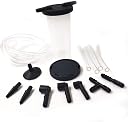
๐ ๏ธ Master your brake game soloโprecision, portability, perfection!
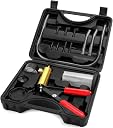
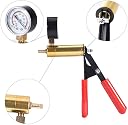
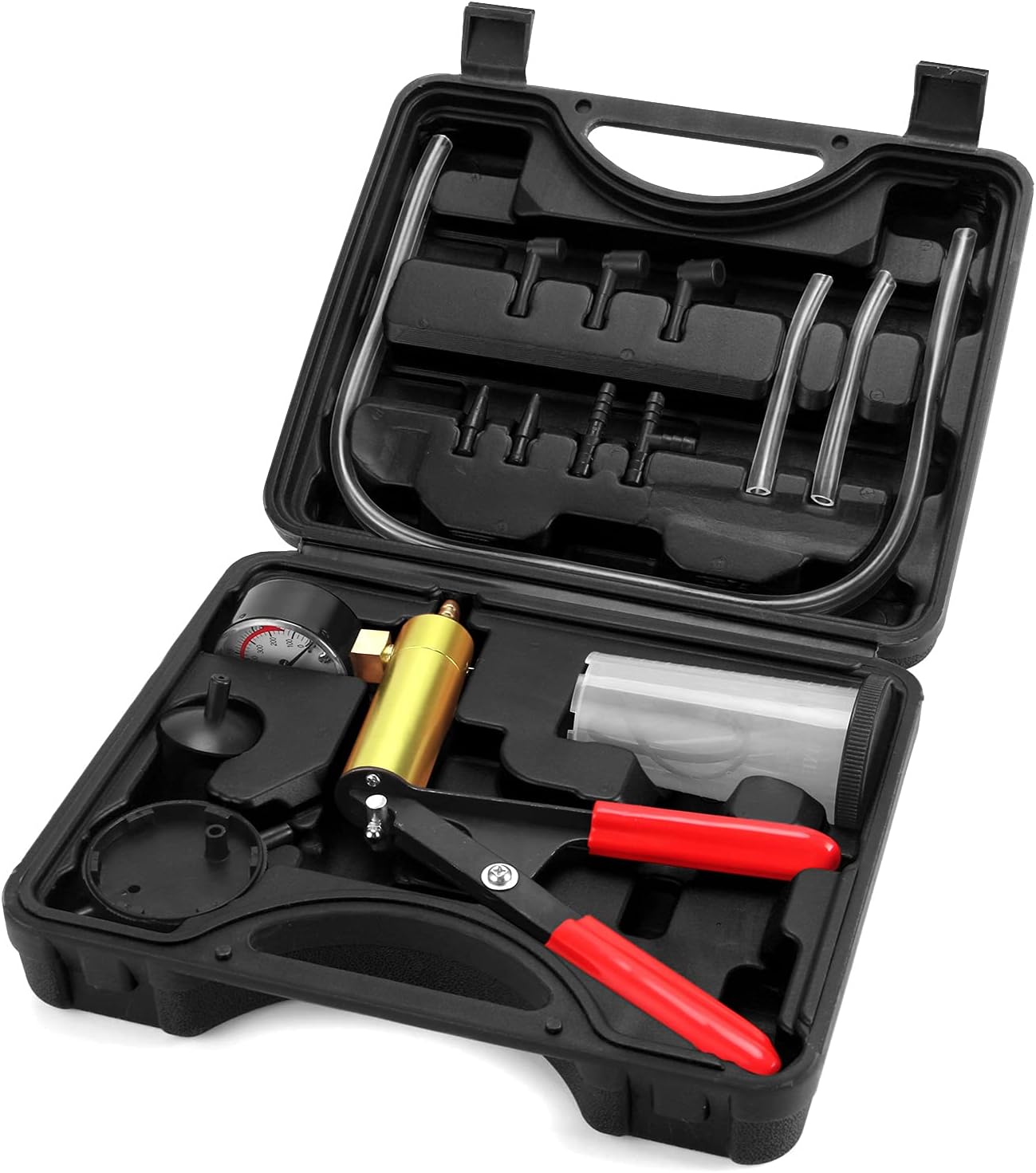
The HTOMT 2 in 1 Brake Bleeder Kit is a professional-grade handheld vacuum pump test set featuring a precise vacuum gauge (0-30 inHg), four adaptable tube lengths, and a rugged carrying case. Designed for one-person brake and clutch bleeding, it includes multiple adapters and spare O-rings, making it an essential tool for both DIY enthusiasts and automotive professionals.


| ASIN | B07XQ1JYXR |
| Best Sellers Rank | #223,932 in Automotive ( See Top 100 in Automotive ) #276 in Brake System Bleeding Tools |
| Brand | HTOMT |
| Customer Reviews | 3.9 3.9 out of 5 stars (10,309) |
| Date First Available | June 23, 2019 |
| Item Weight | 1.81 pounds |
| Item model number | htomt-brake |
| Manufacturer | HTOMT |
| Manufacturer Part Number | htomt-brake |
| Model | htomt-brake |
| Product Dimensions | 7.08 x 7.08 x 6.69 inches |
T**A
Pleased with this product
Works well
F**.
Seems to work well, but there's apparently no ideal solution to the air-leakage problem
11/30/22 In a previous revision of this review, I unfairly cast doubt on the effectiveness of this kit, because the brakes became spongy when they got hot (by my standards) as a result of exiting a freeway onto a fairly long downhill stretch, at the end of which I had to take a right onto a side street. So, the brakes had to absorb much more energy in a shorter amount of time than they had since I had changed the fluid. Later, after they had an opportunity to cool down, the problem disappeared. For a while, I suspected that there was excessive water in the fluid, and that the water had boiled, but after testing the fluid with a brake fluid tester (appx. $15 from Amazon), I realized that the fluid was fine, and concluded that the master cylinder was the problem. Brake fluid becomes much less viscous as it heats up, and more likely to leak past seals. The old brake fluid had probably ruined the old seals, and then when I was experimenting with bleeding methods and pushed the pedal to the floor (which experts discourage, as I learned later), the seals were probably ruined further by being dragged across a rough, unused section of the master cylinder. Fortunately, by the time the fluid heated up, and the brakes became spongy, I was pulling into a parking space with an empty space in front of me, and didn't hit anything despite overshooting the front of the space. But the consequences could have been disastrous. So, the vacuum-pump bleeder wasn't the problem. However, I decided that I'd rather not put up with the air-leakage problem of the vacuum-pump method, and to instead use the pressure method, which is recommended in a Fiat-Chrysler safety recall notice from August 2018 entitled Dealer Service Instructions for: Safety Recall U86/NHTSA 18V-523 Low Brake Pedal which includes the following statement: "NOTE: The bleeding procedure described in this recall may be used to remove air from the brake system. PRESSURE BLEEDING IS RECOMMENDED if pressure bleeding equipment is available. If pressure bleeding equipment is available, follow the manufacturerโs directions for proper use." However, if you don't mind air pockets in the bleeder-hose, or using some technique to reduce the air-leakage through the bleeder-screw's threads (simply pressing on the bleeder-screw might help, without causing other problems, but all of the other methods I've seen supposedly risk contaminating the fluid, and some of them have other problems), you would probably find the vacuum-pump method satisfactory. You would just pump until the fluid color changes from dark to clear, or if the "old" fluid is as clear as the new fluid, you'd just pump out enough fluid to ensure that the old fluid has been removed (a cup might be overkill, but I'd rather waste a little fluid than risk leaving the older fluid in the system). Here's an earlier revision (with minor clarifications), which is still valid and contains some useful information: ============================ The pump works well, although all of the bleeder-screw fittings were too large for my car's bleeder screws, so I connected the hose directly to the front bleeder screws. For the rear bleeder screws, I used a small hose from a $5 bleeder kit (which I ordered before this one and thought was a total waste), and used one of the conical adapters supplied with the pump to connect the small hose to the larger hose. All of my car's bleeder screws were clogged, and the pump was unable to pull any fluid through them until I either replaced them or unclogged them with a piece of wire. If a bleeder screw is clogged and fluid runs out when you remove it, you'll have to get a replacement bleeder screw, or something to plug the bleeder port while you unclog the screw. (I've seen plastic bleeder-port plugs on the internet.) Bleeder screws have fine threads, and equivalent bolts are uncommon. The front and rear screws aren't necessarily the same. Because the pump creates a vacuum in the brake system, some air will get pulled in through the bleeder-screw threads and into the bleeder-port (see the relevant diagram [1], which I posted along with this review), where it is pulled out along with fluid coming from the brake cylinder, creating large air pockets in the fluid in the bleeder hose and giving a false impression that there's a lot of air in the brake system. I didn't bother to seal the bleeder screws, and just ignored the air pockets in the bleeder hose and pumped until the new fluid started coming out. (At the time, I didn't know where the pockets of air in the bleeder hose were coming from, but I figured that they couldn't have been coming from the brake system.) This seems to have worked well. The brakes were a little spongy at first, but after a 30 mile drive they were very solid. I don't know what changed, but I doubt that the hydraulic system bled itself along the way. Before bleeding, use the vacuum pump to remove the old fluid from the reservoir, wipe it out with a paper towel and then fill it with new fluid. Black sludge on the paper towel is supposedly a sign that the old fluid was too degraded and that it had taken a toll on rubber parts such as hoses and seals. Wear disposable nitrile gloves when working with brake fluid, or it will dry out the skin on your hands for several days, and moisturizer won't entirely alleviate the dryness. Some people prefer the pressure method, although it apparently has problems too. The vacuum-pump method is cheap and worked well enough for me. Notes [1] Diagram was created from diagrams from the "REF Wheels, Brakes & Tires - Sportsterpedia" page, which has quite a bit of useful information on brake-system bleeding.
C**K
The vacuum pump is made of high-quality materials
If you're looking for an efficient and easy-to-use brake bleeder kit, the HTOMT 2 in 1 Brake Bleeder Kit Hand held Vacuum Pump is an excellent option to consider. This product is designed to help you bleed brakes, test vacuum systems and perform a variety of other tasks related to automotive repair and maintenance. One of the main features of this kit is its versatility. It comes with two different modes that allow you to use it as a brake bleeder or a vacuum pump, depending on your needs. This means that you can use it to remove air bubbles from your brake lines, test the vacuum systems in your car or perform a variety of other tasks. Another advantage of the HTOMT 2 in 1 Brake Bleeder Kit is its ease of use. The kit includes a vacuum gauge that allows you to monitor the pressure during the bleeding process, ensuring that you get accurate results every time. The vacuum pump also comes with a variety of adapters and hoses that make it easy to connect to different parts of your car. The build quality of this product is also impressive. The vacuum pump is made of high-quality materials that are designed to last, and it comes with a durable carrying case that makes it easy to transport and store. The kit also includes clear and easy-to-follow instructions, which is especially helpful if you're new to brake bleeding or vacuum testing. One thing to keep in mind is that the HTOMT 2 in 1 Brake Bleeder Kit is not designed for professional use. If you're a professional mechanic, you may want to invest in a higher-end kit that can handle more heavy-duty tasks. However, for the average car owner who needs to perform occasional maintenance and repair work, this kit is an excellent choice. In summary, the HTOMT 2 in 1 Brake Bleeder Kit Hand held Vacuum Pump is a versatile and reliable product that offers excellent value for money. It's easy to use, well-built, and comes with all the accessories you need to perform a variety of automotive tasks. If you're in the market for a brake bleeder kit, this one is definitely worth considering.
J**E
Not Recommended
I don't recommend this product. I bought mine about a year ago and got it out to use the vacuum tester and it does not hold pressure. It's sat in it's box from the time I purchased it and wouldn't work when I needed it. I don't think it worked from the get-go but I had a vacuum tester and mainly needed the bleed kit. So I may have used mine that still works perfectly and it's at least 25 years old and likely much older than that. But they don't make them like they used to and China never did.
D**L
Not so great
The product itself is fine but it doesnโt really work well for bleeding brakes at all, doesnโt connect on to bleeder valves air tight whatsoever, no matter what size is used, only thing useful is the damn hose, i would just go get a hose and call it a day, dont waste the extra money for this if you are intending to bleed brakes by yourself
K**T
Exactly as described and works perfect for DIY
Delivered this morning and used it right away by myself to bleed the brakes on my x5 35d BMW. Didn't have to take the wheels off or anything. The hose fits perfectly on the bleeder screw and it seems like it saves fluid during a full system flush because I only used a Pint instead of the usual Quart and all the fluid went from dark green to crystal clear in about 5 minutes per side just pumping by hand with the screw open. The seal on the container is tricky so pay attention to that. If you plug the suction end and pump and you lose vacuum, the seal is not tight. Add a little brake fluid and swish it around and it seals right up. A little bit of air slips past the hose as it's pulling fluid because of the impressive amount of vacuum produced by the hand pump, so bleeding in this fashion is basically a fluid exchange- just wait for fresh DOT 5.1 to come thru the caliper because its going to bubble ALOT; tighten the screw while still under vacuum and you're done :) Best 17 bucks I've ever spent.
S**U
Works well with 2014 Nissan Altima just with the hose. No supplied fitting needed.
Compatibility: Pump works well with 2014 Nissan Altima, 5th gen. I suppose it may work with All 5th gen Nissan vehicles. Reason is that pump hose is direct fit onto front and back break bleeding value. It fits really snug. I do not think they would change those valves/screw between Nissan vehicles. Someone in these reviews has said that it works with most/all imports as valves/screws are same. Do not know. How i used it: i did not use any fittings. Smalls fitting, C fits but it's little too big. Hose fits directly over the bleeding screw. I also wrapped plumbers tape around valvue/bleeding screw to make it more air tight. TIP: I used short tube to fill container and long tube from container to pump. U must use gasket on fill cointainer and makse sure tops is closed properly. I put 8mm rear, 10mm front 6pt tool over bleeding value. Put hose directely over bleeding value. Build up pressure first to about 20ps. The pump builds pressure to about 25psi with mulitple hand pumps. You do not need more then this as pressure will easily pump liquid even with 10psi. I first pumped out entire break fluid resorviour/master cylider. Then poured new Bosche fluid in. Then i started with rear passanger 125ml, refilled resoriour again, 100ml from driver rear, refilled. 100ml from passanger front, refilled, 100ml from driver front. I measured total fluid taken out and replaced after 100ml to total 600ml. I think that's full system flush. I used Bosch break fluid. I think it's excellent for the price. https://www.amazon.com/dp/B07338GQM8/ Breaks pedals now feels hard and breaks now respond to breaking immiedietly even with slight touch of pedal. For $15 this is good value. Trick is to get hose tight or proper fitting tight onto bleeding value. If you can do that pump will work for you. If you can't $100 pump won't work for you either. I actually bought previously more expesive pushing pump that did not work for me. This one did. I am happy about that.
G**S
More than adequate for amateur use.
Obviously not built for everyday shop use, but as long as they sell this cheaper than any other brake bleed kit, it is a good buy for a person who wants to bleed his own brakes. I did not take it apart, so have no idea what the internal parts look like & so unable to guess how long the internal parts will last. I assume it has a limited lifespan, but if it is only used occasionally, I hope that it will last several years, before the internal parts get stiff with age & the pump is no longer capable of producing vacuum. The cylinder is small, so it requires a lot of pumping to build up much vacuum, but does pump up to 25 Hg. This is a good sign. Some cheap pumps cannot make it to 20 Hg. Since it can go over 20 Hg, it could be used with a FoodSaver Mason jar sealer, but because the cylinder is so small, it would require a lot of pumping.
J**Y
Way itโs advertised I thought it would pump as well not only do vacuuming
Vacuum is great but I thought it pumped as well
K**E
Good
Good product
S**R
Thurs
I am not to impressed with this product as right from the start it did not work . I could have sent it back for a replacement but i just couldn't be bother so many goods today are not very well made.
B**M
It got the job done
It doesnโt have much of vacuuming pressure, it cannot exceeds 500. How ever it works for what I bought it for.
G**G
Works just fine
Not sure what others complain about. Anyhow works well for me. Only comment i have, if you want to flush the entire braking system, this would take too long. Better do it from pressure at master cylinder. For caliper work or just basic bleeding, its just fine.
Trustpilot
2 months ago
2 days ago