Desertcart purchases this item on your behalf and handles shipping, customs, and support to Slovakia.
🔧 Elevate your HVAC game with quiet power and precision!
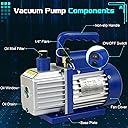
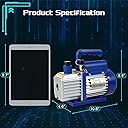
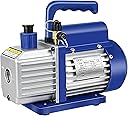
The ZENY 3.5CFM Single-Stage Rotary Vane Vacuum Pump features a robust 0.25 HP motor and a 1/4" flare inlet port, designed for efficient refrigerant evacuation in HVAC systems. Its durable aluminum alloy casing, low noise operation, and built-in cooling fan ensure reliable, long-lasting performance. Ideal for professionals seeking a balance of power, portability, and precision in air conditioning maintenance.


| ASIN | B012CFTYX4 |
| Air Flow Capacity | 3.5 cfm |
| Best Sellers Rank | #149,844 in Automotive ( See Top 100 in Automotive ) #60 in Air Conditioning Vacuum Pumps |
| Brand | ZENY |
| Brand Name | ZENY |
| Color | blue |
| Connector Type | 1/4" Flare |
| Customer Reviews | 4.5 out of 5 stars 3,848 Reviews |
| Horsepower | 0.25 hp |
| Hose Length | 120 centimeters |
| Item Weight | 11.7 pounds |
| Manufacturer | ZENY |
| Manufacturer Part Number | FBA_D1-1090A@#JA0681 |
| Maximum Pressure | 400 psi |
| Model Number | FBA_D1-1090A@#JA0681 |
| Number of Items | 1 |
| Number of Packs | 1 |
| Unit Count | 1 Count |
| Voltage | 110 volts |
B**K
This is a Great Vacuum Pump for Winemakers
Every winemaker should get this vacuum pump. If you aren't familiar with Wine Degassing, you can read more online, but in a nutshell, "degassing" wine removes the CO2 that is created when sugar converts to alcohol. When you leave CO2 in wine, it tastes bubbly, and leaves a foul flavor. I've tried several other products to degas my wine before looking at an actual vacuum pump: * A handheld vacuum, often called Wine Pump or Vacu Vin. This is a six-inch tall pump with a rubber stopper designed for removing the air from a single bottle of wine. This works, but only pulls up small bubbles and takes a lot of effort to get a very small result. * A metal rod wine whip. This is a straight metal rod with two plastic flaps at the end that you attach to a power drill and stick into your wine bucket or carboy to spin the wine around and stir up the bubbles. This was essentially, for me, an electric version of the Vacu Vin. Not much of an improvement, and took a lot of time. * A Wine Whip degasser. This is a C-shaped plastic rod (much like the metal rod) that you also attach to a power drill and stick into your wine bucket or carboy to spin the wine around and stir up the bubbles. It works pretty well, better than the metal equivalent in my case, but takes a lot of time and only gets slightly larger bubbles than the Vacu Vin. * A Vacuum Sealer. This is a completely different product. These are used to vacuum seal food. There are a lot of examples online using a Vacuum Sealer that use the accessory port (normally used for things like sealing Mason Jars) to degas the wine. I haven't tried many of these, but my Vacuum Sealer had a safety mechanism that shut it off when it hit a certain amount of pressure, so I had to restart it over and over. In the end, it never got more than small bubbles. So I started looking for a proper Vacuum Pump; no shortcuts, just a real electric vacuum pump. If you've looked at these much, you probably know that they are pricy. Most of the local big-box stores didn't even carry them, and even the few that did started over $100. At the time that I purchased this unit, it was $48 plus about $10 shipping. I researched the different types of pumps: single stage, dual stage, etc. For Winemaking, a single stage looked like it was going to do the trick. The main advantage that I found in this research was that a dual stage would eventually be quieter as it was running. However, this vacuum pump isn't loud at all. I measured the decibels that it put out after warming up. With the decibel meter 6 inches away from the pump, it produced 64db. This is pretty low, in my opinion. This doesn't sound like an air compressor; it sounds more like a washing machine, dryer, but probably closer to a dehumidifier. This is not loud at all. The vacuum power on this is more than enough for a 23 liter (or 5-6 gallon) glass carboy. You are supposed to put another drip container in between your carboy and the vacuum pump when you start. I had read about how important it was to make sure that you don't get any wine or fluid into a vacuum pump, but having tried the above mentioned methods, I was expecting a slow start when I plugged it in, so I hurriedly skipped adding a drip container, but was ready to pull the hose off in case it started to fill the hose with wine. I am so glad I was ready. When I first turned it on, it degassed so fast! Bubbles shot to the top and wine was in the tube faster than I expected, and I was able to rip the hose away from the pump in time! But be careful, this thing can degas quickly. After that, I connected a drip container and turned it back on and it is pretty amazing how well this works. I was using spare hose, not air hose that is reinforced, so the hose and tubing collapsed on itself and pinched, slowing down the airflow. Tomorrow I'll be heading out to get proper air hose, a relief valve, and probably even a regulator so I can monitor the pressure. This thing works very well and is a great deal!
A**S
Mine makes a mess in the vicinity of the pump.
I purchased this 1 year ago. It’s probably seen 3 hours of use in a half dozen different operations to cure cf and fiberglass. Its been perfect but it uses a fair amount of oil. Being my first vp, I don’t have a baseline for comparison so maybe that’s normal? The consumption isn’t as much a problem as the fact that it exhausts the oil vertically in a 1’ diameter around the pump exhaust. I sit it on a platform of shop towels to absorb some of the oil. The included oil has been used and it’s almost at the low level again so time to buy more. Again, it does the job and for the cost I can hardly complain but it makes a mess. I learned that after it oiled a bin full of fiberglass cloth which of course makes that garbage. This may have improved in the year since I bought it and maybe that’s not the norm but that’s the experience for me. I’d buy again unless better ones don’t exhaust the oil in which case I’d spend the money. Assuming that is the norm I have no complaints. If that is typical I can hardly dock it so the 5stars is based on my ignorance of an appropriate expectation.
O**Y
adequate for 16 feet of line set or shorter
This pump pulled negative 30 psi for a 16 foot line but never reached 30psi for a 25 ft line. I didn't use a schrader valve remover tool and that is something I would do differently since the obstruction might've made a difference. I simply don't trust the pump was strong enough to pull a strong vacuum on a 25 foot line, (50 feet if you add both lines)..... But it worked flawlessly, never leaked, never smoked. I ran it for 4 hours on a single line and it all held negative 25 psi, but didn't reach negative 30 psi on the 25 foot line. If I had a 16 or 10 foot line I would use it again, but for 25 feet of line I think it leaves humidity and air in the line. I didn't use a micron gauge so I don't KNOW, but I suspect it left humidity in the line, although the two units are up and running very cold air. I don't see any bad effects from using this vacuum pump on two zones, but I suspect it was not 100% successful in removing all humidity and air. It was maybe 95% successful. That's my suspicion and I can live with it and the units are working fine. If money is no object then definitely buy the $200 pump with 2 stages and more cfm and a micron gauge and a schrader valve core removal tool. Yes, the $400 will probably be worth it. If you have more time than money then run this pump for 6 hours or even 10 hours if you monitor the oil level and if it holds the vacuum then let the refrigerant into the line set and live with it.
D**H
Great little pump!
I needed a pump for a vacuum press that I purchased. Another, more expensive ( four times the cost of the Zeny ) pump was recommended for use with the vacuum press. As the saying goes "you get what you pay for", I was skeptical but bit the bullet and ordered it anyway. Upon receiving the pump, I noted that it was well packaged and even came complete with the pump oil (none of the other pumps that I looked at did). After having to track down a hose adapter (no fault of Zeny) I was able to put this little bad boy to work. Runs great and is pretty darn quite! I was expecting the noise level of a portable electric tire pump and was pleasantly surprised when I turned it on inside of my garage and it just hummed. Since I only need to run it for a few seconds every time (5-6 time per day), I think this little pump will last for quite a while. I will buy again if I ever have the need!
A**S
OK so far.
It is a toy single stage pump, but for the price it actually seems to work reasonably well. It is rated on the compliance plate at 5 Pa ultimate vacuum (or about 37.5 micron). I get about 120 micron out of it with nothing but the thermocouple gauge. Like most pumps it will bubble and spit some oil out when pumping a gassy load, a small trap would prevent this, I'll likely make one for it. I suspect the oil it ships with is not very good vacuum oil. It has a distinct odour which is generally a bad sign, if you can smell it the vapour pressure of something in it is non-trivial. I will replace the oil with a high quality vacuum oil and see if it can pump a bit lower. Anything around 100 micron is pretty good for a single stage pump anyway, for $60 bucks I am not disappointed. No sign of ceasing or an exploding motor-start capacitor as others have reported yet, but I have only run it for an hour or so.
J**N
Nice little vacuum for Car AC evacuation
I bought it to prep a car’s AC lines for refrigerant. Initial impressions: —quality packaging and instructions given a Chinese company — nice looking and sturdy feeling vacuum ... looks like my mini air compressor from EP auto... nice weight to it. —followed instructions for filling with oil. Don’t be fooled by the little bit of oil in the window and top... it needed half the bottle. —remember to remove the exhaust cap like I did or it goes flying off the first time —if you have an AC manifold you don’t need any adaptors ... otherwise you need to buy some separately —test 1: hooked up to gauges and saw it pulls -15 psi... Given the car’s compressor pulls -10 psi on the low side line by itself, this is a good number. —test 2: ran on high side while compressor is on and this registers as -12.5 psi on the low side... so more than the compressor does by itself. —test 3: been evacuating for an hour without any significant problems. I do make sure the area is well ventilated with a box fan since the oil burns and escapes through the exhaust So far, so good! Long term durability is unknown.
T**O
So far so good
Bought the affordable pump to do AC work at home, used it 3 times so far and works great! The money I am saving has already paid for the pump! Sure you can rent pumps for free at your local parts store, but having to pick it up and then drop it back off is time, and when your time is limited, it's nice to have your own pump. I'll probably use it again for future AC repairs.
T**8
Leaky
Worked well and used it right out of the box. Set it aside for three weeks and came back to find a good sized puddle under the oil housing on top of the base. It had dripped down onto the bench. Can't tell if it came from the drain plug or where the aluminum body of the motor housing meats the oil reservoir, that's the front part with the level window in it. I removed the 4 allen bolts and found the joining surface of the aluminum housing was poorly machined. Oil will always find a way past a seal if there is a way and I could see several surface imperfections that could lead the way. I figured as long as I had it apart I would clean it all up and put a thin layer of RTV on the joining surface and put the reservoir back on. For now I am going to leave the oil out and not put it in until I need it again. No need to tempt fate. Also I noticed the screws that hold the plastic switch cover were loose. Maybe due to vibration from use, it's hard to tell. It was no problem to remove them by had. I went ahead and took the cover off as there was no sticker saying not to and found that that there was a relay after the switch that was not secured inside the housing in any way. Just a red wire going in from the switch and coming out and going to the motor. I felt like maybe it shouldn't be jiggling around in there. A dab of hot melt glue put that right. At this price point I don't think I could do much better and the hassle of returning and replacing is not worth it. The unit works for drawing a strong vacuum in a short amount of time and the price was right. You get what you pay for most of the time and that holds true here.
A**R
Great value
Works greats pulls a great vacuum and was a good price
M**.
Works great
Only used a few times but performed great. Not sure if it could be applied to commercial use.
R**N
Mini split vac pump
Works well shipping was slow
M**T
Fonctionne très bien
Légère et compacte, parfait pour service résidentiel
R**R
Disappointed due to overload
Difficult to rate, because of my issue, but had I not had the issue I probably would have kept the unit and rated it higher. I was disappointed that this unit went off on overload twice, so I felt I couldn't trust it. Maybe I just had bad luck. It looked good, and well made. It did run and pull a vacuum, but I didn't have confidence that it would have a long life, or go off on overload and not re-set.
Trustpilot
1 month ago
2 weeks ago