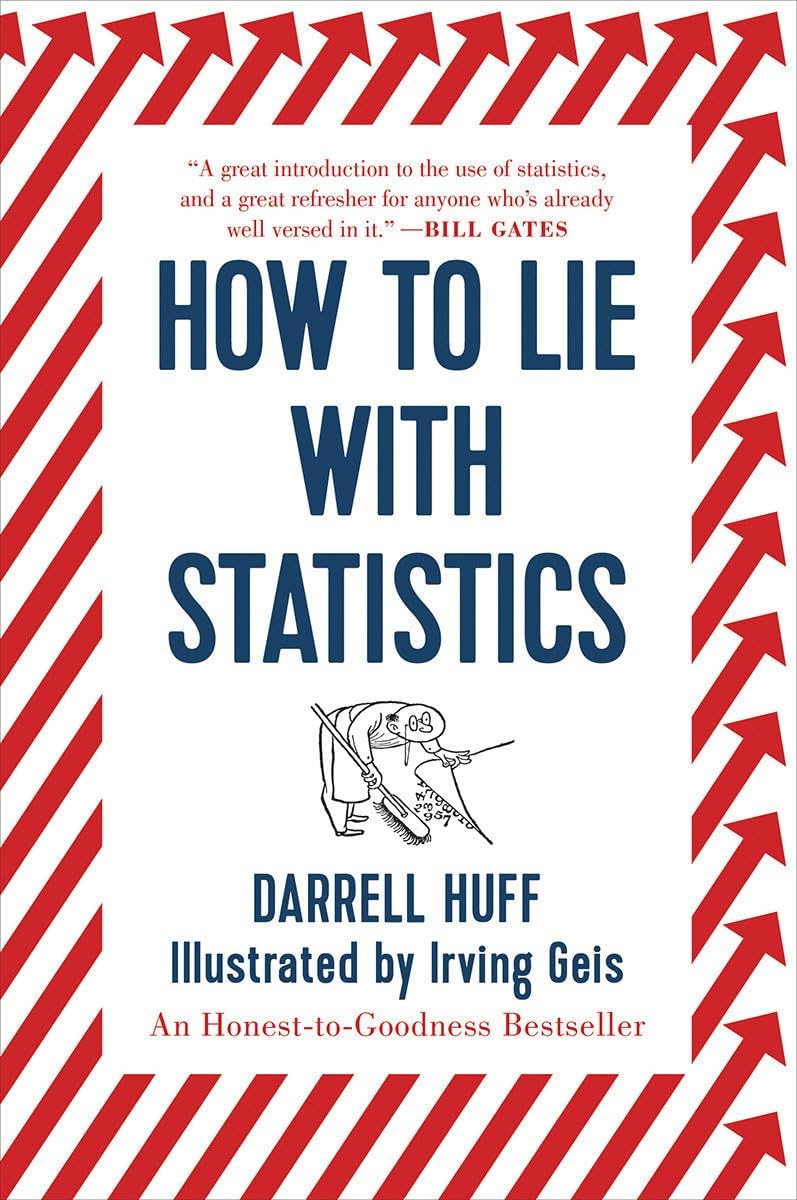
How to Lie with Statistics
Product ID: 2306522
Buy anything from 5,000+ international stores. One checkout price. No surprise fees. Join 2M+ shoppers on Desertcart.
Desertcart purchases this item on your behalf and handles shipping, customs, and support to Slovakia.
desertcart.com: How to Lie with Statistics: 9780393310726: Huff, Darrell, Geis, Irving: Books Review: A classic book of mathematics in plain language - There's a reason this book has been in print for 70 years--it's THAT GOOD. The statistics used may be a bit dated, but are no less effective for that. Every example is carefully chosen to show how numbers can be used to obscure, mislead, and otherwise lie. Best of all, there is a discussion of how to recognize misleading statistics versus honest ones. This book was in my high school math teacher's classroom, and has been in mine as well. Anybody can understand it; anybody can "talk back" to statistics. Even if you're not a big fan of math or numbers, this is an excellent book. Review: Influential book to me. - I'm a college student who had to buy this book for a math class. We had a list of books to choose from and I chose this because it seemed to be one of those interesting debunking type writing pieces that give an alternate perspective on something so commonly followed. With statistics, we see them everywhere and spewing from people's mouths constantly. But where do they come from and why are they unreliable and in what cases are they unreliable? Darrell Huff kind of hits all aspects of statistics, and is sure that he hasn't crossed his own lines of creating bias; throughout the book he addresses each side the story. What sides am I referring to? The statistician's point of view, whoever's hands it was transferred to thereafter, the media that project this news to viewers, and the viewers point of view. He does this all with such a sense of reliability, because he never fails to leave out an aspect that would undermine his conclusions. I found a lot of great information in this book, some that has reinforced my beliefs about statistics and others that have provided me with new views on information. With increasing amounts of information available, and that instant communication that allows us to share information faster, we need people to be reading more books like this so they avoid learning a bunch of value-less information from people who haven't "done their homework." Sometimes statistical deceit is unintentional, while other times it's deliberate. Huff examines each cases, and attempts to provide understanding to all of his readers as to how we can avoid this and the 5 questions we can ask ourselves when we approach information. If you've either: - Wondered about news information and how it's history has influenced citizens (and how it really still applies) - Needed refreshers on the importance of statistics as well as how to approach them - Struggled with reading statistics or producing statistics - Enjoyed being offered alternate perspectives on widely accepted practices like presenting information through statistics - Curious about where people get their information, and why they're quick to spew statistics like it's true knowledge THEN READ THIS BOOK! :)
| Best Sellers Rank | #21,398 in Books ( See Top 100 in Books ) #2 in Business Statistics #7 in Statistics (Books) #11 in Probability & Statistics (Books) |
| Customer Reviews | 4.5 4.5 out of 5 stars (4,485) |
| Dimensions | 5.5 x 0.4 x 8.2 inches |
| Edition | Reissue |
| ISBN-10 | 0393310728 |
| ISBN-13 | 978-0393310726 |
| Item Weight | 4.8 ounces |
| Language | English |
| Print length | 144 pages |
| Publication date | October 17, 1993 |
| Publisher | W. W. Norton & Company |
T**L
A classic book of mathematics in plain language
There's a reason this book has been in print for 70 years--it's THAT GOOD. The statistics used may be a bit dated, but are no less effective for that. Every example is carefully chosen to show how numbers can be used to obscure, mislead, and otherwise lie. Best of all, there is a discussion of how to recognize misleading statistics versus honest ones. This book was in my high school math teacher's classroom, and has been in mine as well. Anybody can understand it; anybody can "talk back" to statistics. Even if you're not a big fan of math or numbers, this is an excellent book.
B**T
Influential book to me.
I'm a college student who had to buy this book for a math class. We had a list of books to choose from and I chose this because it seemed to be one of those interesting debunking type writing pieces that give an alternate perspective on something so commonly followed. With statistics, we see them everywhere and spewing from people's mouths constantly. But where do they come from and why are they unreliable and in what cases are they unreliable? Darrell Huff kind of hits all aspects of statistics, and is sure that he hasn't crossed his own lines of creating bias; throughout the book he addresses each side the story. What sides am I referring to? The statistician's point of view, whoever's hands it was transferred to thereafter, the media that project this news to viewers, and the viewers point of view. He does this all with such a sense of reliability, because he never fails to leave out an aspect that would undermine his conclusions. I found a lot of great information in this book, some that has reinforced my beliefs about statistics and others that have provided me with new views on information. With increasing amounts of information available, and that instant communication that allows us to share information faster, we need people to be reading more books like this so they avoid learning a bunch of value-less information from people who haven't "done their homework." Sometimes statistical deceit is unintentional, while other times it's deliberate. Huff examines each cases, and attempts to provide understanding to all of his readers as to how we can avoid this and the 5 questions we can ask ourselves when we approach information. If you've either: - Wondered about news information and how it's history has influenced citizens (and how it really still applies) - Needed refreshers on the importance of statistics as well as how to approach them - Struggled with reading statistics or producing statistics - Enjoyed being offered alternate perspectives on widely accepted practices like presenting information through statistics - Curious about where people get their information, and why they're quick to spew statistics like it's true knowledge THEN READ THIS BOOK! :)
A**A
A Classic on Misuse of Statistics!
"How to lie with Statistics" adds no more bewilderment to an already perplexing world of numbers. Author's advice is pretty simple and easy to comprehend for professionals and greenhorns alike. Darrell Huff avoids the wonkish stuff and instead builds his work around the common traps in the statistical world. Sometimes, these traps are intentionally deployed by the vested interests whereas a lot of times such pitfalls inadvertently sneak into the picture doing even more damage. One of the basic traps in statistics, according to Huff is the built-in sample bias (a sample is biased when a sample doesn't adequately represent the population from which it is drawn).There is no doubt that the outcome of a sampling study is as good as the sample it is based on and that determining a true random sample us an impossible scenario yet almost everyone claims to have found one. Huff asserts that observers need to be highly skeptical each time they look at research data since there is always a bias hidden somewhere. 'How to lie with Statistics' is an old-fashioned, honest manual (despite its name) on statistical artifices that has withstood the knocks of time and is still as pertinent as it was 60 years ago. The fact that it's a recommended book in some of the undergraduate statistics courses around the world is in itself a grand testimony to its relevance. I strongly recommend this book to those who have a tangential knowledge of statistics and those who work with data day in and day out and feel besotted by all the graphs, trends and averages.
R**N
A fantastic read that aged like fine whisky
This book is 70yrs old and is as relevant as ever and thoroughly enjoyable to boot, far exceeding my expectations. Not only does the reader gain the benefit of learning statistical fallacies he may already be aware of, but sees that they still apply 70yrs later. This book has aged like a fine whisky and serves as confirmation bias to my long held belief that the every day person is easily tripped up by simple percentages. Highly recommend for fellow stats nerds
J**G
Excellent, but dated.
This little book is a great piece to get one in the right mindset for consuming media, political propaganda, science, and more! While it is a lighthearted read, lacking in substantial statistical analysis, it does provide a basic breakdown of how statistics can be used to manipulate, fool, and lie (with oneself as a thinker, and with ones consumers). Even if a given thinker is not using any of the fallacies that this book discusses, it is worthwhile for a reader to maintain the spirit -the mindset- of this book, and always remain critical when reading data, science and statistics. You will probably be best served in reading this book if you already know a little bit about statistics (ie: the difference between mean, median and mode, and when one might use them), but some complementary google searching while reading can fill in the blanks for those less statistically inclined. Admittedly, it is a little bit dated, with most sources coming from a long time ago, and most references falling flat on their faces. This dated-ness doesn't take away from the content though, and should not dissuade you from getting a copy.
J**H
Quite an old book, however still very relevant
G**N
Título interessante pela abordagem com exemplos claros sobre o que está sendo explicado. Pondera inúmeros momentos que precisamos estar atentos, pois sempre haverá bias/vieses e isso não pode nos cegar a avaliação.
K**E
it was written in the 1940ish . but its still relevant
A**I
It's a complete must-have in today's world. We live surrounded by news and articles full of statistics and graphs that seem convincing, but in reality, many can be misleading, not because of wrong data, but because of how it is presented. This book provides indispensable knowledge for better understanding the statistics used in media and knowing how to detect lies or misdirections.
N**5
Je recommande ce livre, très facile à lire (d'un côté grâce à la taille de l'écriture pas trop petite et à une mise en page aérée, d'un autre côté grâce au style de l'écrivain, qui rend accessible au public un contenu pas toujours facile à comprendre). Concernant la commande sur Amazon, la livraison a été super rapide malgré les conditions actuelles.
Trustpilot
1 month ago
1 week ago