Desertcart purchases this item on your behalf and handles shipping, customs, and support to Slovakia.
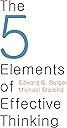
Simple but powerful strategies for increasing your success by improving your thinking The 5 Elements of Effective Thinking presents practical, lively, and inspiring ways for you to become more successful through better thinking. The idea is simple: You can learn how to think far better by adopting specific strategies. Brilliant people aren't a special breed―they just use their minds differently. By using the straightforward and thought-provoking techniques in The 5 Elements of Effective Thinking , you will regularly find imaginative solutions to difficult challenges, and you will discover new ways of looking at your world and yourself―revealing previously hidden opportunities. The book offers real-life stories, explicit action items, and concrete methods that allow you to attain a deeper understanding of any issue, exploit the power of failure as a step toward success, develop a habit of creating probing questions, see the world of ideas as an ever-flowing stream of thought, and embrace the uplifting reality that we are all capable of change. No matter who you are, the practical mind-sets introduced in the book will empower you to realize any goal in a more creative, intelligent, and effective manner. Filled with engaging examples that unlock truths about thinking in every walk of life, The 5 Elements of Effective Thinking is written for all who want to reach their fullest potential―including students, parents, teachers, businesspeople, professionals, athletes, artists, leaders, and lifelong learners. Whenever you are stuck, need a new idea, or want to learn and grow, The 5 Elements of Effective Thinking will inspire and guide you on your way. Review: Thinking Outside the Box! - This short novella-sized book is a unique overview of techniques that will improve your thinking. Written by two Professors from a mathematical background, it presents simple and effective ways to enhance creative thinking and improve the whole process of learning. The book excels by showing how our brains and thinking skills can become more refined through a series of brief but imaginative approaches. This includes brainstorming without edits, making mistakes, finding the "easy" solutions, then assimilating to grow, improve, learn, and ultimately change your thinking. It is basically an approach that gives free permission to "thinking outside the box" since this is often where truth and insight are to be found. This book does not present a cookie-cutter formula to improve thinking. Rather, the authors have given broader categories and outlines to frame their approach to think more effectively. I found that the very act of reading this book improved my own approach to critical thinking and definitely bolstered the creative process. The concise size of the book easily lends itself to re-reading several times. There is a lot of meaning below the surface of the text that will reward the thinker in you. This book makes the discovery process fun and enjoyable. Our minds need challenges to grow and learn. This book presents many examples of people who were initially challenged by a large or forbidding problem, but were able to persevere and subsequently find solutions that weren't apparent at first. Many geniuses were not born that way, but only through systematic and meticulous thinking, by "connecting the dots" of what came before them, were they able to effectively improve their knowledge base. This book shows you how. This book should be required reading for educators and teachers. Our current system has to change. Education in our country is getting worse, not better. A book like this can serve as a platform to throw out old notions, and start afresh. To conclude, this book is a welcome and important addition to the growing body of literature about how the mind works and how we can enhance its function. It belongs on the shelf of scientists, artists, engineers, teachers, and neuroscientists. It should particularly be read by students or anyone interested in lifelong learning. The more people gathered from various and diverse disciplines, assembling together to solve our many problems, the better our society will be prepared for the future. We all need to improve and refine the thinking process, to think more effectively, and this book is a great place to start. Highly recommended. Review: A practical approach for a very important topic - A practical approach for a very important topic. I am giving this book 5 stars for following reasons: 1. Style of writing is excellent, authors have used a story telling style that is very easy to follow and get the message through. Quotations and stories used in book are really inspiring. My favourite one is: "It's not what you don’t know that gets you in trouble. It's what you do know that ain't so." 2. Ideas are not new however book serves as a good reminder to five very simple and basic steps that many of us can use. I used idea of asking questions with my 8 and 10 yr old children and I can see some good changes. I have asked them to ask at least 1 question every day in school and at the end of the day they tell me what question they asked. I am following authors’ advice and reading the book second time, this time stopping to think and applying ideas to my life. I loved it in my first reading. I highly recommend this book to anyone looking to change their approach to learning, and innovating.
| Best Sellers Rank | #71,937 in Office Products ( See Top 100 in Office Products ) #1,250 in Early Childhood Education Materials |
| Customer Reviews | 4.5 out of 5 stars 1,098 Reviews |
N**N
Thinking Outside the Box!
This short novella-sized book is a unique overview of techniques that will improve your thinking. Written by two Professors from a mathematical background, it presents simple and effective ways to enhance creative thinking and improve the whole process of learning. The book excels by showing how our brains and thinking skills can become more refined through a series of brief but imaginative approaches. This includes brainstorming without edits, making mistakes, finding the "easy" solutions, then assimilating to grow, improve, learn, and ultimately change your thinking. It is basically an approach that gives free permission to "thinking outside the box" since this is often where truth and insight are to be found. This book does not present a cookie-cutter formula to improve thinking. Rather, the authors have given broader categories and outlines to frame their approach to think more effectively. I found that the very act of reading this book improved my own approach to critical thinking and definitely bolstered the creative process. The concise size of the book easily lends itself to re-reading several times. There is a lot of meaning below the surface of the text that will reward the thinker in you. This book makes the discovery process fun and enjoyable. Our minds need challenges to grow and learn. This book presents many examples of people who were initially challenged by a large or forbidding problem, but were able to persevere and subsequently find solutions that weren't apparent at first. Many geniuses were not born that way, but only through systematic and meticulous thinking, by "connecting the dots" of what came before them, were they able to effectively improve their knowledge base. This book shows you how. This book should be required reading for educators and teachers. Our current system has to change. Education in our country is getting worse, not better. A book like this can serve as a platform to throw out old notions, and start afresh. To conclude, this book is a welcome and important addition to the growing body of literature about how the mind works and how we can enhance its function. It belongs on the shelf of scientists, artists, engineers, teachers, and neuroscientists. It should particularly be read by students or anyone interested in lifelong learning. The more people gathered from various and diverse disciplines, assembling together to solve our many problems, the better our society will be prepared for the future. We all need to improve and refine the thinking process, to think more effectively, and this book is a great place to start. Highly recommended.
P**L
A practical approach for a very important topic
A practical approach for a very important topic. I am giving this book 5 stars for following reasons: 1. Style of writing is excellent, authors have used a story telling style that is very easy to follow and get the message through. Quotations and stories used in book are really inspiring. My favourite one is: "It's not what you don’t know that gets you in trouble. It's what you do know that ain't so." 2. Ideas are not new however book serves as a good reminder to five very simple and basic steps that many of us can use. I used idea of asking questions with my 8 and 10 yr old children and I can see some good changes. I have asked them to ask at least 1 question every day in school and at the end of the day they tell me what question they asked. I am following authors’ advice and reading the book second time, this time stopping to think and applying ideas to my life. I loved it in my first reading. I highly recommend this book to anyone looking to change their approach to learning, and innovating.
A**C
If you have ever wished you could learn to think like a genius, this book is for you.
I originally became interested in this book after reading a blog on PsychologyToday by one of this book's authors. The blog essentially discussed the values of failure, and how accepting and even encouraging failure leads to a better attitude about learning. This book is one of the few books I have ever read in one sitting. I became very interested in the authors' message, and found the writing to be straightforward and logical. I noticed that the authors do not needlessly repeat themselves, which is funny because in the first chapter they discuss how they initially wanted to literally print the entire text three times, but their publisher wouldn't let them. Good call, Publisher. I have noticed in reviews about similar books to this one (in the same vein of learning how to think better, or be more successful, etc.) that people often complain about the author(s) repeating the material over and over again in different words, as if to take up space. The Five Elements of Effective Thinking is logical, condensed, and never rambles. Reading this book is like drinking a shot of intellectual espresso. The basic point of the book is that there are 5 qualities of thinking that all effective thinkers share. Because it is about effective thinking, the authors rely on a lot of examples of effective thinkers: Famous examples like Thomas Edison and Albert Einstein, and examples of students who learned how to think effectively, like Mary, and the mathematics professor Dr. S who was once the worst mathematician in his class and later went on to receive his PhD in maths. All of the examples are fairly inspirational, and I think they highlight the fact that this book really is a self-help book of sorts, or maybe more accurately, a self-improvement book. I expected to see a little bit more of a psychological analysis of the thinking strategies of smart/successful people, or maybe a little more focus on truly practical tips about thinking, but it is mostly a general overview of a few simple ways to think and behave that the authors believe will make you successful (and they are probably right). I went into the book with the understanding that the authors were a couple of mathematics professors, so I was surprised to see how much of a focus the book has on the humanities. There seemed to be more examples about art and philosophy than there were about math and science (this would require a more detailed analysis). Indeed I was delighted at how interdisciplinarily the authors of this book approach the whole topic of learning how to think better. At many points during the course of the book I was reminded of David Foster Wallace's commencement speech at Kenyon College, in which he discussed the values of a liberal arts education, and how the cliché goes that a liberal arts education is about "teaching you how to think." An excerpt from DFW's speech: "I have come gradually to understand that the liberal arts cliché about teaching you how to think is actually shorthand for a much deeper, more serious idea: learning how to think really means learning how to exercise some control over how and what you think. It means being conscious and aware enough to choose what you pay attention to and to choose how you construct meaning from experience." Indeed many of the ideas that Drs. Burger and Starbird discuss will be familiar to anyone who has ever taken a creative writing class: Don't be afraid to write something bad, just recognize that it is bad, figure out why it is bad, figure out what about it is good, and then write it again except leave out the bad stuff and emphasize and expand upon the good stuff. The authors do a very good job of expanding upon this basic procedure (whatever you may call it) and applying it as a general philosophy of how to think. The "Elements" in the Five Elements of Effective Thinking refers to the classical elements: "Earth, Fire, Wind, Water, Heart, Go Planet!" Oops, I mean Earth, Fire, Air, Water, and The Fifth Element is Love (kiss me Leeloo). Oops sorry, I mean the fifth element is Change. What I'm trying to get across here is that the Classical Elements thing is a little overdone in pop culture, and honestly I think the book would have been better served to just leave that bit out. I don't think the authors needed metaphors to Hellenic Physics (which were ultimately totally and completely wrong) to build their theory about effective thinking. The authors make a few allusions to how they think the education system should work (such as instead of having transcripts with grades for specific classes on them, having a transcript that lists specific skills mastered, and some other pedagogy about effectively asking questions). What I'm really looking forward to is a book by the same authors talking about the 5 Elements of Effective Teaching (if this book comes out, I expect a cut, okay guys?). On a final note, I must give props to the editor. I did not notice one single misspelled word or misplaced punctuation, which seems to be exceedingly rare in first editions these days.
J**A
My first Amazon Review has to be for this book
I bought the five elements of effective thinking after being told about it by a friend. I was slightly intrigued by the title "effective thinking" (what exactly did that mean anyway!), and being generally wary of self-help books i reluctantly decided to give it a try. I did not regret my decision. I have read this book five times within 3 months and i can tell you that it is the best book i have purchased this year. If you are looking for a quick-fix, short-cut method of learning, then you should not bother buying this book. The authors present a road map for those who strive to develop critical thinking skills. Those who want to excel as leaders of thought. Those who genuinely want to be better at creating new ideas and are willing to learn how. Whether in the classroom or workplace, i fully recommend this book. It is concise. It is practical. It is awesome.
B**R
Learning must be learned
This book demonstrates how effective thinking can be mastered. It is insightful and practical. I find this book very useful. I read it more than two times as suggested by the authors. Personally, when I am on a given work, I try to get it right for the first time, which almost never end up successfully as I do imagine before I begin working. But this book does teach and calls to mind a principal truth that most people are not aware of or do forget for the most of time. In order to succeed you must first fail, then learn from your mistakes and misconceptions to make it right the next time you get at the topic you want to master. This book should be read by everyone who is involved in intellectual work throughout his life. Great thanks for the authors.
C**G
How to be a better writer, entrepreneur, energy- and time-manager by becoming a better thinker
The best books don't just contain great ideas. They're not even the ones that have actionable tactics. The best books are those that can change you merely by reading them. This book is one of them. For example, all business books tell you about how important, how essential, failing is. But it still hurts and we can't accept even if our brains want to. This book manages to persuade you to fail. Not only to feel good about it, but to actually seek it out. This book will help you become a better thinker, in tangible as well as spiritual ways. And in the process, it will make you a more effective, more efficient everything: for me it's a better writer and business owner. Buy this book and it will make you get so much more from all the other books you read.
J**N
Great Title - Interesting Concepts - Needs more "How"
I loved the title of the book and was really interested in the chapter descriptions. After making my purchase and starting to read I was disappointed at the lack of depth in the book. Some of the stories were from other books I read and some of the explanations were on the surface or incomplete. As a reader I wanted more "How" coupled with the "What" the authors provided. Here are my notes 1. Grounding Your Thinking 1. Understand simple things deeply 2. Clear the clutter - seek the essential 3. See what’s there 4. See what’s missing 5. Final Thoughts: Deeper thinking is better 3. Igniting Insights through Mistakes 1. Welcome accidental missteps-let errors be your guide 2. Finding the right question to the wrong answer 3. Failing by intent 4. Final Thoughts: A modified mind-set 5. Creating Questions out of Thin Air 1. How answers can lead to questions 2. Creating questions enlivens your curiosity 3. What’s the real question? 4. Final Thoughts: The art of creating questions and active listening 7. Seeing the Flow of Ideas 1. Understanding Current Ideas through the flow of ideas 2. Creating new ideas from old ones 3. Final Thoughts: “Under Construction” is the norm 9. Engaging Change Summary: A Way to Provoke Effective Thinking Quotes * P. 47 Success is the ability to go from one failure to another with no loss of enthusiasm. Winston Churchill * P. 56 A man’s errors are his portals of discovery. James Joyce * P. 58 The way to get good ideas is to get a list of ideas and throw the bad ones away. Linus Pauling * P. 92 There is nothing so useless as doing efficiently that which should not have been done at all - Peter Drucker * P. 125 In a chronically leaking boat, energy devoted to changing vessels is more productive than energy devoted to patching leaks. Warren Buffett Questions * P. 66 How would you teach something if you had no restraints (budget or time)? * P. 75 Even when you do know the answer, asking “What if…” is a great way to see more and delve deeper. * P. 77 Overcoming bias - First acknowledge your biases and then intentionally overcome them by asking - “Do I really know…?” * P.79 What are the central ideas here and do I truly understand them? * P. 83 What would someone ask me in order to determine whether I really understand these ideas? * P. 87 How can I become more engaged in the course material? * P. 89 How can I learn to think better and understand more deeply? * P. 91 What beneficial change could this assignment offer me? * P. 91 What permanent benefit am I supposed to get out of this exercise? * P. 91 What is the goal of this task - what benefit flows from this task? * p. 107 How could the current solution be refined to solve the problem it solved even better? Stories * In 1937 Sylvan Goldman made an observation and then asked a question. He observed that shoppers in his grocery stores were limited to the amount they could carry or place in a basket they held. He asked the question, “How can I help my customers carry more groceries?” The shopping cart was born. * The assembly line - In order to keep up with the increasing demand for those newfangled contraptions, horseless carriages, Ransom E. Olds created the assembly line in 1901. The new approach to putting together automobiles enabled him to more than quadruple his factory’s output, from 425 cars in 1901 to 2,500 in 1902. (ideafinder.com/history/inventions accessed June 16th 2004). Henry Ford improved on Olds invention by adding conveyor belts. Exercise * P. 51 “This attempt is wrong because…..” * Have the individual make a guess at a question * Ask if they think the guess is correct * If they don’t think the guess is correct then ask them for one thing that is wrong with your current answer * Now fix your incomplete answer to remove as many defects as you can. * P. 59 Just get the information down * Open a blank document on your computer * Quickly type any ideas that you have about the issue. * Read what you wrote and focus on two features: What’s right and what’s wrong * P. 61 * My View on X at the start of something * Teach the concept or provide the experience * My View on X after the above * Gives folks prospective and an idea how their thinking has expanded or changed. Thoughts * The Articles of Confederation vs. the US Constitution vs. the Constitutional Amendments - Research this more. AOC were a dismal failure…Constitution monster success. * Today it is unacceptable to tell racial or ethnic jokes. These jokes are considered demeaning and reflective of prejudice. Yet we still hand out grades in school. What do you think a failing grade makes a person feel like? What would be an alternative to provides grades as a way to demonstrate skill mastery?
W**G
Education is what survives when what has been learned has been forgotten. - Skinner
"The root of success in everything, from academics to business to leadership to personal relationships and everything else, is thinking - whether it's thinking disguised as intuition or as good values or as decision making or problem solving or creativity, it's all thinking... Doing anything better requires effective thinking - that is, coming up with more imaginative ideas, facing complicated problems, finding new ways to solve them, becoming aware of hidden possibilities, and then taking action. What is a surprise is that the basic methods for thinking more clearly, more innovatively, more effectively are fundamentally the same in all areas of life - in school, in business, in the arts, in personal life, in sports, in everything. The other surprise is that those methods of effective thinking can be described, taught, and learned. They are not inborn gifts of a special few. They are not so esoteric that only geniuses can master them. All of us can learn them and use them, and that is what this book is about." As pointed out by previous reviewers, this book is slim in size, but nevertheless large on content. The authors have developed an excellent system for applying their 5 elements of effective thinking: Earth = Understand Deeply, Fire = Make Mistakes, Air = Raise Questions, Water = Follow the Flow of Ideas, and "The Quintessential Element" = Change. When I first read about their system in the introduction, it seemed a bit odd and hokey, but by the end of the book, I was very much impressed with the cleverness of the whole scheme. Additionally, the authors have sprinkled in some useful quotes and copious examples to illustrate their points. In sum, I believe this book really does capture what it means, and what it takes, in order to be an effective thinker. It would definitely make a wonderful read for students about to enter, or currently in, high school. (For an equally good, but more advanced book on this same topic, I would suggest James R. Flynn's book: How To Improve Your Mind: 20 Keys to Unlock the Modern World )
C**L
Great book about learning , from the ground up
This Is a great book about learning and personal grow, is a check list to mental información processing that helps learning un a solid way.
M**O
EXCELENTE METODOLOGIA PARA MUDAR O PARADIGMA DE NOSSOS PENSAMENTOS
Um dos livros mais importantes que já li!! Os autores mostram como priorizar os tipos de pensamentos que levam ao sucesso. Ilumina vários tipos de estratégias de pensamentos, sempre agregando suas respectivas ações. O pensamento é o que há de mais valioso para a vida humana! O livro ajuda a organizarmos nossos pensamentos, ensina como transformar pensamentos em ações efetivas, expande a consciência e a criatividade. Mostra como pessoas comuns podem se transformar em gênios extraordinários. Remove o mito de que apenas pessoas geniais alcançam feitos extraordinários. Ensina a fazer iterações de pensamentos e ações. Inspirador! Excelente para estudantes e professores! Oferece um ótimo guia para aprendermos com nossos erros. Apresenta técnica de brainstorming (embora os autores não mencionem esse termo).
R**T
Good
Good
T**R
useful little book
The book gives useful advice on how to improve and change some aspects of thinking. Since most people never receive instruction on how to think, this book closes a big gap.
K**N
A life changing book
A great must read book. A Life changing book.
Trustpilot
2 weeks ago
4 days ago