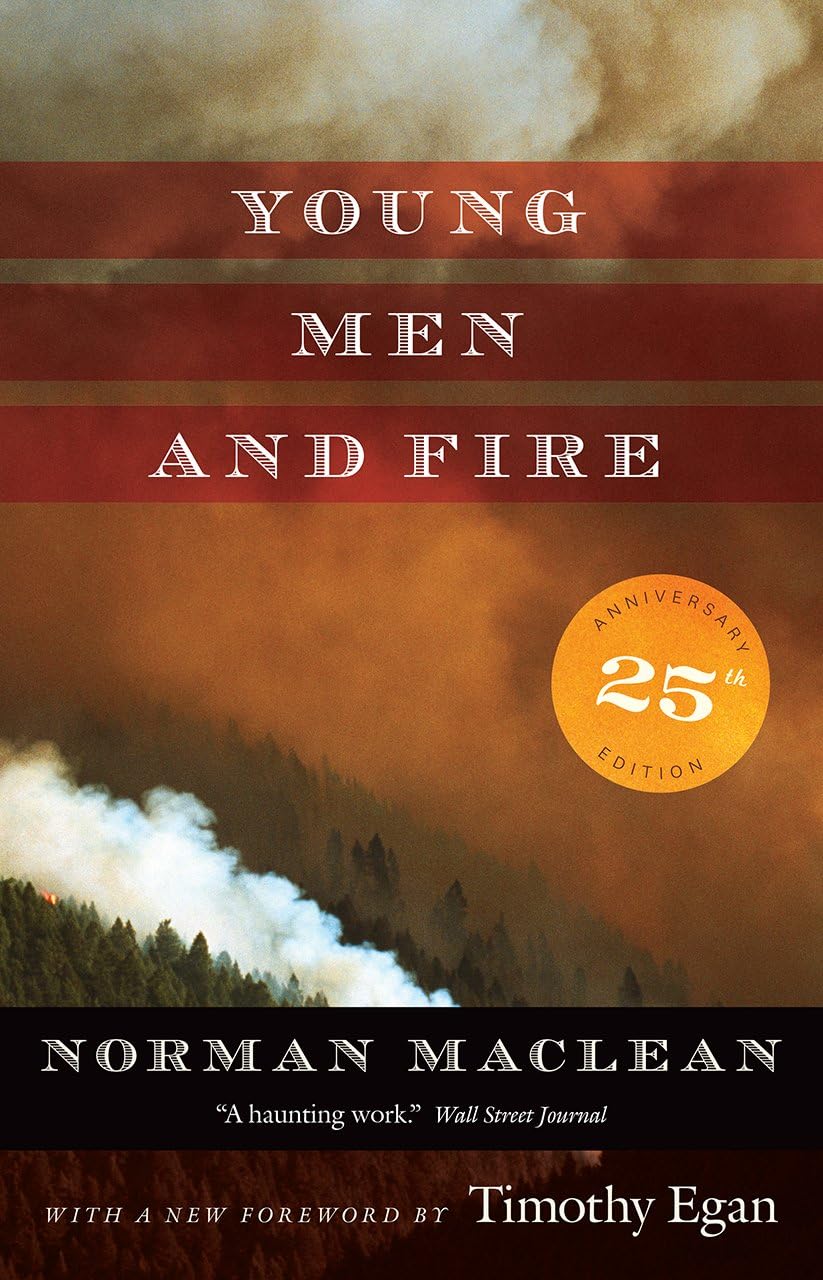
Young Men and Fire: Twenty-fifth Anniversary Edition
Product ID: 44802224
Desertcart purchases this item on your behalf and handles shipping, customs, and support to Slovakia.
A devastating and lyrical work of nonfiction, Young Men and Fire describes the events of August 5, 1949, when a crew of fifteen of the US Forest Service’s elite airborne firefighters, the Smokejumpers, stepped into the sky above a remote forest fire in the Montana wilderness. Two hours after their jump, all but three of the men were dead or mortally burned. Haunted by these deaths for forty years, Norman Maclean puts together the scattered pieces of the Mann Gulch tragedy in Young Men and Fire , which won the National Book Critics Circle Award. Alongside Maclean’s now-canonical A River Runs through It and Other Stories , Young Men and Fire is recognized today as a classic of the American West. This twenty-fifth anniversary edition of Maclean’s later triumph—the last book he would write — includes a powerful new foreword by Timothy Egan, author of The Big Burn and The Worst Hard Time . As moving and profound as when it was first published, Young Men and Fire honors the literary legacy of a man who gave voice to an essential corner of the American soul. Review: Young Men and Fire - The story of the Mann Gulch fire is a story of adventurous young men and their collision with startling tragedy. It is a mystery story, an investigative story, a story of an older man trying to discovery and understand something from long ago, something deeply painful, something most people wanted to forget. It is a story of youth and courage, of the woods and woodsmen, of tragic loss and the suffering of loved ones. Norman writes: "Those who knew something about the woods or about nature should soon have perceived an alarming gap between the almost sole purpose, clear but narrow, of the early Smokejumpers and the reality they were sure to confront, reality almost anywhere having inherent in it the principle that little things suddenly and literally can become big as hell, the ordinary can suddenly become monstrous, and the upgulch breeze suddenly can turn to murder. Since this principle comes about as close to being universal as a principle can, you might have thought someone in the early history and training of the Smokejumpers would have realized that something like the Mann Gulch fire would happen before long. But no one seems to have sensed this first principle because of a second principle inherent in the nature of man--namely, that generally a first principle can't be seen until after it has been written up as a tragedy and becomes a second principle." Staying at his family's lake cabin in Montana during the summer break, Norman was within twenty miles at the time of the fire. A woodsmen himself who almost was caught in the Fish Creek fire when working for the Forest Service as a young man, he always felt a connection to the events that happened on Mann Gulch that hot August day. Upon his retirement, he took upon himself the job of discovering the secrets known only to those that perished in the fire. He did so to honor those that died there, to discover and share with them in their lives, their suffering and their tragedy, and in so doing shed light upon tragedy itself, a thing which in one way or another will ultimately become a part of all of our lives. Norman Maclean is a fine man to head into the woods with. He has a dry sense of humor that is never lost, even when he is suffering through the heat of Mann Gulch in August. Of the many men we meet in our journey, I loved the character of Robert Sallee. Tough young kid and a very straightforward man. He led a very productive life, and resides in retirement today in Spokane Washington. Another favorite is Wag Dodge, the foreman, who kept his cool in the hottest of pressures, and discovered a way out, if only they would follow him to it. The responsibility of keeping those men safe weighed heavy upon him. After the fire, he stayed two more days, helping to identify the lost firefighters and remove their bodies. Dodge could never bring himself to jump again. He went up three more times, but could not go out through the door and into the unknown. His was a particularly tragic story. Norman Maclean never finished Young Men and Fire. Perhaps the journey of self discovery had not reached its end by the time of his death. Perhaps the threads he attempted to weave together could not quite fit. Perhaps he tired before the fire and its tragedy, and was himself overtaken by it all. In the end it was left for his son, John Maclean, to finish the project, which he did along with the help of a number of the editors from the University of Chicago Press. "It is clear to me now that the universe in its truculence doesn't permit itself to be that well known." - Norman Maclean Norman's Young Men and Fire is much more than a story of a deadly forest fire. It is a story of life and tragedy. I am there with Norman heart and soul. He is a fine writer, and it was a pleasure to be able to travel along with him, though the answers we sought were elusive, and sometimes not for us to find. Review: A brilliant, though unfinished, work encompassing decades of research - It is a great thing that this book has been given to the world, considering how much of his life and energy Norman Maclean devoted to it. A shame, also, that he wasn't able to finish it himself. I wonder how much additional polish and editing he would have done to make it a spectacular read. In "Young Men and Fire" Maclean takes the reader to the disastrous Mann Gulch blowup and examines it through testimony of the survivors, all of the photographs and documents that exist, personal interviews and visits to the scene, and modern computer analysis of fire behavior. Along the way he also looks at the ramifications of the events from grief and lawsuits to it's importance in the history of the forest service and the development of fire science as a whole. The book is *also* his personal story...a quest to gather all of the information, expose it with as much truth and perspective as possible, and finally bring closure to questions and controversy that were never completely dealt with. Accomplishing all of this is a lot to do in one work, of course, especially when it's unfolding simultaneously. Because of this it can seem like Maclean is jumping around and repeating himself a lot. Also, he likes to wax poetic (literally) quite a bit about the nature of life and death, fire, youth, and old age (his own). He links these and poetic thoughts to the story often...which is sometimes beautifully poignant but other times fairly jarring as it comes in the midst of technical examination of facts and theories. The last chapter, for example, as he tries to sum up everything into something meaningful for all of humanity...I found pretty unreadable for about 5 pages. It was just over the top with soliloquies and poetic ramblings. But then it returns in clarity and again offers well formed thoughts that romanticize all of it quite nicely. Another challenge I encountered (which seems rather trivial but was quite annoying) is that for much of the book I had a hard time picturing what Mann Gulch and the physical locations where the fire and the deaths occurred looked like. The terms used may be familiar to Maclean and those he referred to as "experienced woodsmen" but for me they were obscure. Ridge, reef, sidehill, gulch, fingergulch, canyon, mouth of the gulch, upgulch, upslope, crevice, saddle. Coming across the maps and photographs included helped some, but unfortunately they were poorly reproduced in the Kindle version I purchased. As Maclean attempted to recreate the events with timelines, yardage, speed, and space he included references to points on the map, for example. Too bad for me these were impossible to see on the poor quality jpegs in my version. It's a shame the publisher didn't do a better job on the ebook. Formatting errors were also found in abundance. If I were unbiased I would have to rate the book on it's own 3/5 stars. It's very hard to be unbiased, though, after going along on the journey with him and knowing it is essentially 15+ years of his hard work and possibly his greatest passion. All in all it definitely accomplishes what it attempts to do and I imagine the need to rework and polish the book into something more digestible (publishable) is what prevented him from doing so. I think if he had had time and ability it could have been polished to an easy 4-5 star creation...a classic, a bestseller. It has the content and legworth to deserve that, I think. Because of this I'm rating it 4 stars. After reading it I will never see some things the same. A fire danger rating, for example. A short news blurb that firefighters got a grass fire in steep terrain contained. The very real risk of wildland fires and amazing power of nature. The fascinating nature of fire science and computer modeling. The terror of being unable to outrun a 30-40 foot wall of flame. Beyond the occasional tedium I am glad I read this book and would highly recommend it.


| Best Sellers Rank | #65,904 in Books ( See Top 100 in Books ) #5 in Firefighting & Prevention #47 in Law Enforcement Biographies #101 in Author Biographies |
| Customer Reviews | 4.4 out of 5 stars 1,339 Reviews |
J**S
Young Men and Fire
The story of the Mann Gulch fire is a story of adventurous young men and their collision with startling tragedy. It is a mystery story, an investigative story, a story of an older man trying to discovery and understand something from long ago, something deeply painful, something most people wanted to forget. It is a story of youth and courage, of the woods and woodsmen, of tragic loss and the suffering of loved ones. Norman writes: "Those who knew something about the woods or about nature should soon have perceived an alarming gap between the almost sole purpose, clear but narrow, of the early Smokejumpers and the reality they were sure to confront, reality almost anywhere having inherent in it the principle that little things suddenly and literally can become big as hell, the ordinary can suddenly become monstrous, and the upgulch breeze suddenly can turn to murder. Since this principle comes about as close to being universal as a principle can, you might have thought someone in the early history and training of the Smokejumpers would have realized that something like the Mann Gulch fire would happen before long. But no one seems to have sensed this first principle because of a second principle inherent in the nature of man--namely, that generally a first principle can't be seen until after it has been written up as a tragedy and becomes a second principle." Staying at his family's lake cabin in Montana during the summer break, Norman was within twenty miles at the time of the fire. A woodsmen himself who almost was caught in the Fish Creek fire when working for the Forest Service as a young man, he always felt a connection to the events that happened on Mann Gulch that hot August day. Upon his retirement, he took upon himself the job of discovering the secrets known only to those that perished in the fire. He did so to honor those that died there, to discover and share with them in their lives, their suffering and their tragedy, and in so doing shed light upon tragedy itself, a thing which in one way or another will ultimately become a part of all of our lives. Norman Maclean is a fine man to head into the woods with. He has a dry sense of humor that is never lost, even when he is suffering through the heat of Mann Gulch in August. Of the many men we meet in our journey, I loved the character of Robert Sallee. Tough young kid and a very straightforward man. He led a very productive life, and resides in retirement today in Spokane Washington. Another favorite is Wag Dodge, the foreman, who kept his cool in the hottest of pressures, and discovered a way out, if only they would follow him to it. The responsibility of keeping those men safe weighed heavy upon him. After the fire, he stayed two more days, helping to identify the lost firefighters and remove their bodies. Dodge could never bring himself to jump again. He went up three more times, but could not go out through the door and into the unknown. His was a particularly tragic story. Norman Maclean never finished Young Men and Fire. Perhaps the journey of self discovery had not reached its end by the time of his death. Perhaps the threads he attempted to weave together could not quite fit. Perhaps he tired before the fire and its tragedy, and was himself overtaken by it all. In the end it was left for his son, John Maclean, to finish the project, which he did along with the help of a number of the editors from the University of Chicago Press. "It is clear to me now that the universe in its truculence doesn't permit itself to be that well known." - Norman Maclean Norman's Young Men and Fire is much more than a story of a deadly forest fire. It is a story of life and tragedy. I am there with Norman heart and soul. He is a fine writer, and it was a pleasure to be able to travel along with him, though the answers we sought were elusive, and sometimes not for us to find.
A**.
A brilliant, though unfinished, work encompassing decades of research
It is a great thing that this book has been given to the world, considering how much of his life and energy Norman Maclean devoted to it. A shame, also, that he wasn't able to finish it himself. I wonder how much additional polish and editing he would have done to make it a spectacular read. In "Young Men and Fire" Maclean takes the reader to the disastrous Mann Gulch blowup and examines it through testimony of the survivors, all of the photographs and documents that exist, personal interviews and visits to the scene, and modern computer analysis of fire behavior. Along the way he also looks at the ramifications of the events from grief and lawsuits to it's importance in the history of the forest service and the development of fire science as a whole. The book is *also* his personal story...a quest to gather all of the information, expose it with as much truth and perspective as possible, and finally bring closure to questions and controversy that were never completely dealt with. Accomplishing all of this is a lot to do in one work, of course, especially when it's unfolding simultaneously. Because of this it can seem like Maclean is jumping around and repeating himself a lot. Also, he likes to wax poetic (literally) quite a bit about the nature of life and death, fire, youth, and old age (his own). He links these and poetic thoughts to the story often...which is sometimes beautifully poignant but other times fairly jarring as it comes in the midst of technical examination of facts and theories. The last chapter, for example, as he tries to sum up everything into something meaningful for all of humanity...I found pretty unreadable for about 5 pages. It was just over the top with soliloquies and poetic ramblings. But then it returns in clarity and again offers well formed thoughts that romanticize all of it quite nicely. Another challenge I encountered (which seems rather trivial but was quite annoying) is that for much of the book I had a hard time picturing what Mann Gulch and the physical locations where the fire and the deaths occurred looked like. The terms used may be familiar to Maclean and those he referred to as "experienced woodsmen" but for me they were obscure. Ridge, reef, sidehill, gulch, fingergulch, canyon, mouth of the gulch, upgulch, upslope, crevice, saddle. Coming across the maps and photographs included helped some, but unfortunately they were poorly reproduced in the Kindle version I purchased. As Maclean attempted to recreate the events with timelines, yardage, speed, and space he included references to points on the map, for example. Too bad for me these were impossible to see on the poor quality jpegs in my version. It's a shame the publisher didn't do a better job on the ebook. Formatting errors were also found in abundance. If I were unbiased I would have to rate the book on it's own 3/5 stars. It's very hard to be unbiased, though, after going along on the journey with him and knowing it is essentially 15+ years of his hard work and possibly his greatest passion. All in all it definitely accomplishes what it attempts to do and I imagine the need to rework and polish the book into something more digestible (publishable) is what prevented him from doing so. I think if he had had time and ability it could have been polished to an easy 4-5 star creation...a classic, a bestseller. It has the content and legworth to deserve that, I think. Because of this I'm rating it 4 stars. After reading it I will never see some things the same. A fire danger rating, for example. A short news blurb that firefighters got a grass fire in steep terrain contained. The very real risk of wildland fires and amazing power of nature. The fascinating nature of fire science and computer modeling. The terror of being unable to outrun a 30-40 foot wall of flame. Beyond the occasional tedium I am glad I read this book and would highly recommend it.
M**S
Still crackles
Published 22 years ago, "Young Men & Fire" still crackles today. Norman MacLean's account of the Mann Gulch fire, which claimed the lives of 13 firefighters in 1949, is a powerful piece of narrative journalism. But MacLean warps the form--fearlessly. He practically instructs us how to react and think about the tragedy, yanking us up steep canyon walls to ponder the series of easily-made mistakes in the tragedy, where "young men died like squirrels." The lightning-sparked fire was a "catastrophic collision of fire, clouds and winds" in Mann Gulch, located between Butte and Great Falls along the upper Missouri River. The fire was first spotted by a forest ranger and soon a C-47 was on the way with smokejumpers on board, heading to the remote canyon with winds so rough that one smokejumper got sick and did not jump. Fifteen smokejumpers parachuted into the fire and joined the forest ranger, who had been fighting the fire on his own for hours, on the ground. MacLean parses these first few decisions carefully and highlights the many ways in which it was unlikely this crew might succeed--their youth, lack of training and lack of training together. To make matters worse, their radio was destroyed during the jump (its parachute failed to open). The tragedy unspools over a few fast hours, flames racing up the steep slopes of the canyon, feeding on knee-high cheatgrass. MacLean does an admirable job of breaking down the series of events, but it gets a bit complicated and hard to picture, no matter how many times MacLean takes us back to various vantage points to consider (and reconsider) how the flames won and the men lost. The Mann Gulch fire is infamous for the tragedy but also noted for the "escape fire" lit by Wagner Dodge, who figured out in the high-pressure situation that the way to survive was to light his own fire and lay down in the smoking embers in order to hide, essentially, from the bigger onrushing blaze. Dodge urged others to join him, but they didn't heed his pleas--or didn't understand the strategy, given the panic. Dodge was one of three survivors. The controversy over this moment--could others have survived as well?--remains. MacLean takes on the role of investigator, prosecutor and philosopher. "Young Men & Fire" is compelling reading precisely because MacLean asserts his point of view and takes us inside his thought process, neatly interweaving his personal take with events on the ground and almost insisting that we try and figure out what happened. "We enter now a different time zone, even a different world of time. Suddenly comes the world of slow-time that accompanies grief and moral bewilderment trying to understand the extinction of those whose love and everlasting presence were never questioned. Al there was to time were the fixty-six speeding minutes before the fire picked watches off dead bodies, blew them up a hillside ahead of the bodies, and froze the watch hands together. Ahead now is a world of no explosions no blowups, and, without a storyteller, not many explanations." Where some writers of narrative non-fiction work hard to keep their distance from their subject, MacLean purposely weaves himself into the story, determined to come to terms with the tragedy in the same way he wrote the novel "A River Runs Through It" as a way to come to terms with the death of his brother. In the end, MacLean doesn't have all the answers and views the Mann Gulch with a long view. The "truculent universe," he concludes, "prefers to retain the Mann Gulch fire as one of its secrets--left to itself, it fades away, an unsolved violent incident grieved over by the fewer and fewer still living who are old enough to grieve over fatalities of 1949."
M**E
"Young Men and Fire" is THE BEST book I've ever read.
What else to say but that this is the BEST book I've ever read, and I've read a good many great, classic and wonderful books in my almost 70 years on this blue planet. I've read this amazing book multitudes of times over the past years, and I learn something new each time. This true story is brilliantly written with an eye to compassion and truth, a compilation of history, observation, research, investigation and critical thinking, with a soothing dose of respect and admiration not only for those 13 young Smokejumpers who lost their race with a wildfire in Mann Gulch on August 5, 1949, but also for others who were in some way deeply and personally touched by the tragic loss of life, those who were affected by this tragedy for the remainder of their days, whether a few years or a few decades. The prose used by the late, great Norman Maclean is wonderfully touching and deeply soulful, his words are like a massage to my heart and mind as I read them ... it's actually hard to properly describe. I knew almost nothing about Smokejumpers and little of the USFS before reading this book, but now I'm fascinated by the Mann Gulch tragedy in particular and by the courage and selflessness shown by Smokejumpers, past and present, and as well by the training of- and abilities shown by- those dedicated foresters of all sorts and their support system folks in the USFS who are devoted to protecting our beautiful forests and wildlands from destruction by wildfires, unregulated pirate logging, and from horrible, greed-driven mining damage that poisoned, and continues to poison, our National Forest's water, woods and wildlife.
A**E
Still needs editing - there's a reason why Maclean wasn't done with it
I loved Maclean's earlier _A River Runs Through It_, which is as beautifully crafted a story as any I have read. His approach here is similar. Presumably because Maclean died before he had finished it, this book is much less well crafted, with too many of asides and tangents that don't yet fit the larger theme and don't come back. The not-yet-complete and not-quite-polished nature of this book is, I suppose, its own testament to mortality, but rather at odds with the view of death that Maclean wants to convey. The book explores the death of 13 Forest Service firefighters in Mann Gulch, Montana, on August 5, 1949. Maclean tells the story in three parts, the original story of the men's final jump, his own investigation of the tragedy while writing this book, and a very brief musing on what it all means. I found the first part unnecessarily meandering, and the second part the most interesting. Given his emphasis on his own connection with the firefighters, I would have advised Maclean to start with a terse narrative of the official story. His personal reflections belong best in the second part, about his investigation, instead of distracting the reader in the first part. Like Maclean, I will not reveal what the third part is about - - but it was only spottily signposted earlier in the book, and I think a master craftsman like Maclean was still working on how to introduce those themes. Though I think the book is too long, especially in its first part, Maclean's prose is a pleasure to read. His was a distinctive voice indeed. The many strengths of this book should not make us overlook its very unfinished state.
N**J
Must read
Riveting blend of history, drama, and personal philosophy — in prose that marvels. MacLean’s layered story is of tragedy and death, with guideposts for us all.
L**O
fascinating book in need of some polishing
Forest fires were expected to be put out by 10 o'clock in the morning after Smoke Jumpers are dropped on them. Alas, in the Mann Gulch fire of August, 1949, this wasn't possible as most of the Smoke Jumpers were dead within hours of being dropped on site. With his forestry background, the author combined knowledge of the subject and his ability to write beautifully to create a disaster book masterpiece. He excelled, especially, at telling the story of the fire and also telling the "what changed as a result." The lengthy middle section of the book--his attempt to track down information--seemed unfinished. This is not surprising because his search for answers and his writing of this book were ongoing at the time of his death, before this book was completed. There's some truly memorable writing here. For instance, from the final portion: "From the elevation of retrospect we can see it all coming together more clearly and sooner than those who were there and running. For us the signs are many that in minutes the blowup would bring a total convergence of sky, young men, and fire, and after that, the dark; on the top of the hill, though there are only occasional partings in the smoke, the flames themselves were blinding and those inside the flames and smoke could no longer see what was happening to them and would happen next." I loved, too, how the author managed to suggest what the dying Smoke Jumpers may have felt. He does so in a beautiful, reassuring way. Due to the fact that the foreman built an escape fire at the last minute, something that hadn't been done before, this fire remains controversial, a mystery. Did the escape fire contribute to the deaths of some of the Smoke Jumpers or could it have saved them? Perhaps if the author could've finished this book before he'd died, we might have a better answer. This is a truly fascinating book, in need of some polishing, but unforgettable nonetheless. Very highly recommended!!
R**S
A super compelling read. Great book.
I read this book after reading A River Runs Through it, And Other Short Stories from the author. Probably drawn to it a little by the Yarnell Hill fire and the movie about that tragedy. McLean writes so beautifully and does a great job of explaining the details of his investigation and the reasons he was so passionate about it. Really great book. Well worth your time to read it.
R**K
Deep and insightful exploration of manhood
Shows you a side of being a man which is absent from today's advice on manhood. Do yourself a favour and discover what you could be.
K**Y
期待通り
映画「オンリー・ザ・ブレイブ」を見て興味がわき、購入しました。期待通りの素晴らしい本です。
K**W
The beginning of a new era for smokejumpers.
I picked up this book after reading The Premonition by M.Lewis. Young Men and Fire is quoted there for the unbelievable survival of a smokejumper by the name of Dodge, during the Mann Gulch forest fire. I was curious to learn more about this technique pioneered by Dodge and ended up reading the book. I think given I had no clue about forest fires, a topic I never thought I would be necessarily interested in, I truly enjoyed McMillan’s writing. He is a gifted storyteller but also an outstanding investigator. The book is well researched and most importantly objective. I must say I would have probably enjoyed it better with a little less of the research presented in the final 80 pages, which were heavily focused on the mathematical modeling of forest fires.
L**E
Very good historical review
I have purchased two previous copies but loaned them out and so decided to get another and never let it out of my sight 😊
M**R
Exceptional journalism.
A very, very detailed investigation and account of an incident. Exceptional journalism.
Trustpilot
3 weeks ago
1 month ago