Buy anything from 5,000+ international stores. One checkout price. No surprise fees. Join 2M+ shoppers on Desertcart.

Desertcart purchases this item on your behalf and handles shipping, customs, and support to Slovakia.
🔋 Power your off-grid lifestyle with confidence and zero compromises!
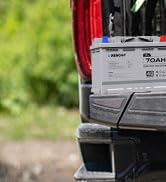
The Renogy Deep Cycle AGM 12V 100Ah Battery delivers robust, maintenance-free power with a 1100A max discharge current and an ultra-low 3% self-discharge rate. Engineered for extreme temperatures (-20°C to 60°C), it’s ideal for RVs, marine, camping, and off-grid systems. Trusted globally with over 230,000 units sold, this sealed AGM battery offers exceptional safety, long shelf life, and reliable performance for powering your essential appliances anytime, anywhere.


| ASIN | B075RFXHYK |
| Amperage | 50 Amps |
| Antenna Location | RV |
| Battery Capacity | 100 Amp Hours |
| Battery Cell Composition | Lead-Acid, AGM |
| Battery Cell Type | Lead-Acid, AGM |
| Battery Weight | 63.9 Pounds |
| Best Sellers Rank | #2,263 in Automotive ( See Top 100 in Automotive ) #7 in Automotive Replacement Batteries |
| Brand | Renogy |
| Built-In Media | Deep Cycle AGM Battery |
| Customer Reviews | 4.4 out of 5 stars 2,224 Reviews |
| Global Trade Identification Number | 00816360025597 |
| Item Dimensions | 13.1 x 6.9 x 8.6 inches |
| Item Type Name | for RV, Solar Marine and Off-grid Applications |
| Item Weight | 63.9 Pounds |
| Manufacturer | Renogy |
| Model Name | AGM Battery |
| Model Number | RNG-BATT-AGM12-100-US |
| Number of Batteries | 1 12V batteries required. (included) |
| Recommended Uses For Product | RV |
| Reusability | Rechargeable |
| UPC | 816360025597 |
| Unit Count | 1.0 Count |
| Voltage | 12 Volts |
| Warranty Description | 2-year prorated material and workmanship warranty |
K**Y
Good specs, good customer service and good price!
Got tired of adding water to both of my 5 year old deep discharge flooded lead acid house batteries for my RV. My battery compartment is just large enough for two Group 31 batteries and these are near in size to that so I bought two of them. It also helps that the price on Amazon is very good! They look good and were easy to install. Quality looks very good, though that's just a visual check at this point in time for me. Note that the terminals have M8 screws - if you get battery cables with M8 (5/16) lugs there will be more metal at the end vs the 3/8 holes on my previous cables which rotted away. Nice removable caps on the battery terminals which help when connecting multiple batteries in parallel. See my photo of the final installation. I bought a Victron SmartShunt IP65 along with the batteries so that I would have more confidence in the state of the batteries when boondocking without shore (120VAC) power. There is a good datasheet for this battery on the Renogy website but that does not include two parameters that can help accuracy with the Victron. So I asked Renogy customer service for the information which they quickly provided! Bravo to them for this! The two parameters and their value are : Peukert’s Constant: 1.1 and Charge Efficiency: 90% I felt that the old batteries didn't have sufficient remaining capacity - though they were originally 120Ah each. Whether that was true or not I really don't know. See below for the reasons for this and why I got the Victron monitor - which I really like. I have a Renogy Rover 30A solar charger which shows the battery voltage and some kind of state of charge (SOC) number. But the voltage on a lead acid battery is an accurate measure of SOC only if the battery has sat completely idle (i.e. disconnected) for at least 24 hours which is a non-starter when you are camping. The solar controller doesn't know how much current is being drawn from my battery pack (both the house load and solar are connected directly to the battery) so it can't calculate any kind of reasonable load drop. From what I read the loaded voltage could be 0.5 to 0.7v or more below the resting voltage as related to SOC. Hence the uncertainty with the old batteries. The shunt battery monitor is in series with the negative battery terminals so it knows all the current in/out of the battery, plus voltages and temperature. So it can calculate SOC more accurately. Note, however, that all it can calculate is the percentage of the battery capacity. If you enter 200Ah as the net capacity for the battery pack and you use 100Ah then it will show roughly 50%. But just exactly what the net remaining capacity is for a battery that is a couple of years old is a difficult question to answer. If the actual capacity has degraded to 150Ah, then that 100Ah discharge is bringing SOC down to 33% which is definitely not good. Apparently the correct way to test actual capacity is to discharge it at the spec rate (100Ah divided by 10 hours equals 10A) until the voltage drops to 10.5V. You want the current to be constant even though the voltage is varying and you definitely want to stop when you get to 10.5V and then immediately charge it up again. I don't see myself setting up such a test fixture nor do I know any place that can do this kind of test...
M**E
Excellent battery.
Excellent battery. Holds a charge when stored and works excellent when we're out using the camper. August of 26 will be three years with no issues. Highly recommend.
J**.
Good value, & good performance for stationary operation where weight is not a consideration.
I received all 8 of these Renogy Deep Cycle AGM 12 Volt 100Ah Batteries in good condition because they were packed with double box and double foam packing pads. They are very heavy and that care of packing was essential. They are wired in parallel for an 800 Ah 12 Volt battery bank. My 36-year experience with solar power taught me that connecting batteries and solar panels in parallel will provide much longer life than connecting them in series. Yes, you need much larger cables. I carefully charged the battery bank and recorded the discharge capacity over a 5-day period without any additional charging input. The discharge rate was a continuous 4 Amps. The capacity started at 800 Ah, 100% At 13.3 Volts. It took 120 hours to discharge down to 41%, 327 Ah remaining, at 12.1 Volts. That is a consumption of 473 Ah capacity. 4 Amps for 120 hours = 480 Ah. These batteries meet their specifications. I will only use them to 60% DOD (Depth of Discharge) max but mostly less than that. They have less points of failure compared to LiFePo4 batteries with their (complicated internal circuitry) and temperature requirements. They are good value, and good performance for stationary operation where weight is not a consideration. My application is the off-grid power source for my well. The input is 860-Watt peak solar array, output through the batteries to a 3000-Watt, 230 Volt AC inverter to power my well pump. The on-time duty cycle of the pump is low.
M**X
Failed to hold up below 32°
Bought batteries on Black Friday a 3 months ago and they will not hold voltage above 11.6v. after stilling in at freezing temps. Is connected to a solar tender does not seem to help. Update, was able to recover the battery by leaving it plugged into a float charger over night. It has been good sense then.
S**T
its shippable
great all around battery for most any vehicle i just put one in my 1998 ram with slight modification on one end 1/2" longer but can be modified to fit all the other dimensions are right and its sealed agm so no more messy acid or corrosion to worry about the truck even runs better now
T**N
Great for off grid 12v cabin with solar.
These batteries came well packaged and fully charged. These work well and I expect 8-10 years of service out of them. I’ve been using similar batteries on my off grid cabin 12v solar system with 200 watts of panels. I also have the system set up with an RV style generac 4000 G generator that I only fire up when I need to run a saw or the washing machine.
A**R
Lies and Stonewalling over a simple Warrenty return.
The battery we bought was put on a trickle charger while in storage before we installed it in our camper (which has a renogy solar panel and charger system). When we installed it, the Renogy charger said it was at 57% capacity. (Odd at the time, so we investigated.) Long story short, when we brought it back, my battery tester said it was bad. Autozone tested it and said it was bad. We called Renogy as there is a multi-year warranty on the battery at the beginning of May. It is now the end of May and after many calls to renogy support (in which we were assured twice that an RMA would be issued), we have been asked to test it with a battery shunt monitor which we do not own or have access to. The description said it is a deep cycle AGM battery with 1100A max discharge rate. When testing it against significantly lower 750A specs, it fails. I have never had such issues with a company. It is one thing to have a bad unit go out the door, it is another thing entirely to stonewall, lie and not follow through with commitments made. I will not buy another Renogy product.
P**I
Fits Watchdog Special Connect box
So far its working great with Basement Watchdog backup sump pump, but since I do not know much about technical stuff I'll just add that it perfectly fits Basement Watchdog Special Connect battery box, which I wasn't sure looking at the specifications. There is even sticker to put on box, just for fun, on the box :o)
S**N
Renogy batterie ont une très bonne réputation 👍
Pour chalet et alimenté par panneau solaire et très bon prix 🥇
K**N
Good value
The battery looks very well made, perfect for my application of powering my greenhouse
K**F
Great price - WIll evaluate over time
Couldn't pass up the sale but now will evaluate "longevity" and "value for money"
L**L
There where no instructions with this item.
I did not know if the battery was charged or not when it arrived. The battery failed. I do not know if it was a problem from the battery or from the controller.
Trustpilot
2 weeks ago
2 weeks ago