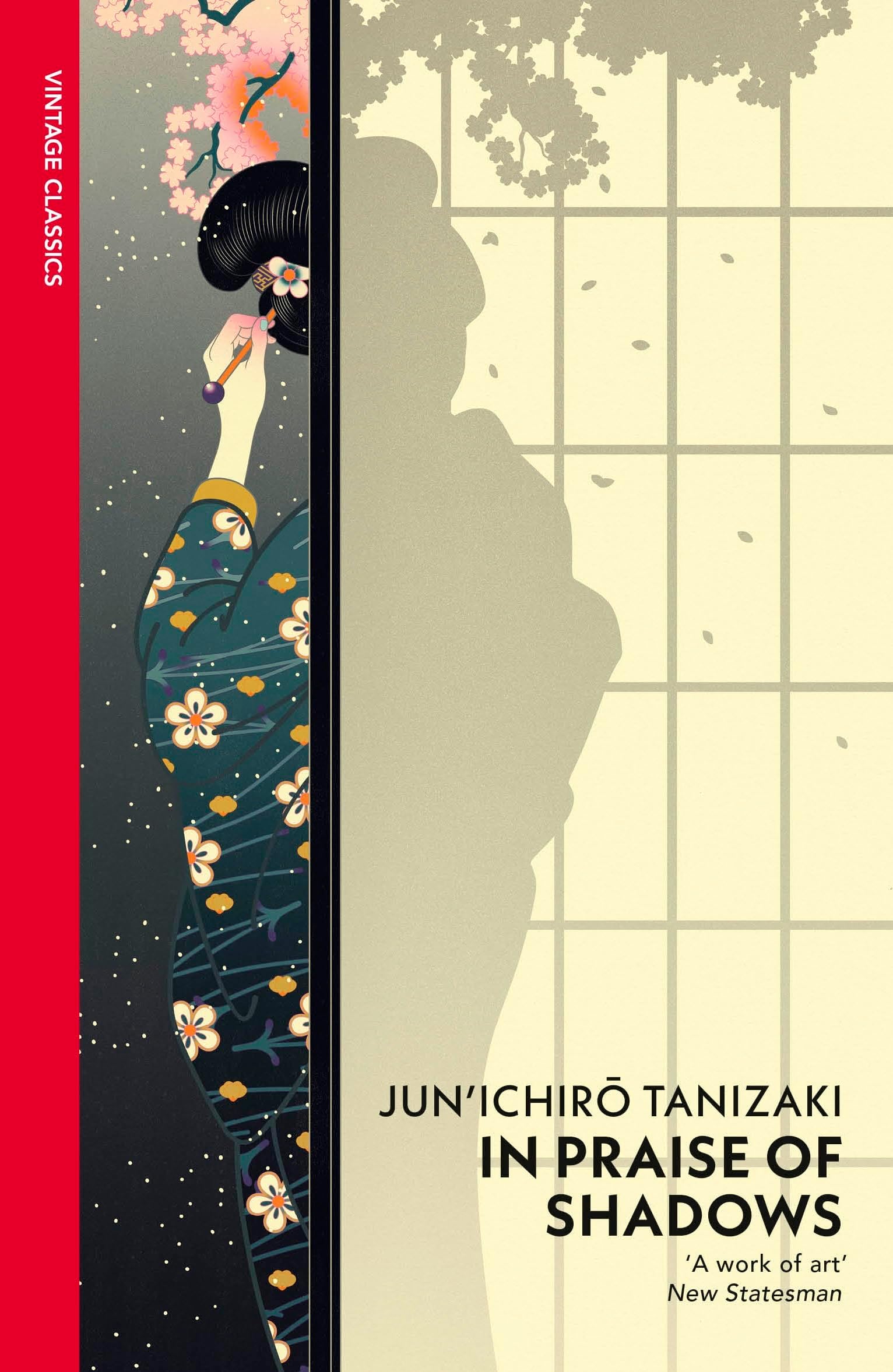
In Praise of Shadows (Vintage Classics)
Product ID: 51983119
📚New mint condition edition
📦Same-day dispatch before noon
🔄No-quibble returns guaranteed
Desertcart purchases this item on your behalf and handles shipping, customs, and support to Slovakia.
📖 Illuminate your space with the subtle beauty of shadows and tradition.
In Praise of Shadows (Vintage Classics) is a pristine, new mint condition edition of Jun'ichirō Tanizaki’s celebrated essay on Japanese aesthetics. Dispatching same day for orders before noon, it offers a premium reading experience with guaranteed secure packaging and no-quibble returns. Ranked among top antiques and literary fiction, this classic explores the nuanced interplay of light and shadow in traditional Japanese art, architecture, and culture, making it a must-have for discerning readers and collectors alike.













| Best Sellers Rank | 23,054 in Books ( See Top 100 in Books ) 73 in Antiques & Collectables by Subject 4,064 in Literary Fiction (Books) |
| Customer Reviews | 4.4 out of 5 stars 1,957 Reviews |
G**L
A timeless book
I bought this edition as a gift, and I’m really impressed. I own a very old version myself, but this one feels much more premium, the cover, paper quality. This is a great book. I absolutely love how it sheds light on a side of Japanese aesthetics that I admire. Subtle and beautifully written. I read it multiple times already and always learned something new.
R**O
East good, West not so good! Very much of its time.
I really enjoyed reading this essay on Japanese aesthetics. The general conclusion is that the darker more diffuse lighting of Japanese lanterns, candles etc sets off the items made for Japanese artefacts found in the traditional Japanese abode. Western bright, crisp lighting and chrome-plated design clashes with Japanese artefacts. Well, duh! Evolution, whether of organisms, design or taste progresses in a direction dictated by the parameters of the environment. If your rooms are dark then that's likely to influence your artifacts. The West followed an evolutionary path cut by science and technology and that's why our lighting improved incrementally, candles, lanterns, gaslight, lime-arc lighting, electrical filament lighting, fluorescent lighting and now LED lighting. Brighter and more efficient. The West ground glass into lenses and made plate glass to let light in to our dwellings- humans are creatures evolved to thrive and bath insight light and cower away from the darkness until the sun rises again. The Japanese cut themselves off from the world (sakoku) abandoned the development of glassware into lenses etc and hence technologies like tele- and microscopes and the advantages they bring and, instead, developed ceramics into beautiful vessels for drinking and eating from, lacquerware etc etc. They were still using naked flames to light their homes when the West was building steam ships! The point is, neither West or East is 'better' than the other, they are just better adapted to their environment as per Darwinism. The thought of the author gazing into his miso in quiet awe as the steam rises from the pearl-like rice makes me laugh really, charming in its own way but pretentious in others. A very enjoyable read but with arguments so full of holes that a 12 year old could criticise them!
E**F
Great read
Really good book actually, was a required reading for my architecture course. If you ignore the anti-western and misogynistic ideology its a very eye opening book
A**E
Shrouded in a Dusky Haze…
Tanizaki’s essay was written 65 years after the Meiji Restoration, which signalled Japan’s turn towards industrialisation. A world of paper walls and frigid candlelit rooms was being erased by one of concrete and neon. In Praise of Shadows is about the meeting of these two worlds; a superior Western civilisation dumping its science, its technologies and appliances on an insular society that has, in the author’s opinion, “come off the loser for having borrowed.” It is Tanizaki’s re-evaluation of what has been lost that forms the bulk of his essay. What he personally has grasped of traditional tea rooms and moon viewings, what he recalls of “the visible darkness” of Japanese homes, even his preference for wooden textures in bathrooms over modern Western tiling. The thread through all this is how Western techniculture has brought everything out into the light, driving away whatever beauty had resided there. Beauty, he argues, has always grown from the realities of life, and the Japanese, living in much the same way as when Confucius and Buddha were alive, came to discover beauty in shadows and ultimately “guided shadows towards beauty’s end.” In Praise of Shadows is essentially a paean to a lost world, the final words of a man looking back at life now gone. A sad, funny, great nostalgic read.
V**N
A Contemplation
In Praise of Shadows is an essay on aesthetics by one of my favourite Japanese writers, it was originally published in 1933, with the English translation coming out in 1977. This is a tiny book of less than fifty pages, containing a foreword and an afterword, making the essay itself only forty-two pages long, which means it can be read in one sitting, although that would be defeating the point of it, this should be savoured, this book should be read and re-read, should be immersed in. Jun'ichiro Tanizaki discusses traditional Japanese aesthetics in contrast to the changes occurring in his country, or to be more accurate the westernisation of it. Through this essay he compares light & dark, stating that the West with it's fundamental quest for progress, can be represented as a continuous search for greater light and clarity, whilst in contrast the Japanese path is through shade, that to appreciate Japanese art and literature, you need to understand it's shadows and the subtle nuances perceived within them. By this method he goes on to explain how this can reach into every part of our lives from what we eat out of, to what our toilets should look like and how they should be perceived. In the afterword it says that one of the oldest and most deeply ingrained of Japanese attitudes to literary style, is that anything with to obvious a structure is contrivance, that to orderly an exposition falsifies the ruminations of the heart, that the truest representation of the searching mind is just to "Follow the Brush" this gives "In Praise of Shadows" a conversational tone, and doesn't come across as an essay, it is more haphazard, as though you were following the thought process of a gifted writer. Although this eloquent strange book is primarily an essay on the Japanese sense of beauty, it is also an act of meditation and an elegy to a culture he perceived to be receiving it's last rites, making it part clarion call, part last post. This little book discusses architecture, drama, food, beauty and various other aspects of Japanese culture and how the rush for progress, with the adoption of western values, has created an uneasy, unbalanced clash of cultures, with the more forceful Western culture, with it's bright garish modern technology, challenging his own softer, quieter aesthetic tradition.
S**E
A sublime book on simple things and ways of seeing!
This book is utterly sublime. It seems such a simple small book about aesthetics in Japanese culture but it is more than that, It is the truth about objects and the preciousness of design and light and dirt. It is a book for those who are busy to bring attention back to the simple act of looking at things, to have the tears for things, the rapture for things! It is a book about the joy inherent in the imprint of dust and debris and fingerprints. It's about the entropy of objects made and found and delighted in. It is a book for the blind artist who has yet to see.....
T**E
A fascinating glimpse into the mind of Japanese and in turn their culture
When we go and visit places, we may be able to look into a culture from the outside – buildings, landscape, a little about their way of life. We may even be able to soak up some of the atmosphere. However to truly know a culture, we need to know how the people think. This is more elusive from our flying visit to places. This book has done tourists of Japan a favour because it attempts to explain how a typical Japanese thinks. Although the author was born in the late 19th century, his view still has traceable relics in modern day Japan and Japanese. At the very least, it certainly would help one appreciate the historical sites more. This book explains Japanese aesthetics. It has got a lot to do with how they lived in the past. I find it fascinating how the necessity of life as dictated by the climate subsequently intertwines with their sense of beauty. It has a lot to with the lighting and in turn the shadows (hence the title of the book). The paper door which they call shoji filters the light through and makes it soft. At night, candlelight flickers from below and casts shadows on the alcoves. He explains how gold was a favourite colour in those days on the inner doors – it reflected the dim light that they had. Black lacquer is iconic for Japan and now I understand more about how to appreciate its beauty – the reflection in the flicker of candlelight gives depth to alcove which would have been a void otherwise. Gold against black is also a combination that expresses Japanese sense of beauty – the contrast of shadows and light. In the same vein, the author talks about the feminine beauty which was shaped by what was kept from view (shadows) against the parts on show in their kimono which were the neck, the base of the neck and the hands (light). He also talks a lot of about toilet, praising in particular the outside toilet which gave rise to special adventures in bracing all elements to tend to our bodily needs. That I think depends on the imagination of individuals. He comes up with the theory that conveniences kill a lot of experiences of life. This I think is worth reflecting upon. Modern conveniences we cannot live without today makes life easy for us. Yet there is a cost. Without much invested effort, we cannot really get into understanding the action. My examples are fast food taking away the art of cooking or car journeys breaking down community. The author absolutely hates the western style of bright light. It is like overexposed pictures that all sense of beauty is washed out. Bright light that chases the shadows away leaves nothing to imagination and takes any depth away. The one question the author poses is a hypothetical one. He sees modernization in Japan as if a runaway train. In the process essence of Japan has been replaced. He wonders modern Japan can develop more out of her roots if scientific discoveries originated in Japan rather than being adopted from the West. Indeed what would Japan be like now if there was no imported modernization in a big-banged style? But then my Japanese friend mentions that they watch a lot of the developments, such as climate change, with aloofness. Perhaps they have learnt their lesson from their Meji period of the 19th century along the line of this author. This is a long essay. In terms of writing style, it is not as structured as the western style would have expected. The essay is a free flow from the author’s mind. It jumps from one topic to another. This again may speak of the Japanese mind? In bigger work, it may be hard to follow.
A**S
Light and shadow
A very interesting book about light and shadow and candlelight
P**O
interesting reading
interesting reading
C**S
Een volkseigen Japanse versie van: minder is meer!
Voor diegenen onder ons die zich ertoe aangetrokken voelen, is het boekje In Praise of Shadows een begrijpbare en verrassende indruk van de beleving en het effect van contrast. In dit geval in de onmiddellijke leefomgeving van de traditionele architectuur en daarmee van de woonsfeer en woonbeleving van Japan. Dit wordt goed verwoord door C. Moore in zijn voorwoord, welk de toon zet voor een erna volgende kennismaking. Geschreven door Junichiro Tanizaki met deskundigheid en begrip voor zijn landgenoten, over de volkseigen omgang met vormgeving en bewoning en de beleving van de afwezigheid van licht, en veelal ook van inrichting, van inventaris; zo anders dan in het westen. Waar wij deze innerlijke houding en omgang met schaduw niet geleerd hebben, en die ons wellicht weinig ligt. Waarvan wij ons doorgaans ook geen rekenschap geven. Hier dus ook een contrast: wij ontwerpen en richten onze woon- en werkomgeving eerder in met het streven naar killere efficiëntie en scheller licht. Het concept tegenstelling roept, steeds wanneer het voor onze aandacht verschijnt, gemakkelijk en vlug twee mogelijke denkrichtingen of associaties op: moeilijkheid of conflict naar de ene richting, of contrast en complementariteit naar de andere kant. De twee begrippen Yin en Yang verschijnen in dat verband dan bij velen al ook snel aan ons bewustzijn en we leggen dan gemakkelijk een al dan niet deskundige link naar oosterse culturen. De schrijver heeft als fijngevoelig waarnemer en insider een haarzuiver, misschien wel enigszins zeldzaam, begrip voor de fundamentele plek die het contrast daar inneemt: een gezochte en geconstrueerde tegenstelling tussen licht en donker, die eigen is aan de aard van het volk. In een esthetische en soms poëtische schrijfstijl laat hij ons kennis maken met een beleving van woonruimte, en hoe het kan zijn dat een anders geaard volk daar juist een fundamentele behoefte aan kan hebben: lege plekken en een buitensluiten van licht en een prominente plaats voor schaduw. Om een idee te geven van die prominentie in het kort enkele voorbeelden van een wat bredere context van tegenstellingen, die we ook in dit werk tegenkomen: - Er is door sommigen op gewezen dat in de architectuur het uiteindelijk de lege ruimte tussen muren is, en tussen vloer en plafond, die de waarde en bruikbaarheid, zeg maar gerust, het doel en nut van een gebouw bepalen. De tegenstelling bestaat hier tussen de compactheid van de bouwmaterialen en de plekken waar die niet zijn. Je zou dus (ongenuanceerd) kunnen zeggen dat het bij gebouwen in feite gaat om wat er niet is. - In gesprekken tussen Japanners, zegt de schrijver, is het in hun communicatie een natuurlijk gegeven dat de pauzes in de conversatie als het meest belangrijk worden beschouwd en beleefd (dat is wel een eyeopener voor westerlingen). - Japanse muzikale composities gaan in wezen om het weergeven of benadrukken van rust en de intentie om weinig te zeggen, om een zekere teruggetrokkenheid. Tenminste de voorouders van de generatie van de schrijver, zo zegt hij, groeiden op met deze traditionele woningbouw, en pas na kennismaking met de modernere bouwstijlen gingen de ervaringen meer in richting efficiëntie en licht, geleerd naar voorbeeld van het westen, waardoor die ouderen juist hun schaduwen van weleer gingen herwaarderen, nu ze die zo misten. Weer dit contrast, maar nu uitgedrukt in opeenvolging van generaties! Het uitgangspunt van dit boekje is dan ook een voorbeeld van dit grondidee: de belevingswaarde van een woonomgeving voor Japanner (tenminste zij die nog traditioneel voelen) ligt in de teruggetrokkenheid uit het licht, zeker het al te felle licht, zodat hij zich daar in rust en thuis kan voelen. Vooral in lege en schaduwrijke plekken en onder donkere plafonds en daken vindt hij in donkere textuur en leegte vaak onvermoede boodschappen waarvoor er niet direct woorden te vinden zijn, en die misschien helemaal ook niet nodig zijn. De rake beschrijvingen van dat besef bij de Japanner, bij zijn gewilde beleving hiervan zoals hier indrukwekkend en op authentieke wijze beschreven, leren wij zo ontdekken en treffender begrijpen dan ik als buitenstaander hier in mijn review zou kunnen. Al moet de schrijver met weemoed besluiten, dat het centrale thema in de huidige Japanse maatschappij, zoals zoveel andere zaken en aspecten, snel aan het veranderen zijn en soms helaas verdwijnen. En dat feit stelde hij dan al een halve eeuw geleden vast (de jaren 1970), toen dit geschreven werd ...
F**O
Bien
Llegó bien
K**A
Good read
I'm not a huge fan of reading- I needed this book for school- but I really liked this book/ essay and it really made me think more about perspectives and shadows
M**M
Essential reading.
Classic book.
Trustpilot
2 weeks ago
1 month ago