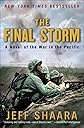
The Final Storm: A Novel of the War in the Pacific (World War II)
Product ID: 8724813
Desertcart purchases this item on your behalf and handles shipping, customs, and support to Slovakia.
NEW YORK TIMES BESTSELLER With the war in Europe winding down in the spring of 1945, the United States turns its vast military resources toward a furious assault on the last great stepping-stone to Japan—the heavily fortified island of Okinawa. The three-month battle in the Pacific theater will feature some of the most vicious combat of the entire Second World War, as American troops confront an enemy that would rather be slaughtered than experience the shame of surrender. Meanwhile, stateside, a different kind of campaign is being waged in secret: the development of a weapon so powerful, not even the scientists who build it know just what they are about to unleash. Colonel Paul Tibbets, one of the finest bomber pilots in the U.S. Army Air Corps, is selected to lead the mission to drop the horrific new weapon on a Japanese city. As President Harry S Truman mulls his options and Japanese physician Okiro Hamishita cares for patients at a clinic near Hiroshima, citizens on the home front await the day of reckoning that everyone knows is coming. Review: An Awesome Novel About The End Of The Pacific War - Jeff Shaara, acclaimed military fiction author, has written an excellent novel about the final defeat of the Japanese in World War II. Most of the novel deals with the battle of Okinawa. Located only 350 miles from mainland Japan, Okinawa was to serve as a main advance base for the upcoming U.S. invasion of Japan. Told through the eyes of Private Clay Adams and the rest of his group of Marines, Shaara takes the reader directly into this bloody battle. Throughout the course of the book, the reader follows Adams and his fellow Marines as they try to dig out the Japanese. Shaara also does a fine job of discussing the battle from the Japanese perspective, and he includes many prominent Japanese participants as well. The reader gets the full effect of the battle, including Adams having to deal with the loss of comrades and the relentless attacks from the fanatical Japanese. As the book progresses and the battle for Okinawa finally ends, Shaara turns his attention to the atomic bombing mission over Hiroshima. Staying with the earlier format, Shaara introduces the reader to real-life characters, including General Curtis LeMay, Col. Paul Tibbetts, and President Harry S. Truman. The afterword contains a brief synopsis of each true-life character included in the book. I've read several nonfiction accounts of the battle of Okinawa, but this is the first novel I've read about it, and I must say that I may have learned more from "The Final Storm" than some of the works of nonfiction. Shaara has a wonderful talent for blending fiction with real-life events, as is so greatly displayed in this book. I enjoyed following the conversations and interactions among the participants, and I also enjoyed reading Shaara's interesting narratives. I give this great book my highest recommendation. This is the first book by Jeff Shaara that I've read, but it won't be the last. Review: The End of WWII - As a big fan of Jeff Shaara I looked forward to his wrap up of World War II history with "The Final Storm". I had hoped for a story about the many battles across the Pacific as we pushed the Japanese back, island by island. Instead, the author focused on the last battle, the invasion of Okinawa and then the subsequent atomic bombing of Hiroshima and Nagasaki. The author takes us through the Okinawa campaign through the eyes of his main character, Clay Adams, a marine private. Adams relates his story as they defeat the Japanese and take control of the island. We see through his eyes the horror and destruction of this last great battle of the Pacific. Most of the book relates the story in this manner and one of the problems of such a narration is that it gets a bit repetitive. Occasionally he breaks it up with a look at the events through the eyes of the enemy but I think the story bogs down a bit. At the close of this battle, Shaara does a great job in relating the story of the dropping of the Atomic bombs which essentially put a final end to this horrible war. His look at Paul Tibbets the B-29 pilot who dropped the bomb is especially interesting and insightful. Throughout the book, the author gives sketches of other important military men, both American and Japanese, who's inpute affected the battles and the eventual final victory. As a wrap up, Shaara lists all those men and what happened to them and their careers after the close of the war. It's an interesting book and a good look at WWII history. As usual, Jeff Shaara does a great job and I think you'll find this an interesting read.
| Best Sellers Rank | #173,067 in Books ( See Top 100 in Books ) #397 in Military Historical Fiction #890 in Sea Adventures Fiction (Books) #1,283 in War Fiction (Books) |
| Customer Reviews | 4.6 out of 5 stars 3,062 Reviews |
J**N
An Awesome Novel About The End Of The Pacific War
Jeff Shaara, acclaimed military fiction author, has written an excellent novel about the final defeat of the Japanese in World War II. Most of the novel deals with the battle of Okinawa. Located only 350 miles from mainland Japan, Okinawa was to serve as a main advance base for the upcoming U.S. invasion of Japan. Told through the eyes of Private Clay Adams and the rest of his group of Marines, Shaara takes the reader directly into this bloody battle. Throughout the course of the book, the reader follows Adams and his fellow Marines as they try to dig out the Japanese. Shaara also does a fine job of discussing the battle from the Japanese perspective, and he includes many prominent Japanese participants as well. The reader gets the full effect of the battle, including Adams having to deal with the loss of comrades and the relentless attacks from the fanatical Japanese. As the book progresses and the battle for Okinawa finally ends, Shaara turns his attention to the atomic bombing mission over Hiroshima. Staying with the earlier format, Shaara introduces the reader to real-life characters, including General Curtis LeMay, Col. Paul Tibbetts, and President Harry S. Truman. The afterword contains a brief synopsis of each true-life character included in the book. I've read several nonfiction accounts of the battle of Okinawa, but this is the first novel I've read about it, and I must say that I may have learned more from "The Final Storm" than some of the works of nonfiction. Shaara has a wonderful talent for blending fiction with real-life events, as is so greatly displayed in this book. I enjoyed following the conversations and interactions among the participants, and I also enjoyed reading Shaara's interesting narratives. I give this great book my highest recommendation. This is the first book by Jeff Shaara that I've read, but it won't be the last.
R**S
The End of WWII
As a big fan of Jeff Shaara I looked forward to his wrap up of World War II history with "The Final Storm". I had hoped for a story about the many battles across the Pacific as we pushed the Japanese back, island by island. Instead, the author focused on the last battle, the invasion of Okinawa and then the subsequent atomic bombing of Hiroshima and Nagasaki. The author takes us through the Okinawa campaign through the eyes of his main character, Clay Adams, a marine private. Adams relates his story as they defeat the Japanese and take control of the island. We see through his eyes the horror and destruction of this last great battle of the Pacific. Most of the book relates the story in this manner and one of the problems of such a narration is that it gets a bit repetitive. Occasionally he breaks it up with a look at the events through the eyes of the enemy but I think the story bogs down a bit. At the close of this battle, Shaara does a great job in relating the story of the dropping of the Atomic bombs which essentially put a final end to this horrible war. His look at Paul Tibbets the B-29 pilot who dropped the bomb is especially interesting and insightful. Throughout the book, the author gives sketches of other important military men, both American and Japanese, who's inpute affected the battles and the eventual final victory. As a wrap up, Shaara lists all those men and what happened to them and their careers after the close of the war. It's an interesting book and a good look at WWII history. As usual, Jeff Shaara does a great job and I think you'll find this an interesting read.
R**N
Brutallly honest novel of the Pacific War and the heros who fought it
"The Final Storm" is an authentic story of the last stages of the American War in the Pacific against the Japanese. It focuses largely on two aspects of the war: the invasion of Okinawa by the United States, and the events leading up to the use of the atomic weapons against Hiroshima and Nagasaki. Although many did not realize it at the time, these two events were linked. The high casualties and brutal fighting that American soldiers endured on Okinawa convinced America's political and military leaders that use of atomic weapons was justified in order to prevent the even more horrendous casualties (on both sides) that would derive from an invasion of the Japanese main islands. Jeff Shaara's graphic portrayal of the fighting on Okinawa has the ring of authenticity. The story acquaints the reader with the awful conditions that the soldiers and marines had to endure during the fighting, and the tough fighting and high casualties against a dug-in and fanatical enemy. Nor does Shaara attempt to whitewash the brutal treatment that the Japanese inflicted on the inhabitants of Okinawa. I would have enjoyed even more writing concerning the decision to use, and the use of, the atomic weapons. Shaara's telling of this story, while well done, is a bit rushed and perfunctory. This is a fascinating story and a more in-depth telling would have been welcome. This is an excellent novel about a great subject. Highly recommended. RJB.
C**N
Jeff Shaara gets better with every book
Mr. Shaara admits that there are more stories to tell than he can fit into any one of his books. But, he manages to see each period he writes about from more angles than one might think possible. After his outstanding three volumes on the US Army in the African and European theaters of WWII, he covers the last months of US involvement in the Pacific war. In the introduction, he begins by telling the story of the first four-plus years of the Pacific war in less than ten pages. Few authors could do this successfully, but he carries it off smoothly. The first chapter covers an instance of submarine combat. Suspenseful and informative. The bulk of the book shifts to the battle of Okinawa. As Mr. Shaara says, he has a special respect for the "the men who carry the rifle", and it shows. He follows Pvt. Clay Adams through the entire campaign, giving you a glimpse into a seemingly endless series of bloody actions. How did these men hold up under the constant stress? You learn how the nature of the Pacific war differed from the combat in Europe. (I have too much respect for all the combatants to say any part of the war was "worse" than another part, but there certainly were differences.) As we continue to see in the wars of the 21st century, bombing or artillery alone almost never win a battle, or a way. People with rifles inevitably have to take, and hold, territory held by the enemy. It is never easy and always ugly, but America somehow finds exceptional men who will get the job done. As always with a Shaara novel, you get to hear a "voice from the other side". A high ranking Japanese officer survived the battle of Okinawa, unlike many of the other battles for Japanese held islands, and you hear the story of the Japanese defense. Telling the story from both sides of the conflict is something the author excels at. The reader's understanding is so much more complete when both sides are presented in the same volume. Finally, the story of the bombing of Hiroshima is told. Most accounts of the development of the A-bomb center on the scientists in New Mexico. This book tells a story that is often overlooked, that of the air crews who trained for a year to drop this new kind of weapon. Plus, you get a taste of some of the infighting at the upper levels of the Army Air Corps. By the end, you have an idea of the outstanding crew of the Enola Gay, along with the strong and stable character of the man who commanded them, Paul Tibbets. This work is "Historical Fiction", but it does not stray from the facts. The fictional part is in the thoughts and conversations of the characters. The events and dates do not diverge from recorded history. I read a fair amount of history, but I always come away from a Jeff Shaara novel with the feeling that I have learned something new. He brings out the characters so well, the journey is always interesting. As much as I admire those who triumphed in the Pacific War, this novel gave me even more respect for these men (and women), and what they accomplished. Above all else, this book is simply a "great read". I could not put it down.
C**A
Great Story of the last battle in the Pacific and the dropping of the bombs that ended the war
Wonderful fourth book of series about WW II. The author again does a masterful job introducing us to the Marines battling the Japanese forces in Okinawa (where in later years I served as a Marine officer with 3dMarDiv) and also the coverage of the Atomic bombs which ended the war in the Pacific and saved perhaps millions of lives while also taken many. I especially like the coverage of the Japanese side of the story and also the part where Tibbits delivers the first bomb on Hiroshima. Very detailed and well presented. Overall a very wonderfully written book which I as a retired Marine officer totally enjoyed as the did the other three of the series. I now look forward to reading more of Jeff Shaara books.
J**H
Solid, not Spectacular, Storm
Shaara's works have a certain predictability (aside from the fact that he is retelling history) in terms of the plot and, perhaps more importantly, character development. More than one reviewer has referenced the presence of the 'stock' character (the Adams brothers in particular). This should not be viewed as a fatal flaw of the work. While we seek texture and complexity from these characters, we may need to make concession to the universal nature of reaction to the horrible events described in this and Shaara's other works. Maybe that's too generous...Shaara seems to have found a certain voice for a particular flavor of character and that's what we get from him. There's nothing inherently wrong with that...it doesn't prevent the reader from having a thoughtful, enjoyable and engaging experience. Finally, while this may be self-serving, but there was something almost mystical in that I reached the chapter telling of the dropping of The Bomb on 6 August.
A**E
Prepare yourself ... then jump in with both feet and learn about the hard true cost of freedom.
Powerful, informative, memorable, moving ... A historically accurate war novel that hits you like a gut punch. I knew hand-to-hand combat on the battlefield must be a horrible thing no human should have to endure, but this book made the reality of that nightmare graphically real. The blood and gore was not gratuitous. It was simply one of many miserable aspects of the battlefield experience. It needed to be described in order to see and understand the bigger picture. As disturbing as the carnage was, it was the emotional aspects of the story that stood out for me. The sheer brutally raw courage and fortitude of the soldiers on both sides of the conflict was just awesome beyond mere words. Most of the men caught in these battles would deny being heroes because in their minds they were simply trying to do their job and survive, but I came away from this book with a far greater respect for these soldiers than I already had, which was considerable to begin with. I was struck by the sheer overwhelming numbers of casualties on both sides during combat. It is doubtful that many Americans fully appreciate how many thousands of American men "gave" their lives during every single campaign to retake the strategic islands from the Japanese forces. It literally came down to which side lost the greatest numbers of soldiers in so many cases. It is difficult to imagine the American public today enduring such losses and finding the political will to continue the conflict. I do not envy the military leaders as they witnessed the mass carnage, and knew there was no other option than to keep sending all those men (and women in many cases) into the jaws of death until the damn thing was over with. The author states right up front in the Forward to this book, that he takes no stand on the dropping of the atomic bombs at the end of the war in his writing. His aim in writing of these events is to relay the facts and the real and probable impacts of these facts on people (military and civilian) who experienced these events. He leaves it up to the reader to form their own moral judgments. After reading this book, it seems clear that the dropping of the atomic bombs was the better of two terrible and unfortunate choices. Clearly, there would have been far greater suffering and loss of life on both sides if our forces had landed on main land Japan and fought a long, excruciatingly protracted ground war to reach the same end. Until reading this book, I never fully appreciated the unimaginable horror of the alternative choice (which is in no way meant to downplay the horror of the atomic destruction).
J**S
Realistic and engrossing
I have completed both The Final Storm and Mr. Shaara's European theater trilogy, and can recommend each of the books enthusiastically. Mr.Shaara's literary style, fashioned after his father's before him, is captivating. His stories tell the basic history of important events, while including human perspective to tell that story. It is especially interesting and important to read the perspective of participants in these events who's view is not the same as that of the average American. Perhaps the most compelling feature of these stories is the graphic description of battles, including the wounds suffered by the participants. I have never personally read any accounts of battle which are more graphic, descriptive, and ultimately tragic. I complement Mr. Shaara on his work, and recommend it to all readers.
D**N
Der Abwurf der Atombombe über Japan
Jeff Shaara schafft es wieder einmal, Geschichte aus Sicht der Amerikaner plastisch und einleuchtend darzustellen. Der Krieg gegen Japan und sogar der Abwurf der Atombombe werden nachvollziehbar erklärt. Wieder ist es Shaara gelungen, neben einem gut recherchierten Kriegsroman auch amerikanisches Denken und Fühlen zu vermitteln. AP
B**9
A good addition to the World War 2 Series
Jeff Shaara's "The Final Storm" showed the horrors of front-line battle as it affected the soldiers who represented the 'sharp end of the spear' in combat. The author's blend of real and fictional characters produces a very readable account of history, especially when the tale describes the procedures required to make the first atomic bomb ready for use over Hiroshima. He describes well the tension and detail associated with this pivotal mission. I have read all of Jeff Shaara's World War 2 books, finding them to be a good read. "The Final Storm" did not disappoint me. It was a worthwhile reading experience.
R**H
The Americans at War.
Excellent series. Read them one after another.
R**T
Very easy to connect with the characters and understand what they ...
Interesting,thoroughly researched and well written.Very easy to connect with the characters and understand what they were going through.
D**D
The horrors of war
Gripping story about pushing the limits of human suffering and endurance on the battlefield. This is advertised as fiction, and I hope it exaggerates the historical realities. What a terrible waste war is.
Trustpilot
2 months ago
2 weeks ago