Buy anything from 5,000+ international stores. One checkout price. No surprise fees. Join 2M+ shoppers on Desertcart.
Desertcart purchases this item on your behalf and handles shipping, customs, and support to Slovakia.
🔗 Connect with Confidence!
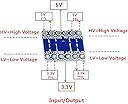
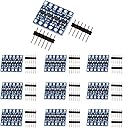
The KeeYees 10pcs 4 Channels IIC I2C Logic Level Converter is a versatile bi-directional module designed to safely convert voltage levels between 3.3V and 5V. With 4 channels for efficient data transfer, it supports a range of devices down to 1.8V, making it an essential tool for any Arduino enthusiast or professional developer.
| ASIN | B07LG646VS |
| Best Sellers Rank | #78,818 in Tools & Home Improvement ( See Top 100 in Tools & Home Improvement ) #291 in Power Converters |
| Brand | KeeYees |
| Brand Name | KeeYees |
| Customer Reviews | 4.5 out of 5 stars 535 Reviews |
| Interface | I2C |
| Interface Type | I2C |
| Manufacturer | KeeYees |
| Maximum Supply Voltage | 5 Volts |
| Minimum Supply Voltage | 3.3 Volts |
| Model | 8541715756 |
| Mounting Type | DIN Rail |
| Number of Channels | 4 |
| Number of Pins | 4 |
| Part Number | KYES505-10 |
| UPC | 705883355413 705883356441 |
J**L
Works as intended!
Works as intended!
N**E
simple and works great
These are simple and works great. I had with a similar one from AliExpress but those were a total waste of time. That other one had a defective circuit design and I spent so much time wondering why my project didn't work. Four channels, simple to use, as these should be.
L**Z
Excelente producto
Muy conforme
C**M
Not all of the channels work
For the channels that do work on the first one (3/4), they're working well.
J**N
Basic level shifter, good price.
Got these level shifters for various projects for use with ESP32 and Pi Pico. The board quality is basic and the silk screen can be hard to read but they come with headers and worked just fine for everything I tried.
T**Y
Works fine -- you just need to understand its limits
The converter does not have active pullups. This means there is slow rise time (about 600ns going from 3.3 to 5v, which is the worst case direction) and limited drive capability. As long as you are CMOS on the receiving end and the wire lengths are kept short you should be fine with data rates of about 500kHz or less. As to product quality, there is no gold plating, but one can't expect that at this price. I only need to use one of the ten, and it was 100% functional. So I have to give this five thumbs up!
R**S
Interesting Device that Should Really Tell You What it Can and Cannot Do
This is kind of an odd circuit setup. Very clever but it's not perfect. How it works: There is an N channel FET with the gate connected directly to 3.3V (LV) and the drain is pulled up to 5.0V (HV) through a 10K resistor. The gate and source are connected through a 10K resistor. Here's a schematic: http://cdn.sparkfun.com/datasheets/BreakoutBoards/Logic_Level_Bidirectional.pdf Now, when the input LV1 is at 0V, the FET turns on, sinking current through the FET, and taking the output HV1 low. When the LV1 input is at 3.3V, the FET turns off (since the gate and source are at 0V with respect to each other), which leaves the HV1 output at 5V through the 10K pullup on the drain to 5V. The other side is kind of nutty. Most people don't control transistors through an output pin, but every N ch MOSFET has an intrinsic body diode from drain to source. This is not a separate component; the drain and the source just act like a diode when reverse biased as a byproduct of the way transistors are manufactured. So with that, if the 5V side is taken low, it shuts off the transistor by pulling voltage out of the gate through the body diode, taking the input voltage to 0V. I think that is quite clever. If the 5V side is at 5V, then the transistor is in the shut off state, which leaves the input pin at 3.3V. Simple, eh? What matters is that the outputs are not push pull; they cannot really drive anything like an LED in most cases. As for speed, these are probably cheap transistors. I think the schematic calls for a BSS138 which should suffice up to a MHz or so. With that all said, I needed to turn on an opto, so I had to jack around with the circuit a bit to get it to sink 10mA through the FET. I wouldn't have chosen this route if I had it to do again, but I had the parts and the show must go on.
C**K
Works for serial at 115200. And isolates a device that's powered off.
Connecting serial data between a 5V Arduino pro mini to an ESP32 at 115200 baud. The logic level conversion might not even be necessary, but what's really nice about these is that they provide isolation. In my case, the 5V Arduino can shut off power to the ESP32 to conserve the battery, and then go to sleep waiting on an interrupt. But if the IO pins are connected directly, the ESD protection on the ESP32 will cause those pins to draw a lot of current when powered off, which defeats the purpose. If I use this module in between however, I don't have that problem.
N**E
Nice
Work as intended. Don't forget pull-up resistor on HV-side in high-speed applications such as 800Kbps WS2812.
D**R
Un module essentiel pour interfacer des composants
Le convertisseur de niveau logique KeeYees 4 canaux est un module essentiel pour interfacer des composants fonctionnant sous différentes tensions, notamment entre 3.3V et 5V. Il est particulièrement utile pour les protocoles de communication comme I2C, SPI et UART, rendant possible l’intégration d’appareils variés (capteurs, écrans, modules radio, etc.) sans risque d’endommager les composants sensibles. Points Forts ✅ Bidirectionnel et fiable Ce module permet une conversion bidirectionnelle, ce qui signifie qu’il peut gérer les échanges de données dans les deux sens entre des circuits 3.3V et 5V. Il est donc parfaitement adapté aux communications I2C, SPI ou série. ✅ Facile à utiliser Aucune configuration complexe n’est nécessaire. Il suffit de connecter les broches HV (5V) et LV (3.3V) à leurs alimentations respectives et d’utiliser les canaux de conversion pour les signaux logiques. ✅ Compatible avec Arduino, ESP32, Raspberry Pi, et plus Il fonctionne sans problème avec Arduino (5V), ESP8266/ESP32 (3.3V), Raspberry Pi (3.3V), STM32, et d’autres microcontrôleurs qui nécessitent une adaptation de tension. ✅ Format compact et pratique Sa petite taille permet une intégration facile dans des montages électroniques sans encombrer le circuit. Points à Améliorer ❌ Limité à 4 canaux Si votre projet nécessite plus de conversions de niveaux logiques, vous devrez utiliser plusieurs modules ou trouver une alternative avec plus de canaux. ❌ Incompatible avec des courants élevés Ce module est conçu uniquement pour des signaux logiques et ne peut pas convertir des tensions pour alimenter des composants nécessitant une puissance significative. ❌ Vitesses élevées limitées Bien qu'il fonctionne bien pour I2C et UART standards, les performances peuvent être limitées pour des protocoles plus rapides comme SPI haute fréquence. Verdict Final Le KeeYees convertisseur de niveau logique 4 canaux est un accessoire indispensable pour tout bricoleur électronique souhaitant interfacer facilement des composants 3.3V et 5V. Il est fiable, simple à utiliser et fonctionne parfaitement pour les communications I2C, SPI et UART. Bien qu'il puisse être limité en nombre de canaux et en vitesse pour des applications très spécifiques, il reste un excellent choix pour la plupart des projets. ⭐ Note finale : 4.7/5
A**A
funziona bene con il modulo bluetoot H5
consegna perfetta nel giorno stabilito
K**S
They do what they say they'll do.
So, electronics newbie here, so I figured I'd solder one up and put a meter on it to see if it was truly dropping the voltage from 5v to 3v as I didn't want to test it directly with my Leonardo and an lcd screen. Voltage showed 5v on the HV lines and 3v on the LV lines regardless of what I did. Since this wasn't what I expected, I then hooked it up to my scope and loaded up a quick HIGH/LOW program and, lo and behold, everything was actually working correctly. There are better explanations in reviews here of how they work but you certainly can't just stick a meter on them and see them work as expected. Don't know that's what those who had issues did to test them, but I have 10 out of 10 working just fine on the scope. **Update: Looking at the application schematic for a similar board on Sparkfun, it makes more sense. Both sides have pull-up resistors and taking either side to ground will take the other side through a MOSFET. So both sides will be at the high voltage unless one side or the other is pulled down.
T**M
Snabbt och bra leverans
Helt enlig beställning !
Trustpilot
3 days ago
1 week ago