
DOWNLOAD THE APP


Customer Services
Copyright © 2025 Desertcart Holdings Limited
DOWNLOAD THE APP
Full description not available
J**A
Of Elephants and Maps
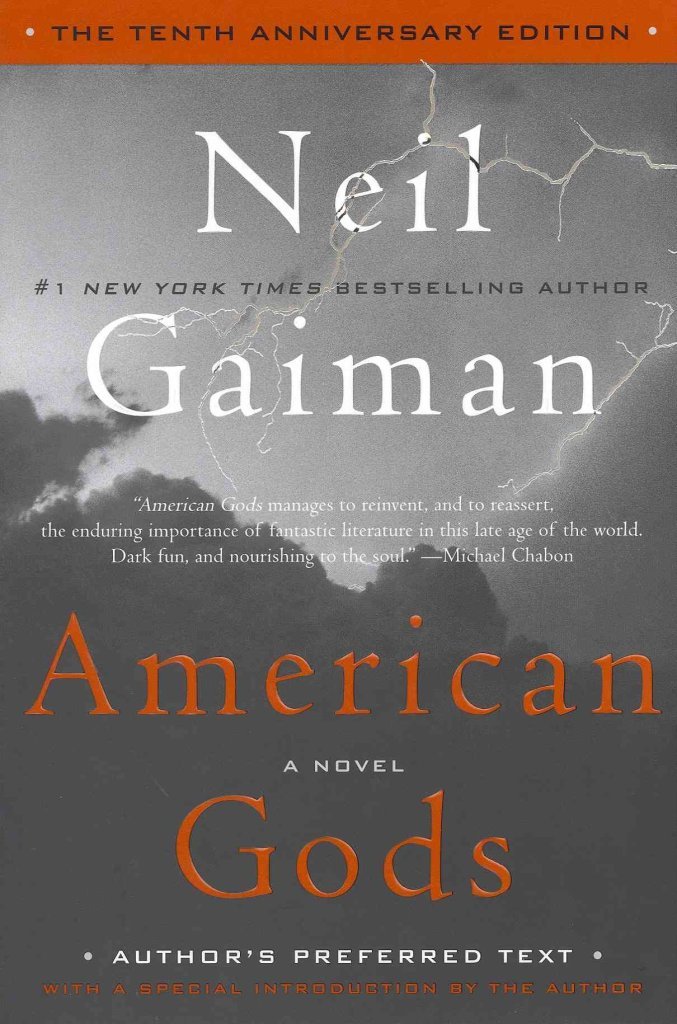
Before I truly get started on my review of American Gods by Neil Gaiman, I should mention a few things. First off, I was struck in awe and wonderment at being able to read the works of such a master wordsmith. Neil Gaiman is a craftsman when it comes to words. His prose, while not overly flowery, has a depth of emotion and poetry that is a joy to read.Secondly, I benefitted greatly from a website that compiled and explained the mythology behind various gods and characters. If you decide to read this book, may I highly recommend bookmarking and referencing "Only The Gods Are Real?" [...]Trust me when I say you will appreciate the way Gaiman weaves metaphor and mythology so much MORE when you understand the stories he's drawing from. The way he describes the gods and the situations he places them in is nothing short of brilliant.American Gods is a really large elephant of a book. It's been a few days since I've finished reading this novel, and I'm still trying to wrap my head around all of the various concepts and layers. When I focus on one aspect of the book, the others seem to fade out of reach in my mind.They're still there, but slightly out of view. Then, as I shift my attention to another angle of the story, the original thought recedes and goes out of focus. I realize that they're all connected and inter-related, but being able to explain precisely how it all fits is a challenge that seems beyond my scope and ability. In the end, I've been left with a sense of enormity and magnificence, while still not managing to see the whole beast at once.So, then, let's look at the components separately, instead.+++American Gods is a story about a man named Shadow Moon.+++Shadow Moon is a man who was sentenced to six years in jail and is due to be released early for good behavior after only serving three of them. A few days before he's to be freed, his life is shattered when he finds out that his wife has died in a car crash.On his way home, to attend his wife's funeral, he meets a man named Mr. Wednesday. Mr. Wednesday wants to hire him on as his bodyguard and all around errand boy. Originally, Shadow declines the offer, but Mr. Wednesday is insistent and eventually Shadow acquiesces- with a few stipulations.From the very beginning, Shadow can tell that things are not all as they seem. At first, he's reluctantly sucked into the events that unfold, but as things progress he becomes more willingly engaged. He comes to understand that there is a storm coming. There will be a great battle between old and new gods, and that Mr. Wednesday, who is really Odin in disguise, is at the heart of the events unfolding.Much like the skin of an elephant, this is perhaps the easiest aspect of the story to identify. It is roughened by age and elements and yet still manages to be intriguing and comforting. Even if all you wanted to do was read this book on the surface level, it would be an entertaining and pleasant read.+++American Gods is a story about the struggle between old and new.+++Odin is the greatest Norse God, otherwise known as the All-Father. Immigrants brought the old gods from all over the world to America in their hearts and minds. Gods have come from China, Greece, India, Ireland, Egypt, and anywhere there were people who prayed and kept faith in a higher being.Slaves, paupers, peasants all brought them oversea and across land on their backs and then tethered them within America's borders through sacrifice and worship. As the people who believed in them stopped believing, or teaching the new generations, or as they began to die off, the power of the old gods faded.The old gods were left to fend for themselves and take what little bit they could from the mythology and stories that remained. They had to resort to lying, cheating, whoring and preying on the people as best they could for their existence.Their diminished power made way for new gods. The gods of credit cards and freeways, television and computers, internet and media, modernization and progress.What the new gods have not realized (or maybe they suspect and fear it's truth) is that everything is impermanent and their very existence is still inherently based off the belief that people instill in them.As time moves forward, they will find themselves in a similar situation as the old gods. The lingo may be different, but the function is the same. The new gods fear that there isn't enough room in the people's hearts and minds for all of them, and so want to kill off the old gods.+++American Gods is a story about religion and the role of gods in our society.+++Gaiman delves into the roles that religion has played in all cultures around the world. At one point in the book, Mr. Wednesday says, "There's never been a true war that wasn't fought between two sets of people who were certain they were in the right."How can anybody say this isn't relevant to today's geopolitical situation? With so much unrest in the Middle East and the blooming of the Arab Spring? With Iran rushing to gain nuclear capabilities and threatening to wipe Israel off the map; Israel threatening to train their weapons on Iran in retaliation. With the ethnic cleansing and genocide in Sudan and the Darfur?Hasn't it always been the same throughout our history? These are relatively recent examples, but at any point in mankind's past, there is a religion being used as an excuse to wage war and commit murder on masses of people who are different and equally- fervently- calling themselves "right."Throughout humanity, gods have been thought of as, "a dream, a hope, a woman, an ironist, a father, a city, a house of many rooms...a celestial being whose only interest is to make sure your football team, army, business, or marriage thrives, prospers, and triumphs over all opposition."The vehicle used to express the idea of God (or gods) is through religion. Religions are, by definition, a metaphor. They are a means to relate the story and concept. At one point in the book religion is described as an operating system.However, if you were to boil any religion down to its base, you'd be left with the concept that, in essence, gods are ideas. Ideas are more difficult to kill than people, it's true, but they can be killed and, therefore, it is possible to kill a god.+++American Gods is a story about the American identity.+++When Gaiman wrote this book, he'd been living in America for a few years and was trying to come to an understanding about our country's sense of identity. In his search, he takes the reader from Chicago to San Francisco to the smallest towns via back roads and kitschy tourist attractions. He addresses his findings and musing throughout the book and makes some very astute observations. Not exactly as a stranger, but not quite as an insider, either.At one point Mr. Wednesday mentions, "This is the only country in the world that worries about what it is." Which, in my own limited experience, is exactly true. Throughout our history we've fretted over the influx of a particular demographic. Long ago, it was the Irish, then the Chinese. We've fought ourselves bloody over slavery and civil rights and interned our Japanese. A more modern example may be the laws recently passed in Arizona, primarily focusing on Hispanics.Each era, we have questioned ourselves and what it means to be American. The ones who have been here longer wrap themselves in the flag and gorge themselves on apple pie, all the while tucking away their own immigrant ancestors. The fact is, nobody is American. Not originally. And, that is entirely the point.One of the things I'm most proud of is my family heritage. My mom is caucasian. Blonde haired and blue eyed, her family has been in America since the 1700s and originated from England (I think there may be a bit of Irish and French in the mix, as well.) My maternal lineage could be considered one of the oldest families in America and has so many branches it's nearly impossible to keep track of them all.In contrast, my dad is full blooded Thai and first generation American. It was my grandparents who immigrated back in the 1940s in order to attend university and eventually make lives for themselves. I love the fact that I am a combination of some of the oldest Americans and newest Americans. I feel like I am the true embodiment of what it means to be American because of these two aspects. It's helped me to have a greater appreciation for our immigrant nature and realized that everybody who comes to this country has had a hand in shaping it's heritage AND it's future.I consider myself to be very patriotic. I still get a lump in my throat when I hear the national anthem hit that high note of hope and aspiration. I still marvel at the brilliance of the fireworks on the Fourth of July. And I insist on representing my country as best as I can when I go traveling abroad; choosing not to hide behind a Canadian flag simply because I'm afraid people will think less of me because of my country's reputation and propensity for war.However, that's not to say that I haven't been critical of our government and foreign policies. That doesn't mean that I haven't marched and protested and written multiple letters to Congress. I think a major part of the American identity is the fact that we DO have a tendency towards self-reflection; of constantly looking in the mirror and asking, "Who are we?"Despite our disparate pasts, cultures, languages and religions, how do we manage to make this country (that doesn't seem like it should work) function and persist? Even as we question our heritage, our language, our "American-ness" we have some undefined quality that makes us distinguishable from any other country.+++American Gods is a story about an elephant.+++Have you ever heard the story of the seven blind men in a room with an elephant? They are all asked to touch some part of the elephant and then to describe what it looks like.The first blind man touches the elephant's leg and says, "An elephant is like a pillar."The second blind man touches the elephant's tail and says, "No, an elephant is like a snake."A third blind man touches the elephant's trunk and says, "No, it's like a tree branch."The fourth blind man touches the elephant's ear and says, "An elephant is like a hand fan."And so on, down the line, each blind man grabs hold of a part of the elephant and declares what it is.In the end, they were all right, and yet...they were all wrong, as well. The fact was, the elephant was too large of a concept for any one man to grasp wholly. Some things are just larger than us and not meant to be fully understood.To fight over things we can't possibly know, such as what the exact parameters are in order to be defined as "American," or over the will of God and the rules of higher beings, is an exercise in futility, ignorance and arrogance. Such is the impression I'm left with after reading American Gods by Neil Gaiman.+++Epilogue+++At the risk of mixing metaphors, or adding to this already bloated review, I'll leave you with one final quote from the book that I hope will help illuminate what I think is the essence of this book."One describes a tale best by telling the tale. You see? The way one describes a story, to oneself or the world, is by telling the story. It is a balancing act and it is a dream. The more accurate the map, the more it resembles the territory. The most accurate map possible would be the territory, and thus would be perfectly accurate and perfectly useless. The tale is the map that is the territory. You must remember this." - The Notebooks of Mr. Ibis.This is my version of a map. I've tried to make it as accurate as possible, but in the end it is incomplete and inaccurate- as all maps must be- in describing this book. The best that anyone can do would be to just read the novel and find themselves as enchanted as I was with the landscape of Gaiman's novel.
S**.
Gods & Monsters
The Christian right likes to claim that there�s not nearly as much God in America as there should be, and that our faithlessness is directly to blame for many, if not all, of the ills of modern society. Never mind separation of church and state, never mind freedom of speech; if only the purported Christian majority were allowed to rule, things would be much, much better. (Better for whom, they wisely decline to specify) In _American Gods_, Neil Gaiman puts it a little differently. The problem is not, and never has been, that there�s not enough God in America; the problem is that there are too many gods � plural � all jostling for space, all desperately trying to gather the worshipers they need in order to survive.Shadow is serving out the final days of his three-year prison sentence, counting the moments until he can return to his beloved wife Laura, get a job from his best friend Robbie, and start putting the past behind him. When he�s summoned to the warden�s office and told he can go free a few days early, Shadow�s naturally suspicious; the prison system isn�t known for impulsive acts of kindness. It turns out that Laura�s dead, killed in the wee hours in a car accident. No need for an autopsy, though � it�s quite evident what her last meal consisted of, since she died with her face in Robbie�s lap (the sexual act being the direct cause of the accident). So: no wife, no buddy, no job, no life. Shadow�s a free man, but he�s far from happy.On the flight home, barely able to think through the maelstrom of anger and sorrow and bile, Shadow gets a job offer from a strange man in a pale-colored suit who introduces himself as Mr. Wednesday. Shadow declines, but Wednesday persists; Shadow flees, but Wednesday follows. He�s offering a job as a sort of bodyguard or messenger � Shadow will go where Wednesday wants him to, and do as he asks. For this, he�ll receive five hundred dollars a week, and when Wednesday�s done with him, Shadow can go free. Numb with misery and indifferent to his fate, Shadow reluctantly agrees, and drinks three glasses of mead to seal the deal. And that�s when things start to get really strange.America is, of course, a melting pot. And when all the immigrants over all the centuries settled here, they brought their gods with them, and anchored them to the land with belief and prayer, ritual and sacrifice. And then�the believers died. They were succeeded by generations who dismissed the old gods as quaint, or turned them into cutesy, powerless caricatures, and finally forgot them altogether. But gods need worshipers to survive � they feed on belief, and on prayers dedicated in their names. Gods can die too, and without the support of the faithful, they simply fade away, helpless and forgotten.Wednesday is a member of the old guard, and he tells Shadow that there�s a war coming between the old gods and the new: snotty upstarts personifying technology, or media, who are determined to refashion America in their own image and sweep the board clear of all the doddering old-timers. Wednesday�s making the rounds, ferreting out all the disappearing gods and trying to convince them to join up for one last, glorious battle. If they can�t regain their old dominions and power, then at least they can go out with a bang, and take some of the obnoxious new deities along with them. As Wednesday�s right-hand man, Shadow follows him through strange realms and other worlds, on a desperate scavenger hunt of the gods. But Shadow has a much bigger part to play in the upcoming struggle than he suspects, and his path will take him to places he�s never dreamed of � or, more accurately, places that exist only in dreams.Neil Gaiman is best known for his excellent comic book, "The Sandman," and Gaiman fans will recognize familiar themes in this novel: the slow deaths of old gods, the blurred boundaries between reality and dreams, the idea of deities as human creations that take on independent existence but which ultimately rely on humans for survival. With an impressive and, apparently, comprehensive command of mythology, Gaiman effortlessly throws gods and goddesses into his narrative by the handful, like a master chef who doesn�t bother measuring but trusts his skills to make the mixture come out right. And it does: rich, dark, and deeply mysterious, Gaiman�s beautifully imagined vignettes (short stand-alone chapters about ancient peoples and their gods) add touches of poignancy and, yes, humanity to the gods� bombastic grandstanding. As I read, I visualized Sandman-esque art enhancing the text; this would make a friggin� awesome graphic novel.Surprisingly, there�s quite a bit of character development, centered on the conflict between the gods� and goddesses� larger-than-life egos and their diminishing power and influence in the world. If anyone comes across as a little flat, it�s Shadow, but he has to play the straight man in order to guide us through this strange and marvelous alternate reality. Not a light read, by any means (if only because you�ll want to stop and enjoy the inside jokes and references Gaiman sprinkles here and there), but intriguing and compelling, American Gods is a deeply satisfying read. If you think there�s not enough religion in America these days, maybe you�re just not looking for the right gods.
Trustpilot
2 days ago
2 weeks ago