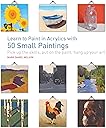

Learn to Paint in Acrylics with 50 Small Paintings: Pick up the skills * Put on the paint * Hang up your art [Nelson, Mark Daniel] on desertcart.com. *FREE* shipping on qualifying offers. Learn to Paint in Acrylics with 50 Small Paintings: Pick up the skills * Put on the paint * Hang up your art Review: Great introduction to acrylics - This book is great fun. I don't know how well it works if you've never picked up a paint brush before; I came in with some intermediate drawing experience, and 3 lessons in acrylics, so I wasn't starting completely from scratch. But this book has definitely help me build on my skills. The 50 lessons are designed to ease you in, each one focusing on a specific skill or style of painting. The early lessons are very simple, but simple does not mean you won't enjoy them or the art that is produced. To save on costs, I used a pad of watercolor paper, which an instructor recommended to me as a reasonable cheap option for acrylics. With each sheet I was able to cut out six 5"x5" squares, which is the recommended canvas size for these mini-paintings. The moisture does cause the paper to curl, but it flattens out as it dries. Much cheaper than getting 50 mini canvas boards, and if you want to display any of the pieces, the book tells you how to mount and hang them. The paintings range from the very simple, to the fairly complex. There's nothing truly breath-taking here, but that's kind of the point. This book is supposed to take the fear away of an enormous blank canvas. At the end, you should feel more confident and more ready to tackle larger projects one piece at a time. I can attest that it is a little challenging for beginners to work with very small canvases, since there's no hiding your mistakes. But because you do so many, the stakes feel low, and the ability to polish each one off in under half an hour leaves one with a real sense of accomplishment, and helps me find time to actually do them. Some have complained that there isn't enough detail in the instructions. So far I haven't found that to be the case. It may depend on your experience. But at least in the first dozen paintings, the instructions do cover the basics well. The idea is to build on your skills, so later lessons may not repeat the same details that were taught earlier. One small complaint is that there is a fairly large required paint list. This does require substantial investment. If you get one of those large beginner kits, you may sfind that you blow through some colors like Unbleached Titanium and Yellow Ochre quickly, while you rarely use some others. It would have been nice to get a list of "optional" colors with instructions on how to mix them from more common ones. It seems unnecessary to buy 5 shades of blue, when they can easily be mixed. Bottom line: if you're new at this, and you want to build confidence, acquire skills, and find a program that lets you do a little at a time, this is a great option. Review: Absolutely PERFECT for the beginner who's never painted! - I love the curriculum of this book. I am an absolute novice with zero knowledge about painting, brushes, techniques, mediums, etc. It starts out with very basic applications and as you progress through the course, you learn new aspects (such as mixing, layering, etc.) Every subsequent painting builds off of the previously learned techniques. As the paintings become more complex, you are introduced to the various styles that are out there. I've read the critical reviews and I feel the comments are unfair. I'll agree that there might be some paintings that could use some additional details (because it was either excluded or mis-written), but by the time you reach those, you should have already developed an understanding of what you are trying to accomplish and how to make corrections. I think this is good because it allows you to make embellishments according to your own taste. That being said, I have progress through 28 of the 50 paintings. I started out rushing through my own paintings and it showed. They looked as though a child had painted them. But by the time I was 8 paintings in, I really began to gain a real understanding and my renderings started to look much better. I started to take my time and more care in my brush strokes. I started to blend my paints much better and even deviated slightly because I wanted to use a different hue than what the author instructed. I also began to utilize more brushes than the one or two which he suggested. But I believe that's what Mark Daniel Nelson what expect from his students. I still have not stopped painting and I expect to finish all the paintings in another month. When I do finish, I will have learned enough about how the paint responds to the canvas and brush strokes, about mixing, about techniques, and even the rudiments of theory. After that, I expect to be able to have enough knowledge to paint some original images with confidence in my amateur ability. The book IS called "Learn to Paint in Acrylics..." and I feel it is perfect for the absolute beginner. Once you're done, then you should be primed to dive into more complex theory and practice. Ignore the poor reviews. I've bought several books on the subject and this is by far the best one if you're a beginner. If you're new and want to learn how to paint, this book is perfect!


| Best Sellers Rank | #56,976 in Books ( See Top 100 in Books ) #7 in Still Life Art #13 in Acrylic Painting #85 in Watercolor Painting |
| Customer Reviews | 4.6 4.6 out of 5 stars (1,039) |
| Dimensions | 8.5 x 0.5 x 10.95 inches |
| Edition | Illustrated |
| ISBN-10 | 1631590561 |
| ISBN-13 | 978-1631590566 |
| Item Weight | 1.2 pounds |
| Language | English |
| Part of series | 50 Small Paintings |
| Print length | 144 pages |
| Publication date | March 15, 2015 |
| Publisher | Quarry Books |
P**Y
Great introduction to acrylics
This book is great fun. I don't know how well it works if you've never picked up a paint brush before; I came in with some intermediate drawing experience, and 3 lessons in acrylics, so I wasn't starting completely from scratch. But this book has definitely help me build on my skills. The 50 lessons are designed to ease you in, each one focusing on a specific skill or style of painting. The early lessons are very simple, but simple does not mean you won't enjoy them or the art that is produced. To save on costs, I used a pad of watercolor paper, which an instructor recommended to me as a reasonable cheap option for acrylics. With each sheet I was able to cut out six 5"x5" squares, which is the recommended canvas size for these mini-paintings. The moisture does cause the paper to curl, but it flattens out as it dries. Much cheaper than getting 50 mini canvas boards, and if you want to display any of the pieces, the book tells you how to mount and hang them. The paintings range from the very simple, to the fairly complex. There's nothing truly breath-taking here, but that's kind of the point. This book is supposed to take the fear away of an enormous blank canvas. At the end, you should feel more confident and more ready to tackle larger projects one piece at a time. I can attest that it is a little challenging for beginners to work with very small canvases, since there's no hiding your mistakes. But because you do so many, the stakes feel low, and the ability to polish each one off in under half an hour leaves one with a real sense of accomplishment, and helps me find time to actually do them. Some have complained that there isn't enough detail in the instructions. So far I haven't found that to be the case. It may depend on your experience. But at least in the first dozen paintings, the instructions do cover the basics well. The idea is to build on your skills, so later lessons may not repeat the same details that were taught earlier. One small complaint is that there is a fairly large required paint list. This does require substantial investment. If you get one of those large beginner kits, you may sfind that you blow through some colors like Unbleached Titanium and Yellow Ochre quickly, while you rarely use some others. It would have been nice to get a list of "optional" colors with instructions on how to mix them from more common ones. It seems unnecessary to buy 5 shades of blue, when they can easily be mixed. Bottom line: if you're new at this, and you want to build confidence, acquire skills, and find a program that lets you do a little at a time, this is a great option.
A**R
Absolutely PERFECT for the beginner who's never painted!
I love the curriculum of this book. I am an absolute novice with zero knowledge about painting, brushes, techniques, mediums, etc. It starts out with very basic applications and as you progress through the course, you learn new aspects (such as mixing, layering, etc.) Every subsequent painting builds off of the previously learned techniques. As the paintings become more complex, you are introduced to the various styles that are out there. I've read the critical reviews and I feel the comments are unfair. I'll agree that there might be some paintings that could use some additional details (because it was either excluded or mis-written), but by the time you reach those, you should have already developed an understanding of what you are trying to accomplish and how to make corrections. I think this is good because it allows you to make embellishments according to your own taste. That being said, I have progress through 28 of the 50 paintings. I started out rushing through my own paintings and it showed. They looked as though a child had painted them. But by the time I was 8 paintings in, I really began to gain a real understanding and my renderings started to look much better. I started to take my time and more care in my brush strokes. I started to blend my paints much better and even deviated slightly because I wanted to use a different hue than what the author instructed. I also began to utilize more brushes than the one or two which he suggested. But I believe that's what Mark Daniel Nelson what expect from his students. I still have not stopped painting and I expect to finish all the paintings in another month. When I do finish, I will have learned enough about how the paint responds to the canvas and brush strokes, about mixing, about techniques, and even the rudiments of theory. After that, I expect to be able to have enough knowledge to paint some original images with confidence in my amateur ability. The book IS called "Learn to Paint in Acrylics..." and I feel it is perfect for the absolute beginner. Once you're done, then you should be primed to dive into more complex theory and practice. Ignore the poor reviews. I've bought several books on the subject and this is by far the best one if you're a beginner. If you're new and want to learn how to paint, this book is perfect!
B**A
Of all the books I have read on “beginning to paint with acrylics” this is by far and away my favourite one! It has really consolidated what I’ve learned previously, enjoyed the most working through and created the most paintings from! I have loved it from start to finish! BUT …if you’re a true beginner (no typo) then this is not the book for you (but do remember its existence!) What do I mean by true beginner? If the concepts of colour wheel, the word ‘value’, creating a wash etc are all new concepts to you, i.e. you’ve never put paint to canvas, then you are a true beginner and there are much better books out there for you to start your journey with. One could argue there are sections in this book discussing beginner concepts, such as the colour wheel, but they are more of an “exam note summary” type section and lack the detail and emphasis a true beginner requires. If you are, however, at a stage where you feel you are confident with mixing colours, what brushstrokes your paint brush can make etc but can’t seem to ‘put it all together in a coherent painting’ then this is the book to dive into next. It will tie everything together and you’ll create some great paintings in the process! As a beginner I did have some frustrations with the book though. In fact, when you read the next bit, you may end up wondering why I’ve given it 5 stars. To be clear, I only list the frustrations below as this book could have been neigh on perfect (in my humble opinion of course). Mark, like all art authors, is happy, at times, just stating “combine this paint with this paint” or “mix these three together” without really discussing in detail the quantities you should be using of each paint for the mix. Frustratingly, at other times, he does state the amounts for the mix. It would have been better if he had consistently told us the required amounts to mix at every stage in the book. [Note to any art author: this is the part us beginners struggle with the most! What is natural for you after years and years of painting is not natural for us and the more guidance here the better!] There is no list of materials regarding the brushes to buy if you want to complete all the paintings? These are the brushes you need by the way… #4 round used in 2 paintings #6 round used in 7 paintings #8 round used in 21 paintings #10 round used in 21 paintings #4 filbert used in 12 paintings #4 flat used in 6 paintings #8 long bristle Egbert used in 1 painting [If you have a set of brushes that covers these sizes, great! If not I would go for the getting a decent pair of #8 round and #10 round brushes – these will serve you in good stead for most of the paintings in this book.] The book could have done with a two page spread discussing the various brushstroke techniques he uses in the paintings. The internet will help you of course but I felt this book could have done with it as a quick reference for those not wanting to fiddle with their phone while painting. In some of the paintings, steps are missed out or are not even discussed. One example was the impressionist painting. I was looking forward to this the most but felt I could have done with a bit more guidance than was given. For example, when painting it, you are given no instructions about the sky. Yes, by now you are 20 odd paintings in and can start to work out what he wants from the picture but as it’s technically your first ‘learning to paint an impressionist painting’ he could have given a bit more help. Contrast this with the Wayne Thiebaudesque ‘piece of chocolate cake’ which he takes you through, step by step, to create a fantastic piece by the end (my 3 year old daughter, often mystified by what I’ve painted, took one look at it and asked if she could have the slice! I take no credit. Mark’s instruction helped me make this painting look so good, hence being so baffled why the impressionist painting is so vague with details in some areas?) Maybe in a reiteration of this book a very basic impressionist work could be done in chapter 2 and then chapter 3 could have the more advanced one that is presented? Finally, for the beginner who goes on to buy this book, I would just like to add my own two pence… Mark discusses the 3 types of pallet in the beginning and as a beginner you may feel you just need to get the basic one. From my experience, I started enjoying the book far more once I shelled out for all the paints in the advanced pallet. This led to getting to paint more often, rather than just getting frustrated with mixing paints in order to get a mix that was a starting point needed for another mix. What? Let me give an example…some of the paintings you mix purple and orange. Using the limited pallet you would have to create a separate mix for each (combine red and yellow to get orange; red and blue to get purple) and then you start your mix by mixing these together as per instruction. If your purple is not dark enough or your orange is too light, you are soon going to enter very frustrating territory for a beginner just wanting to get on and paint! I did, however, learn a lot more about the various mixes a limited pallet can produce before I bought all the paints in the advanced pallet; so there are advantages either way of course. The limited pallet comes with a much steeper learning curve I felt; too steep for me! I would purchase mixed media paper first and try the painting out on it. Beginners make mistakes. It’s why we’re beginners. I duffed at least half of these the first time! When you’re happy you understand what you’re trying to achieve with the painting then commit to putting it on canvas. The difference between my first and second attempts at some of these paintings made it look like I had gained years of experience in between attempts when really I had only slept on my mistakes for one night and tried it again one night later (it was lockdown after all so I had time on my hands!). Enjoy the book and I wish you many happy days and nights painting!
S**E
Commandé pour ses bonnes critiques, et pour une initiation à l'acrylique. Projets décevants et peu inspirants, avec dessins simplistes ou assez grossiers et grands coups de pinceau. Peut-être quatre sur cinquante qui donnent un peu envie. Livre retourné.
C**O
O autor propõe uma série de exercícios que vão do mais elementar até o mais complexo, ajudando nos primeiros passos dos iniciantes da difícil arte da tinta acrílica.
J**.
Gut simple Anleitungen für Malanfänger!
V**A
I bought it for my 12-year-old daughter. The tutorials are so easily written and so well illustrated in colour, that my girl will have no trouble creating her first beautiful paintings.
Trustpilot
2 months ago
3 days ago