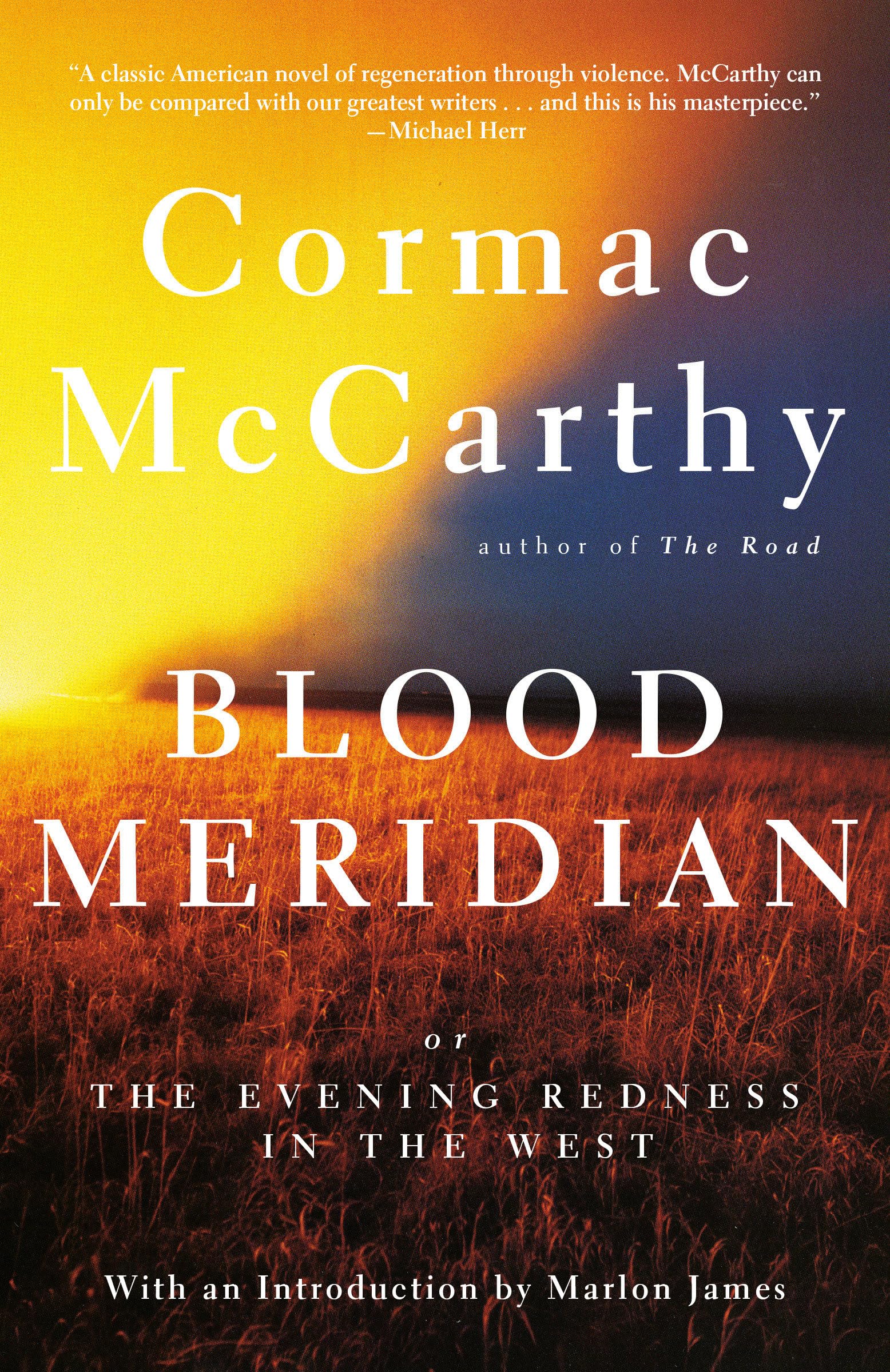
📚 Own the legend: Blood Meridian, where literary mastery meets raw, unfiltered history.
Blood Meridian: Or the Evening Redness in the West is the 56th printing of the May 1992 first international Vintage edition, presented as a pristine, unread trade softcover. This critically acclaimed novel by Cormac McCarthy is celebrated for its masterful prose, brutal depiction of 19th-century American West violence, and complex characters, ranking highly in Western and literary fiction categories. A challenging yet rewarding read, it’s a cornerstone for collectors and literary connoisseurs alike.


| Best Sellers Rank | #455 in Books ( See Top 100 in Books ) #2 in Westerns (Books) #50 in Literary Fiction (Books) #57 in American Literature (Books) |
| Customer Reviews | 4.4 out of 5 stars 19,719 Reviews |
C**S
Comparisons to Faulkner and Melville valid, but a laborious read
Let’s start with the most common complaint about this book. Yes, almost all the characters are violent, but that word doesn’t convey the sheer cruelty inflicted in this story. Certainly all the main characters are violent including the protaganist, “the kid”. The few minor characters who are not are generally brutalized. I quit reading for a few month less than halfway through. When I picked it back up I finished the last two hundred pages in a long day. I guess I was better prepared for the violence and the lack of morality in all the characters, but I also felt I was becoming densensitized during my second attempt. If you read the backcover or a critical summary you should be aware violence is at the core of Blood Meridian, it shouldn’t be a suprise. But the depth of it might. Now this is the type of read that for the average reader, like myself, can be laborious. I do not have the skill to be a book critic and struggled as an English major to understand the intracacies of some masterful writers, compared to my professors and some fellow students who quickly identified subtext and points of style. McCarthy is one of those writers, certainly Blood Meridian is one of those works. This novel is often compared to Moby Dick or Faulkner’s top writing, and the comparison is spot on for me. I struggled to understand the subtext of what is being said, re-reading McCarthy’s frequent long descriptive sentences which are amazing to behold. They can be longer than a typical paragraph but are smooth and flow perfectly. I could never pull that off, it would either be a disjointed run-on sentence or it would take me ten maybe twenty sentences to convey what McCarthy does in one. What is amazing is these are common throughout the book, every page is filled with them. I can only imagine how much work went into each page, this is clearly the result of many years of focused effort. Similarly, I hear complaints from others or see complaints in reveiws regarding McCarthy not using quotation marks to highlight dialogue. This is a hallmark of his work, and he is not the first nor last to choose such a style. I think too much is made of this by people who really just didn’t want to put in the effort to read the book. Which is fine, this is not a traditional Western in any way, its not a tradtional mindless entertaining story. That’s one reason I am just reading this at age fifty and I am a fan of McCarthy. I have had the book for ten years and just read it. I knew going in it was the type of book you need to prepare for. But I don’t believe most people who claimed they couldn’t tell when a character was speaking are being honest. More likely they are just annoyed as it takes more effort to follow who is speaking, to re-read to understand, and if you want to skip the long descriptive sections to jump to the next scene of dialogue it is hard to do without quotation marks. This is just not an issue. Is it a gimick by McCarthy and those who pull it off? Maybe, I don’t know what they have said about the style but I suspect its more about flow and keeping the text clean. The pages do look beautiful and that affects your mood when reading. Also, quotation marks and other punctuation does in fact effect the cadence of you reading. Regardless of all that, I don’t believe it will effect most readers and is a weak complaint. As I mentioned, there are many long descriptive sentences. Sometimes there are pages of this with minimal action occuring, but you tend not to notice unless you are really analyzing the style. Very vivid, I could visualize almost every scene, and appreciated McCarthy’s ability to be so descritpive while simultaneously leaving specifics of how we visualize up to us individually. I suspect how I see each character is different than everyone else, but we all enjoy vivid scenes. For this reason I hope they don’t make a film version of this. For one, I think it would be a failure, especially in today’s hypersensitive PC climate, and two, I just think it would be impossible and an antithesis to what McCarthy’s writing accomplished. I did struggle with the last twenty pages, because, as I’ve said this is not a book where the story is solely at the heart of things. Symbolism and style are equally as important. And the judge as a character is the most complex. The final encounter and how things were left was at first baffling to me, but after re-reading the last few pages I loved it. Won’t ruin things but there is of course room for interpretation. Sometimes I hate that, sometimes it works. For me at least, this time it worked. The epilogue was however completely unnecesary and a distraction. I get what its saying but its like hitting me over the head. I almost feel like ripping that page out it seems so out of place, like a teacher told him, now put this in so it will all be tied together and the stupid people will “get it”. I might be one of those stupid people and I just found it annoying. Overall, I enjoyed the novel once I came to accept the inclusion of so much violence, and am glad I set aside mental space to read it and time to chew on what it was saying. If you want to read a real western, stick with Zane Grey, Elmore Leonard, even Louis L’Amour if you want the heart of the genre. If you want a taste of the true history of the west in the mid 19th century, framed with an exploration on man’s capacity for violence and cruelty, pick up a copy of Blood Meridian. Just allow more time for the read and you’ll likely get more out of it.
D**9
A challenging and worthwhile read
Rarely, okay, never have I read a book which is so simultaneously abhorrent and appealing. Blood Meridian is a book that treats violence as a commonplace occurrence, and offers little respite in its continual assault on all (or anything, please anything) that is good in the world. The prose is stark, direct, and often undefinable (perhaps somewhere, but I often found words for which no definition can be found). The novel immerses you in a world of evil and violence far more terrifying than any post-apocalyptic book can create. And this, indeed, is how I came to this “masterwork” by Cormac McCarthy (bio). I’ve read a few of his novels, and consider “The Road” (blogged about here) one of my all time favorite novels. This novel centers around “the kid” in the 1850s as he travels from his home state of Tennessee and joins up with the Glanton Gang, a real-life group of killers (there are probably more appropriate terms, but I’m calling them what they are) led by John Joel Glanton. Hired by the Mexican government to fight off attacking Native Americans, they killed any Native American they could since they were paid by the scalp. Women, children, unarmed men — it makes no difference. Even non-Native Americans were not exempt for their depravity as all of humanity appears to be at their disposal. What makes McCarthy’s descriptions so unnerving is the calmness and detachment used in describing the killings. You can almost read through some of them before the horror of what is happening dawns on you. I’m reminded of Tim O’Brien’s writing about the My Lai massacre during the American war in Vietnam. In the Lake of the Woods is a novel about a politician later found to have been involved in the massacre. But the most disturbing part of the book is not the fiction, but a chapter of excerpts from the actual court-martial records. What you see is this same dispassionate account of brutal abuse and killing. As if the event itself is not horrific enough, the presenting of it as a normal occurrence makes it even worse. McCarthy’s prose is powerful. It can edge on the dramatic, and at times tips into the over-dramatic category, but its power is clear. "Under a gibbous moon horse and rider spanceled to their shadows on the snowblue ground and in each flare of lightning as the storm advanced those selfsame forms rearing with a terrible redundancy behind them like some third aspect of their presence hammered out black and wild upon the naked grounds. They rode on." The phrase, “they rode on,” is the perfect balance to that long, intricate preceding sentence. Language like his can be hard to follow in our quick read society, but a slow and thoughtful read pays off. Plus, he reminds you of the beauty of words (and perhaps I just tipped into the over-dramatic category). While “the kid” is the anti-hero of this anti-western, it is the Judge who stands out as the most memorable character. A large, hairless, white man, he is often naked and always calm. He appears to be waiting for others as they come to him, and his intellect puts him ahead of both enemies and his fellow travelers. He makes observations in his notebook in order to understand and thus control the world, and is given to long, fascinating discourses on a variety of topics. He is both God-like and devil-like, omniscient and monstrous, and terrifying in his outreach. Toward the end of the book “the kid” faces off with judge, the culmination of a relationship in which they dance around one another throughout the book. "The judge smiled. He spoke softly into the dim mud cubicle. You came forward, he said, to take part in a work. But you were a witness against yourself. You sat in judgement on your own deeds. You put your own allowances before the judgments of history and you broke with the body of which you were pledge a part and poisoned it in all its enterprise. Hear me, man. I spoke in the desert for you and you only and you turned a deaf ear to me. If war is not holy man is nothing but antic clay." It is as if “the kid” recognizes his role in evil, and by the recognition (for there is no repentance) he has broken the fabric of their community. He recognizes the judge as the one behind the evil, but he cannot separate himself. As the judge says, “What joins men together is not the sharing of bread but sharing of enemies.” Clearly, this is a disturbing novel. The fact that McCarthy bases this on historical occurrences does not allow us to write this off as some post-apocalyptic fantasy. Instead, we have to face the judge and his comments about our own culpability in human affairs. "You can find meanness in the least of creatures, but when God made man the devil was at his elbow".
J**N
Blood Meridian- The poetic violence
Blood Meridian by Cormac McCarthy is about violence, violence, and more violence. It revolves around The Kid, who runs away from home to commit violent acts across the southwest untied states/Mexico. He meets other violent hungry characters around the desert, who burns house, kills children, and throws puppies off a bridge. Based on this description, you can guess that this book is detached from feelings. No one in this book is really portrayed as good; Everyone tries to pick a fight with each other, and when they aren’t fighting, they take advantage of each other for their own benefit. The tone itself depicts these actions as no big deal, showing that the people in the story have no regard for the horrific acts they commit. There are a lot of great things in this book. The Kid himself is an interesting character to look at; While he commits horrific crimes for the fun of it, he also shows a little of bit of humanity in him when he shows loyalty to his comrades by not leaving them behind or killing them when ordered. The Judge is also another character of importance. His personality and actions are pretty mysterious, and there’s a lot of symbolism that you can find in character. While some may be turned away, I loved the abundance of violence that is presented in this book. McCarthy does not shy away from the harshness of killing, and the regeneration through violence you feel is not commonly found in other books, thus, making it stand out. He doesn’t use violence just for the sake of having violence, he depicts the violence as the bad side of humanity that just thrive for blood, making it the central theme of the book. I thought the other themes of the book worked great as well. Racism appears throughout the book, and it’s portrayed brilliantly: the people that constantly put down the minorities (African Americans, Indians, Mexicans) are portrayed as narrow-minded killers, while the minorities are shown as nice and helpful. It’s great commentary on how these kinds of people were back then, almost mocking them in a way. This book is not without flaws. As mentioned, everyone in the story is portrayed as bad people, so it’s hard to care about most of them when they get killed off. Besides the kid, no one in the story receives any kind of remarkable character development: they are all static to their personality. McCarthy’s writing style is hit and miss for me. The choice to not use quotes when characters are talking was hard to get used to; often, I would have to reread a page up to three times before realizing that the characters were interacting with each other. While most of the time he keeps his sentences short and straight to the point, there are times where the sentences are really long, up to a full page, and these could be a chore to get through. Also, without giving anything away, I was really underwhelmed by the ending. From a symbolic perspective, it does its job well, but reading it as appears in the story, it was anticlimactic, especially coming from this intense, action book. A good book’s ending should work in the context of story, as well as add a layer of symbolism to it, but the ending here only does half of that. Final analysis: This book is not going to be for everyone. The evil of humanity, with the countless killings and ruthless behavior, might drive people. Even the people who find no problem in excessive violence might take issue with the writing style and underwhelmed by the lack of character development. The way McCarthy displays how the story goes and the symbolic meanings of the character’s personality and choices is a must read for anyone who likes to read books at a deeper level. There’s a lot to analysis, and I will definitely re-read the book several times through different perspectives to get the most out of it. The problems I listed will get in the way, but the story still stands out as a unique outlook on human error.
C**S
A dark novel is a gift to mankind
This is an exceptional and disturbing work of fiction, my favorite kind. There were exceptional aspects to this work; the development of the character of Judge Holden, the vast journey and adventure into meaningless chaos, and the superb writing skills of McCarthy. First, the character of Judge Holden is a fascinating riddle. Judge Holden fiddles and dances nude. Is he Shiva, who dances on the skulls of mankind? Judge Holden appears to be a demi-god among lowly men, much like Hercules among the Argonauts (Harold Bloom's observation). He appears to be ageless and sleepless. When he speaks of war and mankind's tie to this blood ritual, he appears to be Ares, the Greek god of war. At other times he appears to be a dark avenging angel of God and at others the dark agent of the Devil. He is a dark anti-heroic character that speaks of mankind's need to fill the existential void of meaninglessness with a blood ritual, to flirt with the power of death, to bargain with death by sarifice of another victim. The Judge adopts a brain damaged idiot as his ape-like pet yet we feel that all ape-like mankind is the Judge's playground. There are few characters in literature that are as mysteriously and frighfully drawn as McCarthy develops the character of Judge Holden. He appears to be a human being but gradually as the story progresses he is revealed as something else, something very evil and yet something that exists in the hearts of men. Other characters are also well developed through their actions. Glanton, Brown, and Toadvine are born killers and they die by the sword. Jackson the Black is totally accepted into the group because he too is beyond remorse or compassion. There are two scenes where prejudicial statements are made about Jackson and the bigots are destroyed like bugs. Prejudice, bigotry, and sterotyping are more bound to social norms than is blood lust in this work and thus the murderers smash the bigot with the same glee that they would crush the country parson. Second, this is the classic journey novel, much like the Odessey or Jason and the Argonauts or Conrad's Heart of Darkness. A group of terrible killers work as scalp hunters, killing Indians of all tribes, genders, ages, and conditions in a blood-lust horror. Yet as they move from violent killing spree to horrid massacre, they dwindle in number and the protagonist, the Kid, reflects on the nature of this wild evil let loose on the world. The killing Glanton Gang is contrasted with village lowlife, very similar scum but with less imagination. Common villagers and settlers are no match for this senseless violence, primarily because they don't understand that it lacks both logic and compassion, therefore the plea for mercy is a joke, not a strategy for survival. As the Glanton's move to victimize village after village, tribe after tribe, I became very disturbed by the missing children (both boys and girls) in each settlement. Then it begins to dawn on you who is killing these children. Finally, Judge Holden becomes totally blatant about keeping a 12 year old Mexican girl as a sex slave with a dog collar around her neck and food scraps in her food bowl. Judge Blanton calls the Kid his son on several occassions, however the Kid has grown to know the evil he now faces and he knows that to be the Judge's son is to be his rape and murder victim. Third, this novel is beautifully written. The language ranges from poetic and archaic imagery to stark and economic descriptions of horror. The novel is full of words, rarely used in common language, that give the novel double meanings, mystery, and linkage to a mythological past. Whereas some critics link the novel to Melville and Faulkner, I found a common theme with Pat Barker's World War I Trilogy. This is especially true of the third book in the trilogy, The Ghost Road. In this novel the violence of World War I is seen as a blood ritual similar to the blood rituals of headhunters in New Guinea. Both Barker and McCarthy would seem to have us see war as blood ritual so that we can begin to understand the dark gods within ourselves whom we appease with sacrificial death. Dark novels are good teachers.
B**N
Great Book, But Hard to Follow
This isn't my first McCarthy novel, but it's the second one I just didn't want to finish. I endured though. If you like western novels and the signature McCarthy prose, then go for it.
B**S
A Disturbing and Powerful Masterpiece
A fellow author once described Cormac McCarthy as "a genius" who is "also probably somewhat insane." After reading Blood Meridian, I would amend that assessment somewhat, and say about McCarthy what Marlow said about Kurtz: "...his intelligence was perfectly clear. But his soul was mad." I think that same quote also applies to the novel's unforgettable antagonist, the Judge. Everything about the Judge gives me nightmares, from his giant, hairless form, to his egregious acts of cruelty, to his philosophical musings. The moments in which he is gentle and civilized are, ironically, the most disturbing of all. He's a character of Kurtzian proportions, with a dash of Iago thrown in, and maybe a little bit of the "sandman" described in that awful Metallica song. He's the embodiment of evil, and yet there is a certain lucidity and consistency in his thinking, assuming his view of the universe is correct. That's what makes him so downright terrifying. Besides giving the reader some interesting philosophical content to chew on, the novel is really rich in biblical allusion - something that will certainly intrigue the Christian reader. (That is, if he or she can get past the violence, which, in my view, is not as gratuitous as many people say - McCarthy does spare his readers a great deal of gruesome details and leaves many unspeakable things unsaid; often the horror is merely suggested, making it all the more horrifying). Much of the content in Blood Meridian is very much reminiscent of the imagery and rhetoric of Old Testament historical narratives. I'm not sure if McCarthy is making a direct allusion here, but a description of the Babylonians from the book of Habakkuk bears an uncanny resemblance to Glanton's group of warring scalphunters: "[They] march through the breadth of the earth, to seize dwellings not their own. They are dreaded and fearsome; their justice and dignity go forth from themselves. Their horses are swifter than leopards, more fierce than the evening wolves; their horsemen press proudly on. Their horsemen come from afar; they fly like an eagle swift to devour. They all come for violence, all their faces forward. They gather captives like sand. At kings they scoff, and at rulers they laugh. They laugh at every fortress, for they pile up earth and take it. Then they sweep by like the wind and go on, guilty men, whose own might is their god!" (1:5-11) Even the Judge's language sounds as though it were inspired by Old Testament descriptions like these. In one of the most memorable scenes involving the Judge, he says to his fellow scalphunters, "War is the ultimate game because war is at last a forcing of the unity of existence. War is god" (261). What will surely trouble the Christian reader even more, however, is the absence of any Habakkuk who will stand in the midst of violence and despair and say, "I will rejoice in the Lord; I will take joy in the God of my salvation. God, the Lord, is my strength; he makes my feet like the deer's; he makes me tread on my high places" (3:18-19). The closest we get to this in Blood Meridian is the expriest, Tobin. In fact, there is a highly symbolic scene toward the end of Blood Meridian in which the novel's protagonist, the kid, happens upon a group of dead people who had tried to take refuge around a fallen cross, onto which was tied a straw crucifix. The book is hardly subtle in communicating the idea that the universe is a cold and indifferent place, a place where "might makes right" and where the man who comes to terms with this is god. Like the Judge says, "The desert upon which so many have been broken is vast and calls for largeness of heart but it is also ultimately empty. It is hard, it is barren. Its very nature is stone" (344). Yet, while I disagree with these messages, there is a certain kind of intellectual respect that I have for this novel. The only thing more terrifying than reading this novel as a theist is reading it as an atheist. If the latter view is true, McCarthy hits on some terrible truths about human nature. Again, his intelligence is clear but his soul is mad. Blood Meridian is a deeply disturbing novel. In it, McCarthy plunges the depths of the human heart in all its potential and fully realized depravity. After just one reading, I feel unable to assimilate all my thoughts into a coherent response to what I've just read. I feel like some Jane Austen would serve me well now, as a palliative against all the scalphunting, gore and...worse. Yet, there's just a certain gravity and weight to this novel that makes it unforgettable, and truly a masterpiece.
B**Y
American Classic Dispelling Myths
I’ve wanted to read Blood Meridian for some time. However, after watching The Road at some point in my life, I was convinced that Cormac McCarthy was not for me. However, I’m glad I overcame my reluctance (especially since I went on to read a few other books from him). Where to start with this transcendent American novel. I think William S. Burroughs once said that America was not a new land, but it was old and evil. This is the kind of book that embodies that sentiment—a book that ruthlessly interrogates the mythologies of western expansion and the frontier, sharing some of the most violent practices that have rarely been accepted in the myth of westward expansion. I loved this book for so many reasons. It seems to look both forward and backward at the same time, signifying its many influences, but also being influential in itself. I loved that there were traces of other classics like Heart of Darkness and Moby Dick, yet I found myself thinking about Beloved when I read this, wondering if Toni Morrison had read this book while she was writing Beloved. Much of the violence and descriptions of blood and torture reminded me of certain scenes in Morrison’s classic. I could also see themes from other McCarthy works in this one—especially ideas about arrogance, violence, greed, and entitlement, as well as questioning the nature of evil. Furthermore, the book had this kind of magical quality, especially surrounding the judge. I found him to be such a complex and compelling character—not someone I liked necessarily, but just wondering how he gained so much authority and power, and how we wielded it. Blood Meridian is not an easy book to read, so I imagine that I will revisit it at some point. It’s also a book that I would have loved to have read in a class or in book club (although I think the book club would have to be the right one; it’s definitely not a book for everyone. After reading it, I hopped online to read about other interpretations, symbols, themes, meanings etc., and I think that having some kind of group discussion or a further format to explore the many different layers and techniques from this book would add to my understanding. I also liked that I read James Welch’s Fools Crow right before this since it acts as a kind of different perspective to the violence from Blood Meridian. Although both books deal with different incidents and groups of frontiersmen, they both looked at the expansion of America’s conquest, examining the consequences and implications, but for different people. Blood Meridian is such an important American novel (as is Fools Crow), challenging our assumptions and the history we’ve learned about manifest destiny and westward expansion.
S**S
Lord Gro as Exhibitionist?
This book employs an engaging writing style. The author conjures a romantic, phantasmogoric image of a lost, perhaps purely fantastic northern Mexico of a bygone era. He employs a hypnotic, skewed vocabulary that surprises and drags the reader along his frankly rather threadbare plotline and character development. For example, the author says "prairie wolf" instead of coyote, dishclout instead of dishrag, etc. There is a lot of Spanish, too much, in fact, for the nonspanish speaker. I myself read Spanish, so this was no impediment. McCarthy's talent is in presenting bizarre, gripping scenes that enthrall and surprise the reader. He presents sensory and technical details that ring true, yet inform. His literary influences are Clark Ashton Smith and E. R. Eddison, the fantasists. The substance of the book might me a mash up of The Wild Bunch and the Worm Ouroboros, but lacking the heart and wit of either. The characterization is also absent. The characters are presented as masks with no inner dialogue much like in Worm Ouroboros, which is written in a faux epic style like the Icelandic sagas. The party encounters a blond colored grizzly bear, echoing the scene where they encounter a manticore, which is taken from a scene in Nyall's saga where they fight a bear, so he brings it full circle. The author tries to create a fascinating character like Lord Gro with the Judge, but I thought this a pale mockery as well. Lord Gro, an all time favorite from Worm Ouroboros, is an avatar of Loki, and perhaps represents a figure such as Lord Rothchild. The Judge has the same symbolism, but fails to be convincing. Such a character is believable as the courtier of an emperor, but not as a common bounty hunter. He also fails of the deeper, wider meditation on the Gros. Lord Gro would just laugh and the Judge would run away. If he saw the Witch King, he would urinate on himself. The book is ridiculously violent and bloody, and of course I see why it has garned such rave reviews; it portrays white Europeans as genocidal maniacs. He really sees how to pander to the critics. How brave. Except here too, the artist fails to offer any chord of redemption as in Wild Bunch, where the characters are redeemed somewhat by their loyalty to one another. I never was able to understand why the Judge came after the Kid. Nor did I get the little epilogue. On the other hand, McCarthy appears to understand his sources in great depth. I've already mentioned the scene with the grizzly bear, but also the Judge would appear to represent satan to some degree. There are several indications. James Franco said this actually. As Lord Gro is an avatar of Loki, so also the Judge of Satan. Loki is the closest analog to the Christian devil in Norse mythology. So it seems McCarthy was riffing on this aspect of lord Gro as well. If so, fascinating how well he comprehends his sources! I am intrigued by the book, and will read more Mccarthy. I certainly like the style, but I wish the story telling could have been better. The book Dead Man's Walk by Larry McMurty is almost completely derived from this(actually, I saw the movie), but the characters are likeable in that. The whole book is suffused with the odd rituals of the Gros and the depiction of white Europeans as blood crazed maniacs. What a sick culture it has become! E. R. Eddison, restore us!
Trustpilot
3 weeks ago
3 days ago