
DOWNLOAD THE APP


Customer Services
Copyright © 2025 Desertcart Holdings Limited
DOWNLOAD THE APP
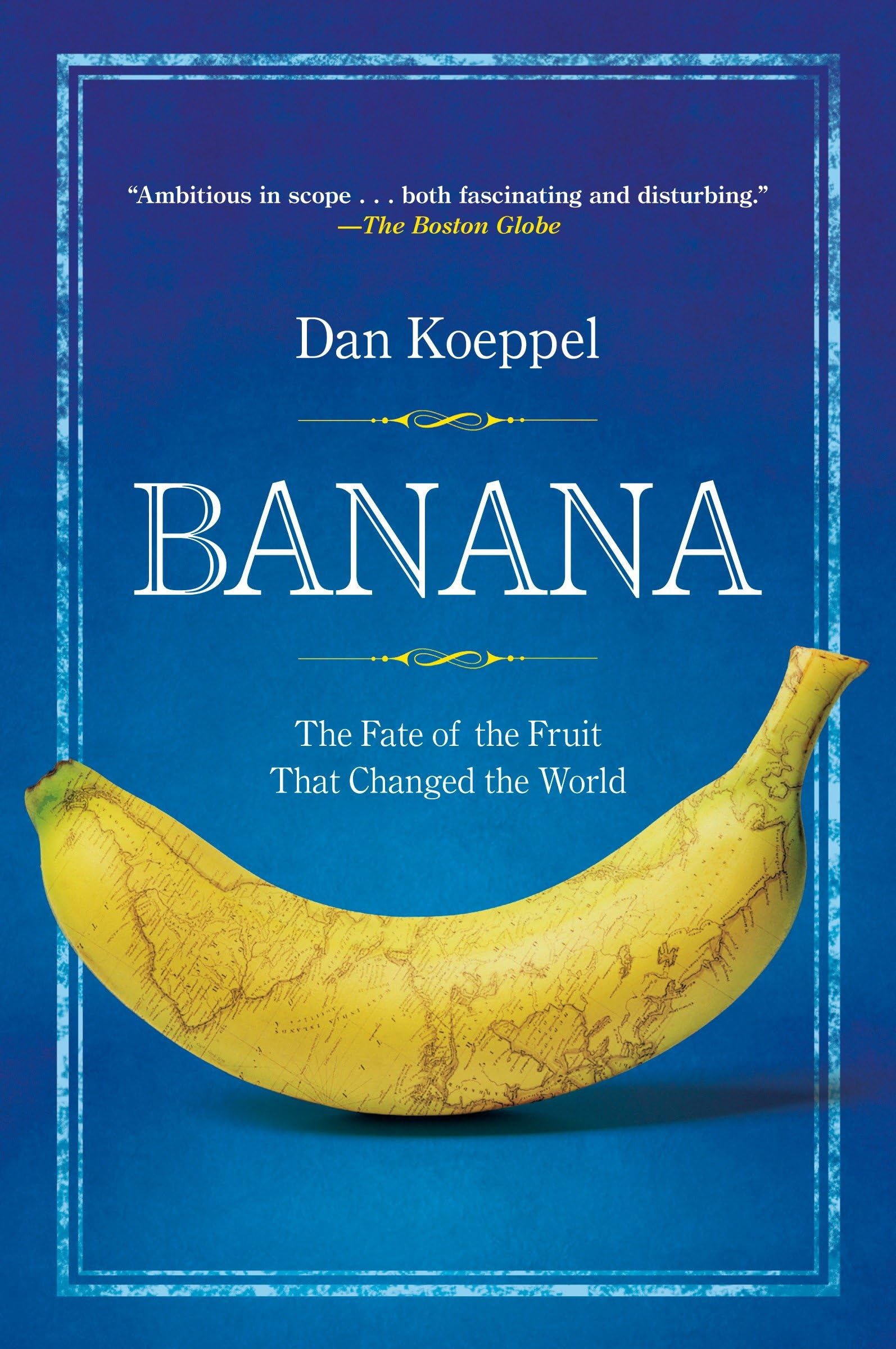
Banana: The Fate of the Fruit That Changed the World [Koeppel, Dan] on desertcart.com. *FREE* shipping on qualifying offers. Banana: The Fate of the Fruit That Changed the World Review: Informative read about banana republics and the past and future of an unusual fruit - Fascinating details on how banana diseases are a major global problem because all commercial bananas of the same variety are genetically identical and most growers aren't careful about spreading contamination. Explains how the Gros Michel was replaced by the modern Cavendish, the difficulties researchers have breeding replacements, and the properties of different varieties people might be interested in trying. If you've ever wondered about the phrase "banana republic", this book covers a lot of shocking history of violent U.S. intervention in Central America to advance the interests of American banana companies - now Chiquita and Dole. Chiquita and its puppet governments (previously United Fruit) were especially implicated in environmental destruction, massacres, coups, and sterilizing many workers as a byproduct of pesticide use. Good read and good research. Definitely makes me want to buy only organic bananas, at least until a better variety is invented. Sounds like we're going to need genetically-modified bananas that can resist disease without pesticides (which don't exist for all diseases). Review: Fascinating account of the banana business and one of the world's most popular fruits - The author does a fine job with this history of banana-business rivals United Fruit (now Chiquita) and Standard Fruit (now Dole). Interspersed with the details of corporate development are scientific details on the banana, the diseases that afflict it, the people that rely on it, the governments that are (or have been) ruled because of it and the issues it faces. Something I didn't know before I read this book: Bananas are not grown from seeds. Cuttings are taken from existing banana plants and nurtured into yet more banana plants from which cuttings will eventually be taken et cetera et cetera et cetera. The book would have benefited tremendously with the addition of more pictures and maps, plus a list of every known banana type and the odds of anyone getting his or her hands on one. Although the author mentions various banana varieties, he typically does not show you what they look like. Color plates of the top bananas (pun intended) along with their region of origin in the caption would have enabled a further grasp of how different some bananas really are from others. That creamy purple Tahitian one is something I'd like to check out. Sounds tasty. Wish I knew what it looked like. At the end of the book, there is a short timeline of the banana and the people, countries and companies involved with its business or scientific development. All in all, very interesting and informative. Left me wanting more. As another reviewer complained, by the end of the book, you're really not sure how much longer the currently consumed (yet endangered) supermarket banana (the Cavendish) has before extinction. Maybe no one really knows. Worth a look if you've ever been curious about the banana.
| ASIN | 0452290082 |
| Best Sellers Rank | #133,357 in Books ( See Top 100 in Books ) #4 in Crop Science (Books) #19 in Agriculture Industry (Books) #1,446 in Engineering (Books) |
| Customer Reviews | 4.4 4.4 out of 5 stars (468) |
| Dimensions | 5.21 x 0.71 x 7.93 inches |
| Edition | Reprint |
| ISBN-10 | 9780452290082 |
| ISBN-13 | 978-0452290082 |
| Item Weight | 8.8 ounces |
| Language | English |
| Print length | 304 pages |
| Publication date | December 30, 2008 |
| Publisher | Plume |
B**D
Informative read about banana republics and the past and future of an unusual fruit
Fascinating details on how banana diseases are a major global problem because all commercial bananas of the same variety are genetically identical and most growers aren't careful about spreading contamination. Explains how the Gros Michel was replaced by the modern Cavendish, the difficulties researchers have breeding replacements, and the properties of different varieties people might be interested in trying. If you've ever wondered about the phrase "banana republic", this book covers a lot of shocking history of violent U.S. intervention in Central America to advance the interests of American banana companies - now Chiquita and Dole. Chiquita and its puppet governments (previously United Fruit) were especially implicated in environmental destruction, massacres, coups, and sterilizing many workers as a byproduct of pesticide use. Good read and good research. Definitely makes me want to buy only organic bananas, at least until a better variety is invented. Sounds like we're going to need genetically-modified bananas that can resist disease without pesticides (which don't exist for all diseases).
F**Y
Fascinating account of the banana business and one of the world's most popular fruits
The author does a fine job with this history of banana-business rivals United Fruit (now Chiquita) and Standard Fruit (now Dole). Interspersed with the details of corporate development are scientific details on the banana, the diseases that afflict it, the people that rely on it, the governments that are (or have been) ruled because of it and the issues it faces. Something I didn't know before I read this book: Bananas are not grown from seeds. Cuttings are taken from existing banana plants and nurtured into yet more banana plants from which cuttings will eventually be taken et cetera et cetera et cetera. The book would have benefited tremendously with the addition of more pictures and maps, plus a list of every known banana type and the odds of anyone getting his or her hands on one. Although the author mentions various banana varieties, he typically does not show you what they look like. Color plates of the top bananas (pun intended) along with their region of origin in the caption would have enabled a further grasp of how different some bananas really are from others. That creamy purple Tahitian one is something I'd like to check out. Sounds tasty. Wish I knew what it looked like. At the end of the book, there is a short timeline of the banana and the people, countries and companies involved with its business or scientific development. All in all, very interesting and informative. Left me wanting more. As another reviewer complained, by the end of the book, you're really not sure how much longer the currently consumed (yet endangered) supermarket banana (the Cavendish) has before extinction. Maybe no one really knows. Worth a look if you've ever been curious about the banana.
I**U
A must read!
Fascinating!
C**N
Fascinating
Full of fascinating information. Easy read. Captivating.
C**R
Good, but not exactly a 'keeper'
I enjoyed this book for revealing the actual, factual story of 'Big Banana' in Central and South America. It was good to finally read an account of what ACTUALLY happened, as opposed to the generalized 'it was a very bad time' story that one hears from people who either lived through it themselves, or heard it from their parents. Or worse, other writers who have either downplayed the villainy of these companies, or exaggerated it to demonic proportions. The reality was ugly enough. Having visited and/or lived in some of the banana growing regions of the Western Hemisphere, I can tell you the damage is/was real, and continues to this day. The runoff from banana fields contaminates every body of water for miles around an active field. The writing in here was pretty good. Not great, but not bad. The style is a little breezy in spots, but thats to be expected in a 'popular' book of this subject matter. I really think a few more photos would have enhanced this book tremendously, as well as a slightly more scholarly tone in a few areas. However, I realize that this is personal preference, and does not detract from the quality of the book. It just got a bit 'chatty' for my taste. I would have given a 4 star, but the book lacks any detailed horticultural information (other than discussion of the use of pesticides), and that seems like an appropriate and needed addition to a book that tries to discuss a fruit that supports millions of lives. Politics, science and history are well discussed, but I really would have liked a little more about the impact of this fruit on lives of individuals who depend on it for daily sustenance. Horticultural info, a deeper discussion of varieties (including some more obscure cultivars), recipes, maps...something that would make this book less disposable. A good, quick read (2 nights), but not one that is going to have a permanent home on my bookshelf
T**Z
An uncommon tale of the most common fruit
This book does an amazing job telling the history and the challenges of the humble banana. Hint: it’s one of the most interesting fruit species out there, is not a tree, and it’s like grass on steroids. Every banana tree is a clone, and that makes it pretty vulnerable to blights.
A**R
Great story about the "taken for granted" banana and its history.
R**E
Eine unheimlich spannende und informative Reise in die Welt der Bananenindustrie. Kennen Sie "Gros Michel"? Nein? Das war die Bananensorte, die noch Mitte des 20. Jahrhunderts in Aller Munde war, bevor sie durch einen Schimmelpilz ("Panama Disease") vernichtet wurde. der "Dicke Michael" war geschmackvoller, robuster und größer als unsere heutige "Cavendish" - was heute auf unseren Teller kommt ist ein wahrer Rückschritt. Aber auch die Cavendish ist seit einigen Jahren wieder Bedroht - von einer Mutation des originalen Panama Disease Pilzes. Doch heute fehlt eine Ersatzsorte und die Banane, wie wir sie kennen, kann aussterben. Was klingt wie eine Utopie ist aber tatsächlich Realität. Dan Koeppel nimmt uns mit auf eine Reise durch die Zeit: Von der Geschichte der Banane, über den Stand der heutigen Bananenindustrie und die Auswirkungen von Monokulturen und Preiskämpfen, und gibt einen Ausblick in die Zukunft - mit oder ohne Banane. Ein interessanter Einblick in die Welt der modernen Lebensmittelindustrie, und viele - teils unglaubliche - Informationen über eine Frucht, die wir als selbstverständlich erachten. Ein Buch für alle, die Bananen lieben und mehr darüber wissen wollen, woher die gebogene gelbe Frucht eigentlich kommt.
F**E
a great read. great condition.
V**N
Perfect DNA of Banana
O**E
Koeppel covers just about all conceivable ground, but his concise political and historical summaries are rather more effective than his attempts to deal with the more scientific side of the story. These are diffuse if not obscurantist or irrelevant (e.g., a page-long description of a banana-devoid street outside a building that houses an institute devoted to study of the banana). Students of Central American history are likely to find the relevant sections of the book of interest.
Trustpilot
5 days ago
3 days ago