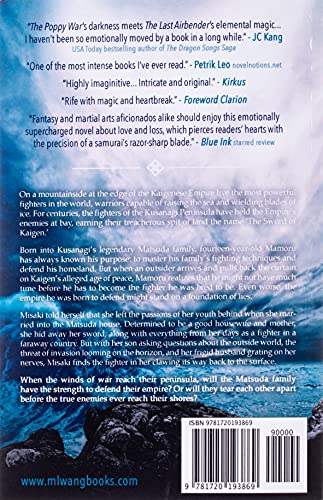

Immerse in a world of powerful warriors, family drama, and looming war. Follow the Matsuda family as they navigate their violent legacy and defend their empire. Review: Samurai and elemental magic fantasy epic! - An epic standalone self-published fantasy novel. Set on the richly imagined planet Duna, we're given just enough information to see the bigger picture while the majority of the novel takes place in one mountain village in the Kaigenese Empire. It's a war novel with incredible samurai action and intense fighting between elemental power wielding superhumans. A manga/anime/X-Men hybrid with Kaigen as an alternate Japan and the enemy nation of Ranga equating to China with their superior size and military might. Let me paint you a picture by drawing your attention to the cover. An image of my new favourite character Misaki, facing away from us. Inspired by the romantic painting by Caspar David Friedrich 'Wanderer above the Sea of Fog'. Emblematic of self-reflection and contemplation of life's path. At it's heart this novel is about Misaki's journey through life and it will make you feel every emotion. The 'Sea of Fog' becomes a literal sea as Misaki looks out from the peninsula, dressed in traditional warrior garb. A nationalistic outfit. Misaki as a symbol of the pride and strength of the Kaigenese Empire. It is sublime. The beauty of the landscape. The total confidence in Misaki's pose, powerful Theonite, a Jijaka, wielding power over water, control of ice, and blood magic. The writing too is sublime. The characters live and breathe in our minds. We experience their loves, losses, the horrors and consequences of war, the dangers of nationalistic propaganda, the growth of a family and the changing dynamics within a marriage. The journey is over. There will always be a place in my heart for Misaki, Mamoru, Takeru, Setsuko, Robin, Kwang and all the others in this martial arts fantasy. Just incredible. ✨✨✨✨✨5 stars Review: Great Japanese-inspired fantasy - My rating: 4.5 of 5 stars I’ve got to admit, when I first sat down to read this book, I wasn’t really sure what to expect. It had been sitting in my to-read pile for a few years, and I knew from reading a few reviews and the blurbs of the other Theonite books (now discontinued) that it wasn’t just another Japanese-inspired fantasy, but beyond that I hadn’t allowed any real expectations to develop. In effect, I went in blind, and I am so glad I did. The core story revolves around the Matsuda family, a warrior house famed for their control of water and for their legendary Whispering Blade technique that allows them to form swords made of ice that are said to be stronger and sharper than any other known weapon. For the most part the narrative focuses on Misaki, wife to the second son of the family, and her oldest son Mamoru, as they try to come to terms with the world changing around them and adapt to the growing storm of war approaching their otherwise quiet little peninsula. However, there is also a secondary storyline that explores the wider setting of the Kaigenese Empire, and its relationship with its closest neighbours. Stylistically, the book seems to have been influenced by a mix of manga and anime, with a dash of Eastern (particularly Japanese) heroic fantasy thrown in for good measure, and for me this is a good thing. The action sequences are well-written, easy enough to follow, and capture the essence of those influences really well. But there’s also some remarkably well-paced plot growth and character development that gently pulls the reader forward, building in intensity through to the mid-point of the novel, and the first of two crescendos in the story. Without giving away any spoilers, the second half of the novel shows us how the characters deal with the aftermath of certain cataclysmic events, and here we see the true strength of Wang’s writing as those characters are irrevocably changed by what has gone before. And it really is the characters that make this book so captivating. As well as the beautifully written and realised characters, there’s also a lot of gorgeous world building going on here. The principle locale of the Kusanagi Peninsula is described so well that it’s easy to picture it in your mind as you read. Add to that the imaginative and well-thought-out magic systems presented throughout, and you soon feel like what you’re reading is just a small part of a much bigger whole. All-in-all, I absolutely adored this book and will almost certainly have a look at other works by the author. The series that this one was spun out of has been discontinued in the last few years, but she has a few other books out there that look interesting. If you’ve read and enjoyed Ron J Hayes’ Mortal Techniques books, or just like Japanese-inspired fantasy in general, definitely give this one a try. I don’t think you’ll be disappointed.
| Best Sellers Rank | 1,846 in Books ( See Top 100 in Books ) 3 in Asian 14 in Military Fantasy (Books) 157 in Epic Fantasy (Books) |
| Customer reviews | 4.6 4.6 out of 5 stars (17,139) |
| Dimensions | 13.34 x 4.14 x 20.32 cm |
| ISBN-10 | 172019386X |
| ISBN-13 | 978-1720193869 |
| Item weight | 730 g |
| Language | English |
| Print length | 649 pages |
| Publication date | 13 Feb. 2019 |
| Publisher | Independently published |
G**N
Samurai and elemental magic fantasy epic!
An epic standalone self-published fantasy novel. Set on the richly imagined planet Duna, we're given just enough information to see the bigger picture while the majority of the novel takes place in one mountain village in the Kaigenese Empire. It's a war novel with incredible samurai action and intense fighting between elemental power wielding superhumans. A manga/anime/X-Men hybrid with Kaigen as an alternate Japan and the enemy nation of Ranga equating to China with their superior size and military might. Let me paint you a picture by drawing your attention to the cover. An image of my new favourite character Misaki, facing away from us. Inspired by the romantic painting by Caspar David Friedrich 'Wanderer above the Sea of Fog'. Emblematic of self-reflection and contemplation of life's path. At it's heart this novel is about Misaki's journey through life and it will make you feel every emotion. The 'Sea of Fog' becomes a literal sea as Misaki looks out from the peninsula, dressed in traditional warrior garb. A nationalistic outfit. Misaki as a symbol of the pride and strength of the Kaigenese Empire. It is sublime. The beauty of the landscape. The total confidence in Misaki's pose, powerful Theonite, a Jijaka, wielding power over water, control of ice, and blood magic. The writing too is sublime. The characters live and breathe in our minds. We experience their loves, losses, the horrors and consequences of war, the dangers of nationalistic propaganda, the growth of a family and the changing dynamics within a marriage. The journey is over. There will always be a place in my heart for Misaki, Mamoru, Takeru, Setsuko, Robin, Kwang and all the others in this martial arts fantasy. Just incredible. ✨✨✨✨✨5 stars
S**T
Great Japanese-inspired fantasy
My rating: 4.5 of 5 stars I’ve got to admit, when I first sat down to read this book, I wasn’t really sure what to expect. It had been sitting in my to-read pile for a few years, and I knew from reading a few reviews and the blurbs of the other Theonite books (now discontinued) that it wasn’t just another Japanese-inspired fantasy, but beyond that I hadn’t allowed any real expectations to develop. In effect, I went in blind, and I am so glad I did. The core story revolves around the Matsuda family, a warrior house famed for their control of water and for their legendary Whispering Blade technique that allows them to form swords made of ice that are said to be stronger and sharper than any other known weapon. For the most part the narrative focuses on Misaki, wife to the second son of the family, and her oldest son Mamoru, as they try to come to terms with the world changing around them and adapt to the growing storm of war approaching their otherwise quiet little peninsula. However, there is also a secondary storyline that explores the wider setting of the Kaigenese Empire, and its relationship with its closest neighbours. Stylistically, the book seems to have been influenced by a mix of manga and anime, with a dash of Eastern (particularly Japanese) heroic fantasy thrown in for good measure, and for me this is a good thing. The action sequences are well-written, easy enough to follow, and capture the essence of those influences really well. But there’s also some remarkably well-paced plot growth and character development that gently pulls the reader forward, building in intensity through to the mid-point of the novel, and the first of two crescendos in the story. Without giving away any spoilers, the second half of the novel shows us how the characters deal with the aftermath of certain cataclysmic events, and here we see the true strength of Wang’s writing as those characters are irrevocably changed by what has gone before. And it really is the characters that make this book so captivating. As well as the beautifully written and realised characters, there’s also a lot of gorgeous world building going on here. The principle locale of the Kusanagi Peninsula is described so well that it’s easy to picture it in your mind as you read. Add to that the imaginative and well-thought-out magic systems presented throughout, and you soon feel like what you’re reading is just a small part of a much bigger whole. All-in-all, I absolutely adored this book and will almost certainly have a look at other works by the author. The series that this one was spun out of has been discontinued in the last few years, but she has a few other books out there that look interesting. If you’ve read and enjoyed Ron J Hayes’ Mortal Techniques books, or just like Japanese-inspired fantasy in general, definitely give this one a try. I don’t think you’ll be disappointed.
M**O
On the Physical Book: Sturdy and easy to handle. The paper selection could have opted for a paper quality that would allow a more flexible spine. The cover treatment is average, as the outer plastic film shows signs of peeling after a few days at the beach (under shade, no sun exposure). On the Story: The Sword of Kaigen (@mlwangauthor ) is a gut wrenching epic with an amazing set of character arcs with really cool development that show depth and uniqueness . The world building is detailed and immersive with good socio-political nuances. The magic system is well developed and easy to grasp and complements well a martial arts background. The Sword of Kaigen is sadly only 600+ pages and seems to be a standalone. My wish is that the author may eventually bless us with more incursions into Duna and the Matsudas.
L**S
Es un increíble libro lo que más me gusta usa frases del japonés para referirse a cosas comunes para que tu vayas como aprendiendo y es muy listo me encanta el sistema muy bueno
L**N
The Sword of Kaigen is a deeply moving standalone fantasy. The slow beginning worked perfectly for me, building up the family and setting so that when tragedy struck, it hit incredibly hard. The battle scenes are cinematic, but what truly stands out is the subtle emotional writing — a single quiet line of grief often carried more weight than pages of description. Where the book lost me was in the final act. After such an unforgettable middle, the story seemed to lose focus. The Robin subplot felt forced, and several loose ends felt bolted on, as if the author was preparing for sequels that never came. The wider political threads also faded away, leaving an ending that didn’t provide the closure I had hoped for. Still, this remains one of the most emotional and impactful fantasies I’ve read in a while, and I’d strongly recommend it to anyone looking for a standalone with real depth.
A**.
It has been a very long time since a book floored me like this. And of those books that have affected me, I don't think any other book has ever resonated this much with me on a personal level. In full disclosure, this may be due to my timing of reading this book while going through my own personal issues. But then again, this book still made me question the power of the universe by coming into my life at this particular time. A little over two years ago, I challenged myself to start reading more and mainly what I wanted to read were sci-fi and fantasy novels. At the start of researching the books I wanted to read; The Sword of Kaigen was always at the very top of everyone's lists. Despite its (very well deserved) high praise, I held off reading it for a very long time. I don't know why. I was either not ready to read to something so "heavy," or I doubted that the book could live up to expectations. I was wrong on both counts. The Sword of Kaigen is an incredible human story wrapped in a fantasy adventure. The story mainly follows one family's struggle to protect its village from outside forces and the changing of the times. What makes this book so special are the family dynamics and how they're presented and developed over the course of the book. While the world-building and action are on par with any other great fantasy adventure, the character work and development are uniquely masterful in this book. The author's delicate exploration of the meaning of family, grief, identity, emotional growth, and resilience in the face of devastating hopelessness, places this novel among literary greats, and takes it well beyond its categorizing as a "standalone epic fantasy adventure." There isn't much more I can say about this book because I don't have the ability to articulate my feelings into words on the level this book deserves. All I can say is that, if you've ever loved someone in any capacity, then you should read this book. My final point is simply a personal and selfish lament that the author chose to discontinue this series (for now). As a fan of the book, I would love nothing more than to continue following some of these characters in future stories. But I understand and respect the author's decision. As an ardent fan of this particular book, I very much appreciate that experiencing its greatness is now increased by that fact that it is a standalone, one-off, great novel. There are no sequels to Blood Meridian or Of Mice and Men, and I am OK with that too.
J**R
Sometimes when I am about half-way through a book and I am reading something as powerful and impressive as this was, I have a fairly good idea what my review is going to be about. And at that half-way point, I did think I was going to write about the world building, and characterizations, magic and everything else that I found to be notable about this story. But, then I read the last half, and I can say that since reading Stephen King’s Wizard and Glass a few years back- I haven’t been so affected by a story as I was this one, or so emotionally invested in characters as these, that I cried through a good twenty percent of this book. See, I was expecting a regular epic-style fantasy, and when we had that amazing battle midway through, all I could think was holy crap, how is the author going to top this? And where can this possibly go from here with so many pages left? What I didn’t realize was, that the incredibly intense first half the book, was only part of the story and not even the best part. So, this stand-alone book works to set-up a little history of a country, and way of life of a people for a later series. While the front-half gives us this incredible world, people, and epic scale battle, the back-half deals with the aftermath, and is about a community finding strength to survive events that are just too horrifying to even imagine- surviving loss of everything from your loved ones to your home and livelihood. It’s about rebuilding and finding hope in each other, and coming together as people. But, at the core of all of that- was Misaki, and even though it was filled with a community of people that were just as full of life as her, this was really her story. Misaki was the heart of this book. She is a mother and wife, coming to terms with a life that maybe didn’t quite go the way she expected. Her story is about healing, regrets, grief, and feeling like you have no voice but also being scared to have one. And just as importantly, it’s about being responsible for your own happiness. Misaki’s journey is raw and painful but it’s also fulfilling and beautiful. As a mother, daughter and wife- her every fear, joy, and regret, resonated with me, and I applaud her characterisation. Without her this would have been a great book with some very cool fight scenes (I’m still in awe over the Matusda brother’s Ice Dragon) and a good solid base for a later series. With her though- it became an outstanding piece of storytelling that needs to be experienced, and one that is going to stick with me for a long time. Other Notes and small criticisms - Even with the huge amount of subtitled stuff I watch, which most of it is tv and film (where they sometimes tend to drop/change this sort of thing in favor of digestibility) and not print, it took me a while to keep the honorifics straight in my head. Particularly when there were a lot of different characters addressing one character. Misaki for instance, who is an elder, mother, and/or respected member of the community, has a different honor appropriate for each title depending on who is addressing her. There was a handy dandy glossary at the back of the book, which I did use once at the beginning, but kindle makes these things not the funnest things to flip back and forth between, so I rarely end up using them once I get going, and just rely on my bad memory for the rest of the book. Making this quibble more my problem than the authors’. Hey, I had to think of something to criticize. -The ending while I did like it giving Misaki a little closure, and setting up stuff for later books, I also felt it could have been trimmed a lot. At that point, I was happy with her present and didn’t want her past to interfere with the contentment she was beginning to find. c/p from my goodreads
Trustpilot
1 month ago
2 weeks ago