Some deliveries may take a little longer than usual due to regional shipping conditions.

DOWNLOAD THE APP


Customer Services
Copyright © 2025 Desertcart Holdings Limited
DOWNLOAD THE APP
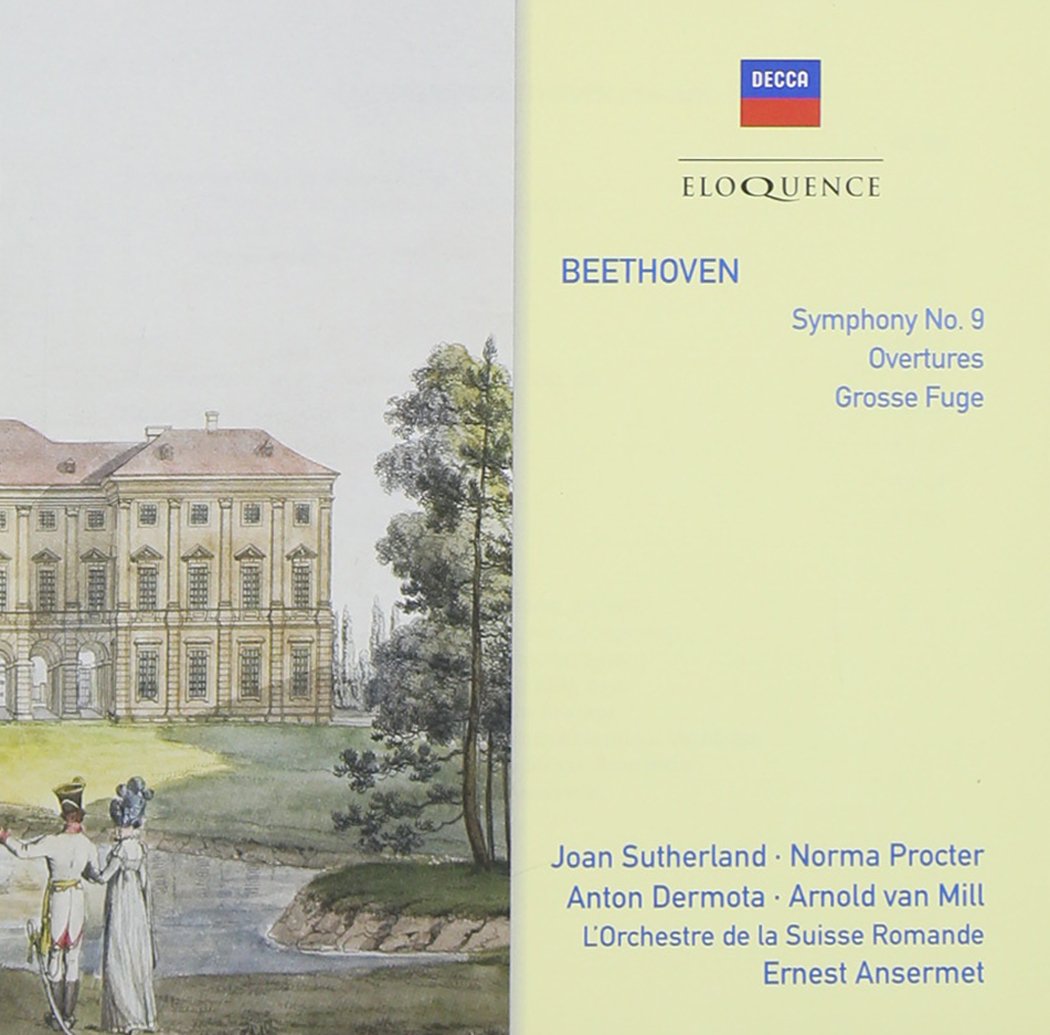
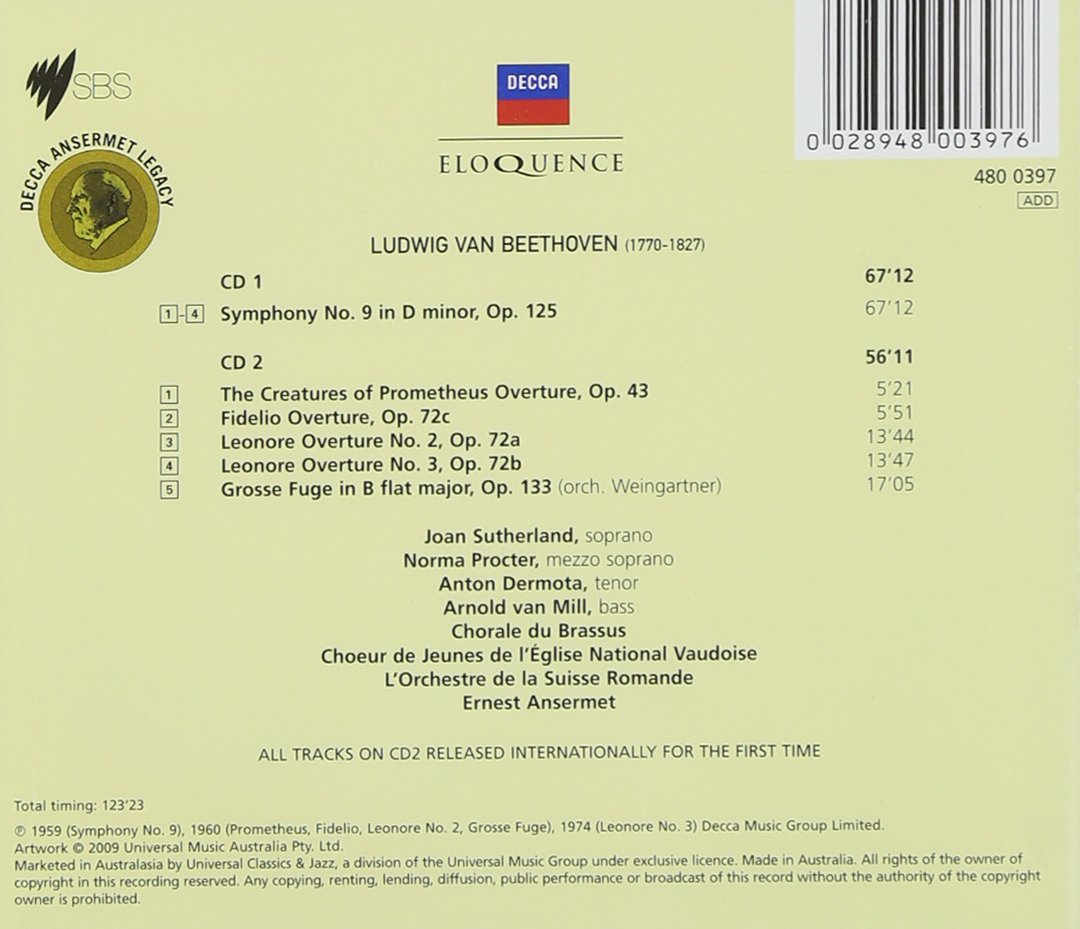
Beethoven’s crowning symphony features stirring choral finale “Ode to Joy,” matched with intense, dynamic overtures in this vivid orchestral recording.
C**N
Eloquence Is The Right Word.
Once upon a time there was a young college student who was just beginning to discover the joys of classical music. One of his earliest purchases was a complete set of the 9 Beethoven symphonies featuring the Geneva ensemble L'Orchestre de la Suisse Romande led by the Swiss conductor Ernest Ansermet (1883-1969). Being of Swiss ancestry himself and not knowing that much about classical music at the time, the Swiss factor was instrumental in his purchasing the set. That and the fact that the set was part of London (Decca) Records' Stereo Treasury Series which made it quite affordable. Later a musician friend of his said that the set wasn't "Germanic" enough and suggested that the student should purchase the Bruno Walter box set on Columbia Odyssey which was also quite affordable. Having done this the student (who couldn't read a note of music) learned about differences in interpretation regarding the same pieces of classical music. Many years and several interpretations later, the no longer student always came back to the Ansermet set . It's slightly reduced forces and clarity of texture made it his favorite. Then tragedy struck! In the midst of a life upheaval, the set was boxed up with several other albums which were then stored in a less than ideal space which was full of moisture. Mold, mildew, and general sogginess had ruined all the LPs. Some of these albums were never replaced on CD and that included the Ansermet set.Flash forward 30 years. The former student had become a classical music announcer for his local public radio station. He remarried, raised a family, played lots and lots of classical music on the air but not the Ansermet recordings of the Beethoven symphonies which were not readily available in the U.S. Other Ansermet recordings of his French & Russian repetoire were available on less than ideal sounding budget CDs but no Beethoven. Finally, earlier this year thanks to Amazon, he discovered that the Ansermet recordings had been remastered and were being reissued by the Australian branch of Decca Records as part of their Eloquence series of CDs. Included in that catalogue were the Beethoven & Brahms symphonies as well as the first stereo release of the complete NUTCRACKER. Eloquence indeed! Imagine the former student / radio announcer / family man's delight that he would finally be able to hear these recordings again and in high quality, remastered sound....I know this story to be true because the central figure in that story is me. Out of the set I chose Beethoven's 9th to review because of how forward looking it turned out to be. There was no period instrument or authentic performance practice back in Ansermet's day but his lean, no-nonsense approach combined with the clarity of the singers in the choral finale make it sound like a recording made 20 years later. There's also the undeniable nostalgia factor. We always remember our firsts whether they are good or bad and when they are good, as in this case, then it is cause for celebration.
J**Y
Beethoven Symphony 9 in D minor plus overtures
This is the concluding volume my survey of Ansermet's 3-volume comprehensive survey of Beethoven's Symphonies and Overtures. Like the others, which I suggest you read, it is as a whole very good, though not phenomenal. In particular it does not rise above the general level of informed quality observable in the first two volumes. If you read my reviews of these earlier volumes, you will find performances of generally high quality of structure and realization. In the case of Symphony 5, an astoundingly fine reading is realized, one that raises the level of Volume II to the heights of unqualified 5-star excellence. This one is very well played and recorded, brisk but not too fast, generally well performed. You will derive much pleasure and no unpleasant surprises from it. Symphony 9 goes well, with excellent work from the singing cast and chorus. It is a very good performance, but doesn't quite realize the level of thrill conveyed by Weingartner and the Vienna Philharmonic nor Karl Böhm and the excellent Frankfurt Radio Orchestra on Brilliant Classics. Unfortunately, both these rivals are mono, though otherwise well realized. In my book, spacious mono trumps routine stereo every time, but if you insist on stereo, you would have to go far to obtain a better performance than Ansermet's, particularly inasmuch as it is accompanied by uniformly fine performances of the overtures Prometheus, Fidelio, Leonore 2 and 3, plus the Grosse Fuge Op. 133. There are performances of these individual works that occasionally excel these, but as a whole they are more than satisfactory. You could do well to visit Amazon's online store to explore this territoty.
B**S
Pure Joy
I was THRILLED to finally find this version of Beethoven's 9th available in CD format. I purchased my original LP back in 1978 and lost it in a house fire many years ago. I have been looking for it for a very long time. And listening to it now, 35 years later--well let's just say I was not disappointed!!!!To me, this is the quintessential 9th, bursting with life and passion. The finale 4th movement (chorale) in this recording is nothing short of spectacular. The chorus and all four soloists give outstanding performances: bass Arnold van Mill, tenor Anton Dermota, alto Norma Procter. Dame Joan Sutherland soars magnificently on the soprano parts of the quartet.What is truly amazing to me is the fact that this version was originally recorded in 1959 (!!). While the strings might seem a bit thin in places to some, the basses and woodwinds really shine in this recording. Ansermet's crisp, up-tempo interpretation of the score is one of the best ever, in my estimation, and not to be missed.Pure Joy!
K**N
Finally Found It
My mother purchased this recording of the 9th in 1961 when I was 14 and perhaps one can get caught up in that "I love the first recording I ever heard" syndrome and I've been looking for it ever since I got a computer. This recording of the 9th is as smooth, as well as intense, as one can ask for. For me, most endings seem to race too fast whereas Ansermet keeps pace with the music leading right up to that point. Not being a musicologist, I can't comment on structure or performance; I only know what my heart tells me and it says, 5 stars!The overtures on CD #2 are first rate.
A**R
... finally I've got it and listening everyday now with great satisfaction.
I've been looking this album for years without success and finally I've got it and listening everyday now with great satisfaction....
M**C
« La musique de Beethoven est l'être de l'homme en présence de la vie, en présence de la nature, en présence de Dieu...
...et, pour la première fois, en présence des autres (IX° Symphonie) ».Face à tant d'autres interprétations qui briguent la transcendance, l'expression du génie surhumain, ces lignes qu'écrivit Ansermet nous autorisent-elles à percevoir cet enregistrement d'avril 1959 sous le plafond de l'immanence ? -vision à hauteur d'homme.Tout au moins d'y admirer son art du façonnage instrumental épousant si perspicacement, si intelligemment, si consubstantiellement le développement intrinsèque du discours musical. S'appropriant le chaos du Allegro ma non troppo comme celui qui génère un univers à son image, modelant des paysages endogènes qui surgissent dans l'exaltation (la transe des violoncelles à 8'54- un effet inouï !) Deux ex machina plutôt que démiurge ?Le maestro helvète ne se soumettait pas docilement à la partition, notamment en matière rythmique, rappelant que la musique ne vit pas dans l'abstraite métrique mais dans la perception subjective de la cadence existentielle : fondamentale distinction entre temps externe/interne, temps mécanique/vivant, temps mesuré/senti. Cette quête de la temporalité organique l'amenait à douter de la noire à 60 indiquée par le compositeur pour l'Adagio molto : l'exécutant doit plutôt « retrouver la condition où était Beethoven quand il concevait son oeuvre, non celle qui était sienne quand, l'ayant faite, il reprenait à froid son texte pour en fixer le temps au métronome ».Cette recherche du sens, cette maîtrise du flux amène par exemple sa baguette à faire saillir les pizzicati de contrebasses (3'08-) pour donner un pouls référentiel à la mélodie des violons qui s'affirme ici dans une conscience vécue de la durée.L'oreille sera par ailleurs sensible à la franche vitalité de cette lecture enthousiaste de l'opus 125. Le Scherzo s'anime farouchement, sous une force de persuasion sans velléité d'arbitrage.L'orchestre suisse se montre en épatante santé. Valorisant aussi le caractère de ses pupitres de bois, garants d'une fraîcheur bienvenue (comme quand ils contrepointent délicieusement le chant d'Arnold van Mill dans le Finale (« Freude, schöner Götterfunken, Tochter aus Elysium »).Rectifions l'orthographe des protagonistes, écornée dans le livret du CD : Jeunes de l'Eglise national vaudoise (et non « de Vandoise »). Et rappelons qu'ils sont dirigés par André Charlet, dont les ensembles choraux collaboraient avec Ansermet depuis l'avant-guerre.Précisons aussi que cet enregistrement voyait apparaître la soprano Joan Sutherland pour la première fois sous label Decca.Au cours de sa carrière discographique, Ansermet grava la quasi-totalité des Ouvertures de Beethoven (sauf les "Ruines d'Athènes", "La Consécration de la maison" et "Leonore I") incluant les "Leonore II" (janvier 1960) et "Leonore III" (mai 1958), cette dernière le montrant ici moins maître de ses pupitres : le crescendo s'enfle bien baveusement à 4'02-.Il estimait "Fidelio" (« le plus bel opéra que je connaisse ») au point de le choisir quand le Grand Théâtre de Genève lui offrit de représenter l'oeuvre de son choix en l'honneur de ses quatre-vingts ans en 1963.Face aux micros, il en dirige ici l'Ouverture avec une ardeur et une virtuosité spectaculaires. Et quel brio pour "Les Créatures de Prométhée" !Enregistrer la "Grande Fugue" (arrangée par Felix Weingartner à partir du Quatuor n°13) : un exemple de l'insatiable curiosité du chef barbu et de son éclectique répertoire...
L**E
ANSERMET, chantre de Beethoven
L'orchestre de la Suisse Romande est fondé par Ernest ANSERMET, musicien et mathématicien, en 1918...et qui le dirige jusqu'en 1967, soit pendant 50 ans! Cet orchestre de renommée internationale est basée à Genève. ANSERMET a enregistré une intégrale des symphonies de BEETHOVEN et des ouvertures à l'époque bénie du début de la stéréo captée par DECCA, c'est dire le grand intérêt acoustique et musical de ce très grand chef. Cette intégrale se compose de trois double CD : les 1 à 4, les 5 à 8 et la 9e avec les ouvertures et la grande fugue. A un prix aussi modique, il faut se précipiter sans complexe, joie assurée. De 1950 à 1967, dans un son de grande fidélité, une vaste discographie illustre l'art exceptionnelle de ce chef qui a crée de très nombreuses partitions du XXe siècle. ANSERMET, également pionnier de la musique du XXe siècle... à découvrir absolument.
B**E
Grande interprétation
Grande interprétation. Le très beau son de l'orchestre de la Suisse Romande avec son chef Ernest Ansermet. A noter la qualité de l'enregistrement et leur restauration, du beau travail du label "Eloquence"
M**T
Magnifique
On peut ne pas aimer certains tempi un peu lents (9ème) voir certains timbres de voix mais l'ensemble est d'une clarté et d'un équilibre qui étaient la marque du chef suisse. Pour moi une des meilleures neuvièmes
T**Y
60年ぶり再会のベートーヴェン「第九」
自身のクラシック愛好歴60年中、あまたある音源・名盤のうち最も早期から愛聴していたのが「第九」と「田園」である。まだ十代の中学生が何の知識もないまま購入した(買ってもらった)のが、アンセルメ指揮スイスロマンド管弦楽団の2枚のLPであった。古いクリスタル・ピックアップのレコード・プレーヤをTVの入力端子につなぎ、何度も繰り返し聴いたものである。2~3年前YouTubeかストリーマー音源で彼のベートーヴェン交響曲全集を聴き、懐かしさとともに意外に良い演奏であることに驚いた。もちろんPCに取り込んだが音質が良くなくしばらく放置していた。奇しくもAmazonがオート・リコメンデーションで"DECCA_Eloquenceシリーズ"を知らせてきたので、おもわず「ポチッ」てしまった。届いた2枚組には「第九」の1枚に加えて、4つの序曲集と大フーガ_Op.133(ワインガルトナー編曲)を集めた2枚目CDも入っていた。期待にたがわぬ思い出深い良い演奏、1959年収録とやや古いがしっかりとしたテンポ設定や、ドイツ人指揮者にも負けない曲想展開は、彼はやはり一流の指揮者であったことを彷彿とさせる。50枚にも及ぶ「第九」のライブラリにもう一枚永久保存盤が加わった。
Trustpilot
5 days ago
2 months ago