
DOWNLOAD THE APP


Customer Services
Copyright © 2025 Desertcart Holdings Limited
DOWNLOAD THE APP
Full description not available
A**E
you should come away from this book with a broader and better understanding of this wonderful art
Nigel Sutton is both a very experienced martial artist and also a talented writer. For me that means I come back to his books time and again, discovering more on successive readings. "Wisdom of Taiji Masters" tells us about the teachers in Southeast Asia who have shaped Mr Sutton's understanding and practice of Taijii as a genuine fighting art. They are fascinating portraits of men who have made Taiji their lives and within their stories there are, if you look for them, many tips on how to improve your own skills. Whether your interest in taiji leans primarily towards the martial, spiritual or health aspects, you should come away from this book with a broader and better understanding of this wonderful art.
A**R
I have always enjoyed Nigel Sutton's books
I have always enjoyed Nigel Sutton's books. His explanations of the Malaysian view of Cheng Man Ching's taiji adds perspective and depth not only to that particular branch of taiji, but to the practice of taiji in general. The wisdom of masters provided in this book is not theoretical, but quite practical because it is based on experience gained over years of physical practice of the art. If the ultimate advice for understanding taiji as a martial art or as a health practice is to "study the Classics", then the interviews in this book can provide insight to some degree of understanding.
S**E
Interesting history previously unknown to us
The story of the development of Cheng Man Ching's Tai Chi though the memories of his most advanced students. This will deepen your understanding of what is becoming recognized as a new branch of the art.
B**N
Order the paperback version
The content of this book is 5 star but the Kindle version has major formatting problems with portions of text clearly missing. I have unreserved recommendation for this book, but do yourself a favor, order the paperback version.
T**Y
Five Stars
great
H**D
"A feast of caviar" for taiji beginners and masters alike
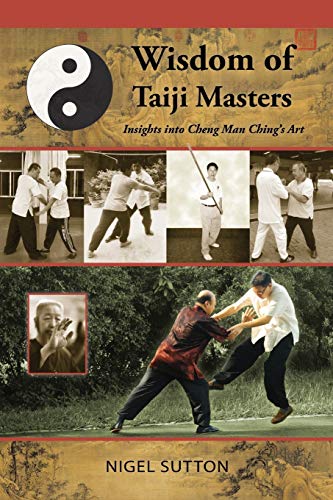
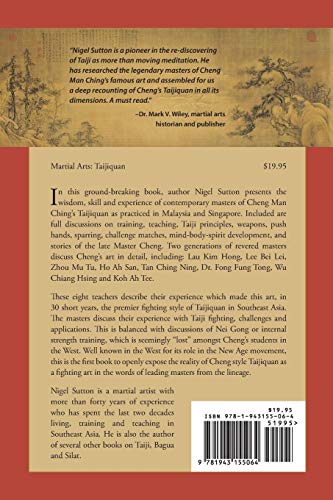
"Wisdom of Taiji Masters: Insights into Chen Man Ching's Art" by Nigel Sutton is a feast of caviar for practitioners of tai chi chuan.The late Chen Man Ching, although controversial, was and is considered to be among the finest masters of "internal" boxing who ever lived. His skills in the use of the effortless, qi-based fighting art were nearly supernatural.The first Western student accepted by the Professor, as Cheng was called, was Robert W. Smith, who wrote the first important book in English about taiji. In the Seventies, I had the great honor of being Mr. Smith's first closed-door (private training) student and so took my small place as the founder of a now-thriving American lineage.Author Nigel Sutton is a Surrey-born Englishman who moved to Beijing while in his twenties to train in authentic Chinese martial arts. In one important competition, in years since, he was the only non-Chinese to win a gold medal. In 1987, he went to Malaysia to research taiji among the masters there in Chen Man Ching's lineage. "I thought," master Sutton admits, "I knew quite a lot -- turned out I knew nothing.""Wisdom" presents the teachings of seven different Malaysian masters. For those who doubt that this seemingly slow, soft, and innocuous art cannot seriously be used to fight with, prepare to be startled and enthralled. To those who already apply taiji as an ultra-sophisticated form of combat, here is treasure: a resource of proven and practical wisdom which inspires and instructs how to proceed to the highest levels of what Chinese believe to be the only truly unbeatable style of kung-fu.Highly recommended.
B**N
Cheng Man Ching in Malaysia
The book - Wisdom of the Taiji Masters - is a compilation of a series of interviews with key Cheng Taiji Masters active in Peninsular Malaysia which were documented by Nigel Sutton, the founder of the Zhong Ding Association in Malaysia, in the 1980s and 1990s. They provide a valuable resource for research into the development of Taiji in a style that is usually most closely associated with Taiwan and parts of the United States but also provides a peek into one of the countries where there is a a long tradition and deep pool of CMA masters but is rarely documented or acknowledged - Malaysia.Cheng Taiji is the style that is attributed to its founder Cheng Man Ching who studied with Yang Cheng Fu from 1930-1936 and had many influential disciples in the West such as Robert Smith, T.T. Liang, William C.C. Chen. Huang Shen Hsyan was one of his most successful disciples, establishing over 40 schools in South East Asia. Although considered to be a subset of the Yang Style, a case could be made for characterizing it as an independent style.The following are some of the characteristics of his "Yang-style short form." (1) It eliminates most of the repetitions of certain moves of the Yang long form. (2) It takes around ten minutes to practice instead of the twenty to thirty minutes of the Yang long form (3)The hand and wrist are held open, yet relaxed, in what Cheng called the "Fair Lady's Hand" formation (as opposed to the straighter "Chinese tile" formation of the Yang style) (4) The form postures are not as expansive as Yang Chengfu's form Cheng postures are performed in "middle frame" style, which changes the movement of the feet from the Yang version. (5) Cheng's concept of "swing and return" in which the momentum from one movement initiates the next.This book is valuable on a number of fronts, as it fleshes out the lineage and development of Cheng Taiji in Malaysia with background on the early generation of teachers such as Yue Shu Ting and Tan Ching Ngee who studied with Cheng himself, and interviews with the second generation of teachers such as Lu Tong Bao, Lee Bei Lei and Koh Ah Tee, who taught in Penang, Malacca and Kuala Lumpur. From the interviews themselves one is able to gain an insight into the curriculum taught by each of the teachers and the differences in content and emphasis of each of the teachers.Cheng Taiji is controversial as it is often criticized as a "watered-down version" of the Yang Style and there is still an ongoing debate as to whether Cheng Man Ching had any "gongfu" or if he did whether he deliberately chose to withhold some of the key teachings from his disciples. There is a perception that those of his disciples in the USA and Taiwan lack his level of martial ability.Hence each teacher in the book has had to address these fundamental criticisms and discuss their teaching methods relatively openly and with a close reading of their interviews there are many training secrets (or "nuggets of gold" as Nigel Sutton puts it) that are helpful to a experienced practitioner buried in the text. From the viewpoint of a martial arts historian it is fascinating to see what other training methods each teacher has added above and beyond the 37 posture set and push hands and their justification for doing so. It is an interesting study in how an art evolves in an environment of incomplete knowledge (for many of these masters were not well educated) and cross fertilization with other arts extant in Malaysia (many of these masters studied more than one style and had more than one teacher). Malaysia in the middle and even late twentieth century remained a relatively rural and traditional society and these teachers often had to demonstrate the effectiveness of Taiji in a combat setting. And many of the teachers in the book had given up other styles to focus on Taiji because of its practical efficacy.Thus this book bears close reading and includes detailed discussion of many topics that are of interest to any dedicated Taiji practitioner. These include whether the Fair Land's Hand has improved Ting Jin or sensitivity as compared to the traditional Yang Style, of the need to use sandbags to condition the hands (often taught in the lineage of Lu Tong Bao), the role of dian xue, different weapons such as the sword and staff and most importantly of all, whether Cheng Man Ching taught neigong. This is an important topic and stands at heart of the discussion of whether Cheng style is an effective fighting art and whether it should be characterized independently from the Yang style, which does not teach neigong. Power in the Yang Style stems primarily from dou gan or pole shaking exercises. Indeed most of the teachers in the book teach a version of neigong (but even from a cursory reading text it seems that the nature of the neigong taught varies from teacher to teacher in the book). Cheng Man Ching's neigong practice was attributed to Zhang Qin Lin who taught Cheng Man Qing the Zuo Lai Feng system of internal stength. Many teachers in the book also emphasize zhan zhuang which is also absent from the traditional Yang Style. There are discussions on the "killer qi" in the Yang style versus its absence in Cheng Style. This is all fascinating stuff and rewards close reading and discussion.At the same time misunderstandings also abound in the book, due to the biases of the teachers and lack of exposure to the wider martial arts community. Understanding these "mistakes" are also important for the serious practitioner, as part of one's martial development involves an understanding of the source of one's teachings and what may be later interpolation or false paths. For instance Koh Ah Tee states that Cheng Man Ching took the Taiji sword from the Yang Family and made it more natural. But in actuality, if one looks at the set one can see what Cheng Man Ching taught was Wudang Sword and not Taiji sword and his paired sword set is also traditional Wudang Sword as taught by Li Jing Lin. Lu Tong Bao called the long form (108 or 85 form) Long Fist as it took longer to complete. This is a misnomer as traditional Taiji Longfist is a fast set in Yang Taiji with more explicit fajin. Dr. Wong Fu Jing incorporates the Yijing (Book of Changes) into his Taijquan but admits that he has had no teacher in the Yijing. But all of this is what makes tracing the development of the art so fascinating.All in all, Nigel Sutton has done us a great favor in compiling this book, for these interviews were made over twenty years ago and in the interim some of these masters have passed away. This is a valuable document as the art we know as Taiji continues to evolve on a global basis and has become a part of mankind's intangiable cultural heritage. This is a good book for any practitioner of Taiji with its numerous training tips and is heartily recommended.
A**R
A "must have" book for all Zheng style Taijiquan practitioners
This is an extremely important book for all practitioners of the Zheng style of Taijiquan. So much of the literature on this style emanates from Professor Zheng's American students and their subsequent students, rather than from those who had contact with him in the East. Sadly, much of the Western literature on Zheng style has not focused on Zheng Taijiquan's martial prowess.What Nigel Sutton has shown with this book is that Zheng style was and still is regarded as a strong fighting style in the East, and especially among Malaysian Chinese teachers and students of the art. Through his extensive research and personal commitment to Zheng Taiji, which includes his being a "closed-door" disciple of a number of the teachers in the book, and with his innate understanding of Chinese culture, Mr. Sutton provides insights into the personalities and key teachings of some of the most important Zheng style teachers living today.This really is a book that should be a "must have" for every Zheng Taiji practitioner, and is an excellent read for any practitioner of Taiji regardless of style, and for martial artists in general.
F**F
Ergänzung
Interessant als Ergänzung der Tai Chi Chuan Bibliothek.Eher der Kampfkunst gewidmet, als dem Gesundheitsaspekt.
K**E
Interesting background on ZMQ and his students including their training philosophy
Nice to read some background on ZMQ's students, how they train and how it spread in Malaysia.
A**.
Tai Chi als Kampfkunst
Endlich ein Buch über die praktische Seite von Cheng Man Ching's Tai Chi. Nicht der übliche Esoterikschmarrn von amerikanischen Schülern Cheng's die von der praktischen Anwendung ihres Taichi keine Ahnung haben, geschweige denn es auch umsetzen zu können. Hat mir sehr gut gefallen.
D**R
très bon livre mais version Kindle pleine de défauts
C'est un très bon livre, très riche en enseignements. Ce livre s'adresse à tout pratiquant de taiji quan, quel que soit son niveau. On y trouvera dans les paroles de maîtres des conseils, des confirmations de ce que l'on sait, la parole de son propre maître retranscrite autrement... Bref un livre à lire et à relire.Je ne mets que 3 étoiles parce que j'ai acheté la version Kindle et que la mise en page est remplie de défauts, d'accord elle est moins chère que la version papier mais ce n'est pas une raison pour se moquer du consommateur à ce point.Pour résumer: 5 étoiles à nigel sutton et 0 à Amazon !
Trustpilot
2 months ago
1 month ago