
DOWNLOAD THE APP


Customer Services
Copyright © 2025 Desertcart Holdings Limited
DOWNLOAD THE APP
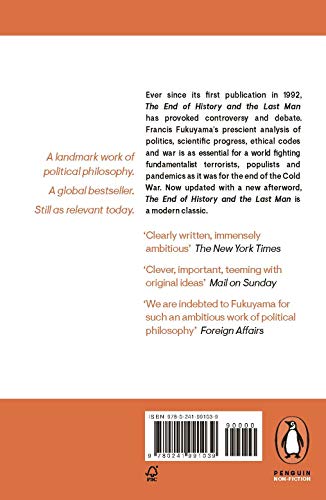


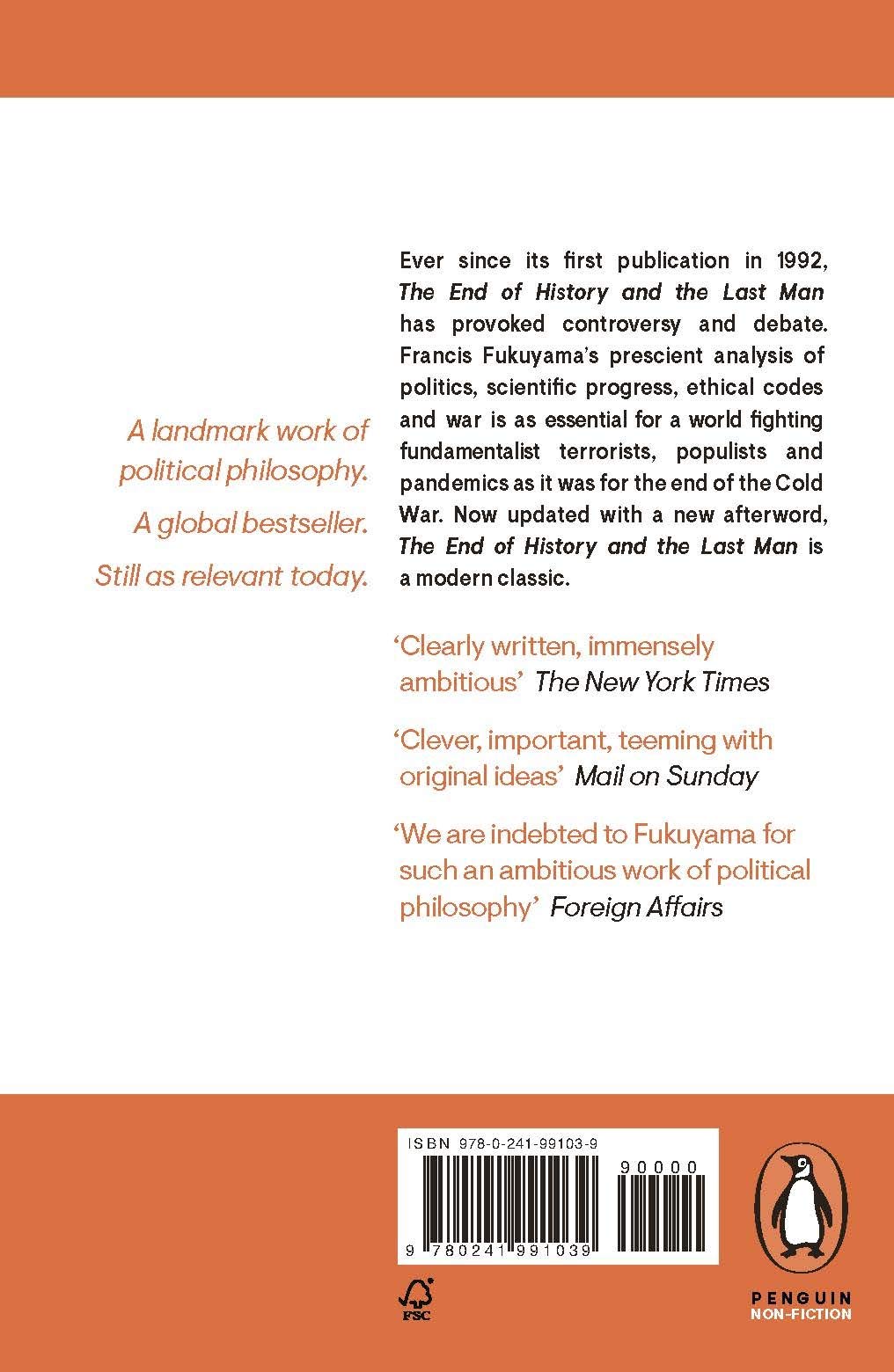
Buy The End of History and the Last Man: Francis Fukuyama 1 by Fukuyama, Francis (ISBN: 9780241991039) from desertcart's Book Store. Everyday low prices and free delivery on eligible orders. Review: Important and insightful work. - An important work. Everybody should read it. Review: Book in good conditions. Great read. - Excellent pre-loved book. In very good conditions.
| Best Sellers Rank | 71,450 in Books ( See Top 100 in Books ) 8 in Historiography 120 in History of Civilisation & Culture 441 in Philosophy (Books) |
| Customer reviews | 4.4 4.4 out of 5 stars (843) |
| Dimensions | 12.9 x 2.7 x 19.8 cm |
| Edition | 1st |
| ISBN-10 | 024199103X |
| ISBN-13 | 978-0241991039 |
| Item weight | 319 g |
| Language | English |
| Print length | 464 pages |
| Publication date | 17 Sept. 2020 |
| Publisher | Penguin |
G**N
Important and insightful work.
An important work. Everybody should read it.
M**G
Book in good conditions. Great read.
Excellent pre-loved book. In very good conditions.
S**D
I may not agree but it's still a good book
Fukuyama writes very well, he engages you right from the beginning and takes you on a mesmerising journey that includes tables, figures, stats, quotes, everything he needs to posit his theory of American democracy being the solution for all the world's ills. And while reading it you find yourself slowly being convinced and taking note of the various catchy statements he makes at the end of each chapter. However when you finish the book and realise its 2013 and not 1989/1992 you will see the flaws in the argument and how far away we actually are from the End of History. I liked it though and I'm sure there are plenty in the US administration who believe this theory may actually be correct and have desires on implementing it.
T**D
Still relevant !
Even if you don't agree with all of Fukuyama's opinions (or even any) one has to admire some of his insights and the clarity of his expression. Capitalism should, of course, never be confused with Democracy - but as the author points out both ideals seem to be the most compatable with human nature, therefore the dominant ideologies... for now! The end of History ? No THE text pointing us to a new era - definately!! A must read for anyone with a wish to broaden their political, philosophical or historical horizons and frankly who doesn't!?
S**H
Engaging but unconvincing
The year is 1993. The Berlin wall has fallen. The West has won the Cold War. The West's ideology seems triumphant as Communism has been discredited around the world. In this heady political milieu, Francis Fukuyama posits that History has ended because it is directional and inexorably leads all people to choose the most rational form of government: liberal democracy. Twenty years on, Fukuyama's thesis seems questionable. THE THESIS The End of History is based on the Hegelian conception of history as the unfolding of Spirit. History, defined by Hegel as the progress of mankind to higher levels of rationality and freedom, terminates in the achievement of full self-consciousness. Fukuyama argues that mankind seems to be making Hegelian progress for two reasons: economics and the need for self-recognition. 1. ECONOMICS. Modern economies need to be rationally organised. Plans need to be made and products produced using rational means. As such, reason and efficiency become the animating features of a modern economy. In the process, rational means of production undermine traditional sources of authority such as clan ties and religion. 2. SELF-RECOGNITION. Various interest groups in a modern country vie for power in order to be 'recognisd'. People, being social creatures, want to have their voices heard. The only system that guarantees that the voices of competing interest groups will indeed be heard is liberal democracy So far, so good. THE ANTITHESIS The End of History was written at the end of the Cold War when Russia was comatose and China had not yet emerged on the world stage. Fast forward twenty years and the story is different. China is the second-largest economy in the world and is emerging as a counter weight to the West. A resurgent Russia has weathered the debilitating storms of the post-Communist era. And both countries are decidedly not liberal democracies. According to Fukuyama, we were at the end of History in 1993. Apparently, Fukuyama missed something. NO SYNTHESIS: THE POWERFUL AND RE-PACKAGED MILLENARIANISM The main weakness in Fukuyama's thesis - and its underlying Hegelian foundation - is the notion that there is directionality in history; that History has a goal which will unfold by and by. This is not only a weakness, it is a dangerous notion because it glibly justifies the status quo. In essence, Fukuyama's thesis is an ode to the victors of the Cold War; he seems to be saying, 'Why not pat ourselves on the back? Guess why we (the West) are dominant? Well, because we are the culmination of History; all of History has been leading us to this point.' Such thinking is intellectual cowardice since it does not examine power relationships. Instead, it papers over the real human misery that the powerful inflict on the less powerful. Afterall, if the powerful are only playing their part in the unfolding of a universal spirit of History, why should one question imperialism, colonisation, slavery and other shameful episodes through which the powerful have dispossessed the powerless (in the name of a greater good)? While reading the book, Fukuyama's thesis - and indeed Hegel's - felt oddly familiar to me: I had heard it before in Sunday School. Fukuyama has repacked the millennial promises of a New Jerusalem (in the Book of Revelations) into a secular narrative and presented it as definitive History. It is not clear to me why there is rational directionality in history and why the end thereof should be 'Christian'. Fukuyama does not explain this well. CONCLUSION Are we are all destined to be liberal democrats (in the Western mould)? Fukuyama assumes that there is one way of coming to terms with modernity - the Western way. As such, he does not pay adequate attention to the traditions of non-Western cultures and how these cultures might embrace modernity on their own terms. Despite the considerable weaknesses of the book, I thoroughly enjoyed reading the End of History because it is very well-written and quite engaging. Yet, I was unconvinced by Fukuyama's arguments. My recommendation: Read the End of History because it is an influential and interesting book; however, be skeptical about its universalist secular eschatology.
B**M
Exceeded expectations
Arrived very quickly and much sooner than predicted by Amazon. Quality was better than announced too!
A**H
A compelling insight into the nature of progress
This eclectic, highly innovative piece of works intellectual influence is difficult to underestimate. Using an intriguing blend of various schools of thought, some highly conflicting, Fukuyama provides us with the a uniquely compelling case for the virtue of republican rule. Using both theoretical and pragmatic examples this work takes us through a whirlwind tour of social darwinism. Dismissed as Neo Conservative (like that's actually supposed to be derogative?) by some socialist, perhaps the hostility towards it stems from the fact that it is very difficult to intellectually and morally oppose. Recomended for all enthusiasts of political thought whether new or experienced.
M**A
Muito bom o livro sobre como os eventos da historia estão levando o ser humano para nao ter mais o que contar, ou seja o fim da historia. O autor narra os diferentes modelos políticos e econômicos do mundo e deixa claro que todos os países caminham para a democracia, e que a democracia e liberdade trará um momento em que sera difícil de escrever a historia pois todos os países serão iguais.
T**I
Toward the end of the Cold War, three very different books were published within five years of each other that sought to explain the likely contours of the inchoate new world order emerging from the implosion of the communist bloc: David Kennedy's "The Rise and Fall of the Great Powers" 1989); Francis Fukuyama's "The End of History and the Last Man" (1992); and Samuel Huntington's "The Clash of the Civilizations"(1994). The second in this triumvirate is the deepest intellectually, one might even say profound, yet the most widely misunderstood and often ridiculed. The vast majority of critics, I'm convinced, never actually read the book, as Fukuyama's thesis is sober and thoughtful. Unlike Kennedy's thesis, which is based on relative economic growth rates, or Huntington's, which is rooted (I would argue) in cultural anthropology, Fukuyama's argument is built upon the foundation of modern western philosophy. For those, like me, who only have an armchair education in philosophy, "The End of History" will be both a primer on the basic tenets of liberal political theory and a compelling argument for the spread of both capitalism and democratic representative government. Fukuyama's argument is direct, but cerebral, and fundamentally grounded in the political philosophy of early 19th century German philosopher Georg Hegel, and supported by the further interpretations of Hegel by fellow German Friedrich Nietzsche and the 20th century French-Russian philosopher Alexandre Kojeve. At the dawn of the twenty first century, Fukuyama writes, there were two undeniable trends in global affairs: a movement toward market capitalism on the one hand, and a shift toward liberal democracy on the other. He notes that these two trends are not, at least superficially, mutually reinforcing. In fact, one could argue that they should naturally work against each other. After all, authoritarian regimes in East Asia (Taiwan, Singapore, South Korea, China) have proven that dramatic, market-oriented economic growth does not rely on a liberal political order. Indeed, democracy may actually stymie the efficient allocation of central resources toward critical infrastructure projects. Fukuyama sees Hegel's "need for recognition" as the missing link tying liberal economics with liberal political democracy. This book is broken into five parts. The first two provide a background on the philosophical argument behind "The End of History" as posited by both Hegel and Marx, who agreed on the basics but reached radically different conclusions on the end point. Fukuyama maintains that politics is more like natural science than art or literature - its trajectory is directional and cumulative, with each generation building upon the efforts of the past, unlike the more liberal arts whose value remains subjective across the ages. (e.g. Are paintings or architecture better today than in ancient Greece or fin-de-siecle France? Depends who you ask. Are we more advanced in physics than those societies? No doubt. Fukuyama claims government is more like physics than art.) I found part three to be the most informative and fascinating. Fukuyama explains that part of the problem with Hegel's focus on "recognition" in political philosophy is that there is no one word in English that accurately captures the true meaning. Machiavelli spoke of "glory," Hobbes of "pride," Rousseau of "amour-propre," Hamilton of "fame," Madison of "ambition," and Nietzsche of "the beast with red cheeks." Fukuyama makes a strong case for Plato's Greek word "thymos," the same word and concept that Jonathan Shay uses to develop his convincing hypothesis on the nature of moral degeneration after close order combat in his brilliant piece "Achilles in Vietnam." In short, every man, no matter his station in life, has a natural sense of self-worth, of dignity, and when that sense of personal dignity is violated the reaction can be severe. When we don't live up to our own estimate of thymos we feel shame, and when we do we feel pride. And when someone else, especially those in positions of power or authority, fail to recognize our thymos we feel indignation (or, as Shay wrote about Achilles and soldiers in Vietnam, rage). Thus, a healthy political order needs to be more than a basic social contract between man and his government, exchanging some personal rights in exchange for the ability to acquire property (what the Founders referred to as "happiness"), a sort of mutual societal non-aggression pact. Rather, it must also somehow serve man's desire for recognition, of his dignity and worth. In part four Fukuyama presents his central thesis of the desire for recognition as the motor of history, looking at the recent past and projecting into the future some of the different ways the desire for recognition will be manifest. He notes that it was present in the people who fought for greater representation in right-wing authoritarian regimes in the 1970s and 1980s (Spain, Greece, South Korea, Philippines, Taiwan, etc.) and against communist dictatorships at the end of the Cold War - and arguably what is driving the Arab Spring movement across North Africa and the Middle East. The governments rocked by pro-democracy movements span most continents and cultures, include nations that have experienced rapid economic growth and others that have been moribund for decades, and have sought to overthrow or dramatically reform regimes that range from the far left to the far right. The common denominator, Fukuyama argues, is that they failed to satisfy the collective thymos of their people, as only liberal democracy can do that. The fifth and final chapter addresses the question of the "end of history," what the final end state looks like, the so called "last man," as liberal democracies wrestle with their inherent contradiction that they treat unequal people (i.e. based on talent and success) equally. In closing, this is a marvelous, thought-provoking book that, in light of the Arab Spring (depending how that turns out), may come back into fashion nearly a generation after its initial publication. Huntington's "Clash of the Civilization" may still stand as the leading interpretation of the post Cold War international order, but "The End of History" is still very much in the race and gaining ground everyday.
C**S
c'est exactement ce que je voulais.
A**.
I like this book for its attempt to go deep in exploring the political order - looking at the nature of a man and the essence of life. At the same time, it combines this depth with entertaining examples, making it fun to read.
M**O
Bom livro.
Trustpilot
1 month ago
5 days ago