
DOWNLOAD THE APP


Customer Services
Copyright © 2025 Desertcart Holdings Limited
DOWNLOAD THE APP
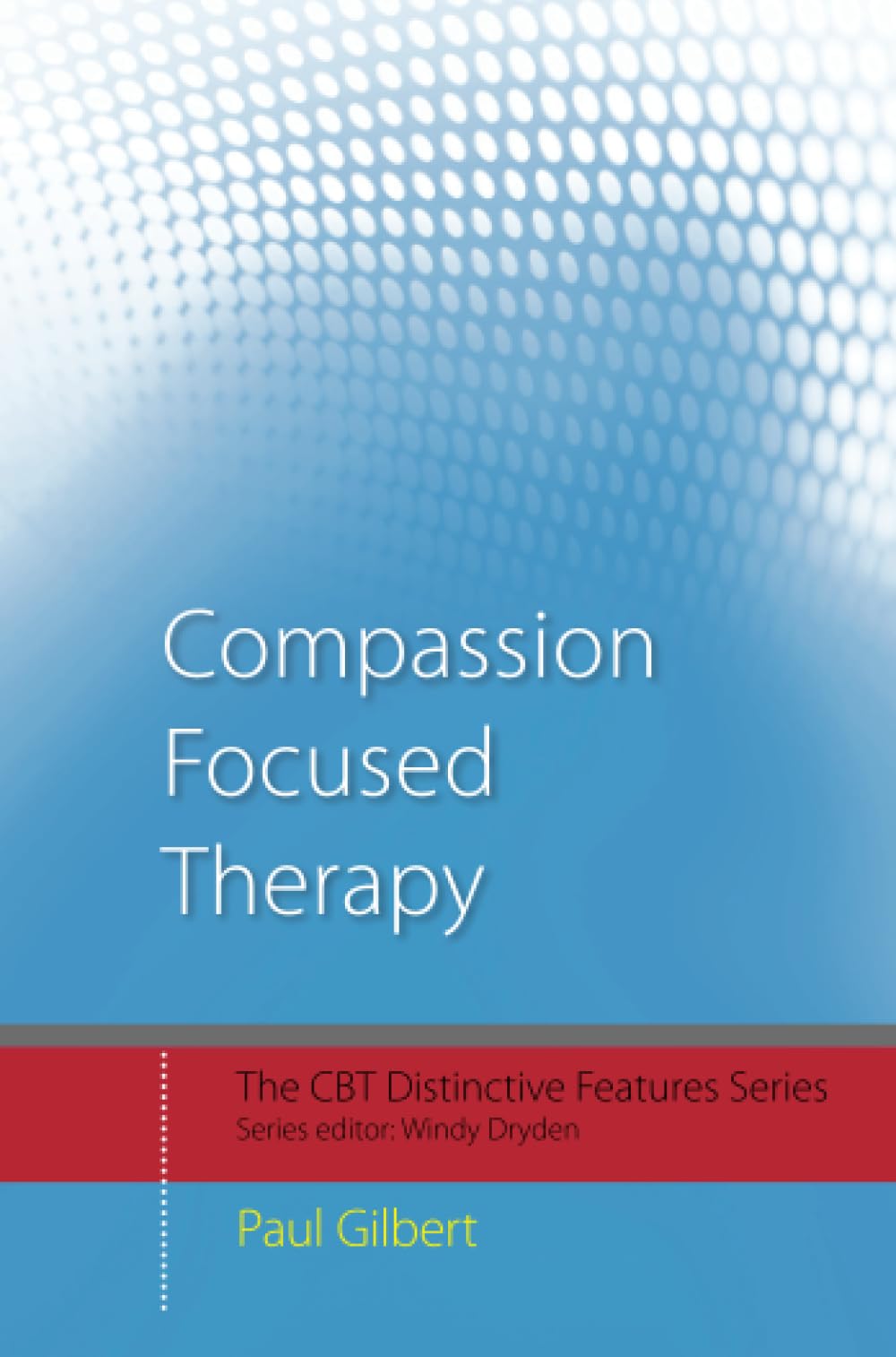
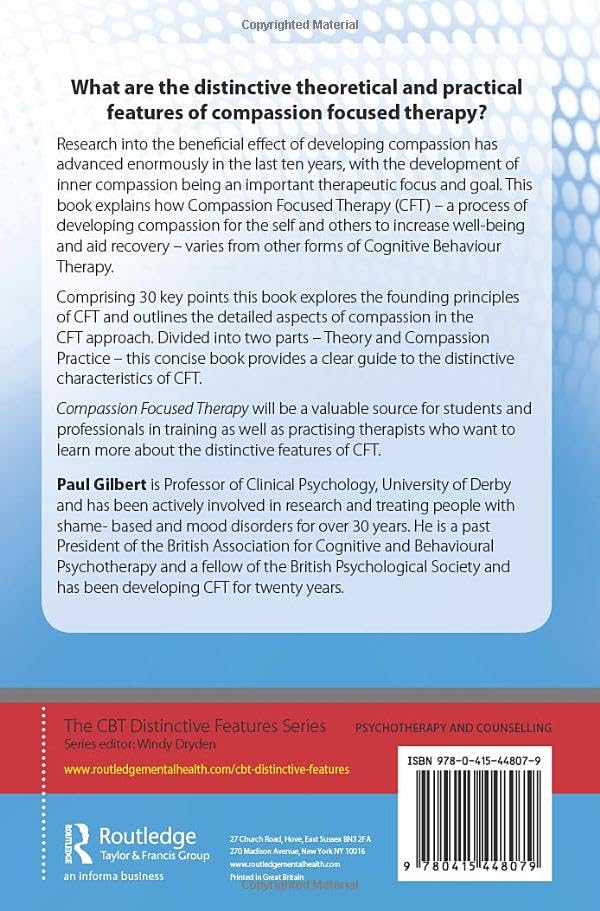
Buy Routledge Compassion Focused Therapy: Distinctive Features by Gilbert, Paul online on desertcart.ae at best prices. ✓ Fast and free shipping ✓ free returns ✓ cash on delivery available on eligible purchase. Review: Buon prodotto, la spedizione è stata veloce. Il libro è intatto così come lo era la confezione quando è stato spedito. Review: This book serves as an excellent introduction to the theory and practice of Compassion-Focused Therapy (CFT), a model of psychotherapy based in Professor Paul Gilbert's Compassionate Mind model. This model, rooted in evolutionary psychology, affective neuroscience, and social psychology, makes a major theoretical contribution toward understanding psychological difficulties and helping people to change how they relate to them. The book,is divided into two sections, the first providing an excellent overview of the theoretical model underlying CFT, and the second providing a nice set of techniques to be used in the therapy. In the spirit of full disclosure, I should say that I am far from being an unbiased reviewer. I am currently using compassion-focused therapy in both individual and group therapy formats, and am authoring a book applying the model to working with anger. The group (focused on anger) is currently being conducted in a medium-security correctional facility, and I cannot over-emphasize the effectiveness of this model in terms of its benefit to the men I'm working with. In a prison environment, these men are actively using the combination of the purposeful cultivation of compassion and contemporary psychological techniques to transform their lives. It is profound. This model is already a well-respected and increasingly used therapy in the UK, and it deserves to be much more well known here in the United States and elsewhere. I've also used it with excellent results with individual psychotherapy cases involving depression and anxiety in non-correctional settings. For a more complete description of the Compassionate Mind model, please see my review of Gilbert's "The Compassionate Mind." I will say here, however, that CFT is not a stand-alone therapy model, not another therapy to be added to the growing list of empirically supported treatments (although it is supported by an evolving literature base). Rather, it provides a model for understanding psychological distress that is intensely pragmatic, theoretically sound, based in good science...and which is entirely compatible with most other effective treatment models. The model on which it is based provides patients with a way of understanding their suffering that is non-shaming and non-blaming, and in doing so helps patients approach their difficulties head-on using any number of techniques. I have found it to be the single most effective approach for working with experiential avoidance that I have ever encountered. Because of this, Gilbert's approach helps to magnify the effectiveness of a wide variety of therapeutic strategies by increasing the patient's ability to relate to their suffering in helpful ways and to utilize the techniques effectively. CFT makes heavy use of mindfulness training and includes techniques specifically designed to take advantage of what we know about contemporary affective neuroscience, particularly with regard to Oxytocin and the neuroscience of affiliation. Specifically with regard to this book, in my opinion it is the perfect introduction to CFT. Organized in a number of relatively short, pithy chapters, it presents the model's fairly detailed theoretical foundation in bite-sized chunks, perfect for experienced clinicians and graduate students alike. I highly recommend it for any clinicians who work with patients struggling with affective difficulties, particularly those who utilize mindfulness approaches, ACT, DBT, and other CBT models. I'm planning to use it as a text in a seminar. And at $14, you can get it for the price of a few cups of coffee. Highly recommended.


| Best Sellers Rank | #423,404 in Books ( See Top 100 in Books ) #1,013 in Psychotherapy, TA & NLP #1,596 in Clinical Psychology #5,137 in Mental Health |
| Customer reviews | 4.6 4.6 out of 5 stars (124) |
| Dimensions | 12.29 x 1.42 x 18.59 cm |
| Edition | 1st |
| ISBN-10 | 0415448077 |
| ISBN-13 | 978-0415448079 |
| Item weight | 249 g |
| Language | English |
| Print length | 248 pages |
| Publication date | 7 April 2010 |
| Publisher | Routledge |
V**.
Buon prodotto, la spedizione è stata veloce. Il libro è intatto così come lo era la confezione quando è stato spedito.
R**S
This book serves as an excellent introduction to the theory and practice of Compassion-Focused Therapy (CFT), a model of psychotherapy based in Professor Paul Gilbert's Compassionate Mind model. This model, rooted in evolutionary psychology, affective neuroscience, and social psychology, makes a major theoretical contribution toward understanding psychological difficulties and helping people to change how they relate to them. The book,is divided into two sections, the first providing an excellent overview of the theoretical model underlying CFT, and the second providing a nice set of techniques to be used in the therapy. In the spirit of full disclosure, I should say that I am far from being an unbiased reviewer. I am currently using compassion-focused therapy in both individual and group therapy formats, and am authoring a book applying the model to working with anger. The group (focused on anger) is currently being conducted in a medium-security correctional facility, and I cannot over-emphasize the effectiveness of this model in terms of its benefit to the men I'm working with. In a prison environment, these men are actively using the combination of the purposeful cultivation of compassion and contemporary psychological techniques to transform their lives. It is profound. This model is already a well-respected and increasingly used therapy in the UK, and it deserves to be much more well known here in the United States and elsewhere. I've also used it with excellent results with individual psychotherapy cases involving depression and anxiety in non-correctional settings. For a more complete description of the Compassionate Mind model, please see my review of Gilbert's "The Compassionate Mind." I will say here, however, that CFT is not a stand-alone therapy model, not another therapy to be added to the growing list of empirically supported treatments (although it is supported by an evolving literature base). Rather, it provides a model for understanding psychological distress that is intensely pragmatic, theoretically sound, based in good science...and which is entirely compatible with most other effective treatment models. The model on which it is based provides patients with a way of understanding their suffering that is non-shaming and non-blaming, and in doing so helps patients approach their difficulties head-on using any number of techniques. I have found it to be the single most effective approach for working with experiential avoidance that I have ever encountered. Because of this, Gilbert's approach helps to magnify the effectiveness of a wide variety of therapeutic strategies by increasing the patient's ability to relate to their suffering in helpful ways and to utilize the techniques effectively. CFT makes heavy use of mindfulness training and includes techniques specifically designed to take advantage of what we know about contemporary affective neuroscience, particularly with regard to Oxytocin and the neuroscience of affiliation. Specifically with regard to this book, in my opinion it is the perfect introduction to CFT. Organized in a number of relatively short, pithy chapters, it presents the model's fairly detailed theoretical foundation in bite-sized chunks, perfect for experienced clinicians and graduate students alike. I highly recommend it for any clinicians who work with patients struggling with affective difficulties, particularly those who utilize mindfulness approaches, ACT, DBT, and other CBT models. I'm planning to use it as a text in a seminar. And at $14, you can get it for the price of a few cups of coffee. Highly recommended.
M**M
Un point de vue qui va dans le sens de la "troisième vague" des TCC, à lire pour approfondir Jeffrey E Young,Tara Bennett-Goleman et parmi les auteurs français Stéphanie Hahusseau ou Isabelle Filliozat. Le "plus" de cet ouvrage est qu'il s'appuie sur des données neurologiques et scientifiques, des preuves donnant une base physiologique à une expérience des phénomènes psychologiques et surtout qu'il met l'accent sur le pouvoir de la compassion (et pas seulement sur celui de la "pleine attention" ou les vertus curatives de la méditation). Le "moins" évidement, c'est qu'il n'est pas encore traduit en français...
J**D
This book is very readable. Paul Gilbert explains very clearly why conventional CBT often fails to work, and grounds his compassion focused therapy in research, and also neuro- science. I found that this book was very clear and very informative. For me the most important insigts in the book, were his recognition that our Brains have different processing systems, and that different therapies can access different systems. Conventional CBT utilises the neo-cortex, and acts as a regulator of emotions, while more experiential therapies, ( MBCT) access other processing parts of the brain. I also realised as well, how I can better intergrate some CBT ideas into my own therapy practise. One of my main objections to CBT was that the theory that explained it, ( eg distorted cognitions causing psychological disturbance) to be deaply flawed. This of course is true. However the insight that CBT techniques can regulate, difficult emotions, was very useful since sometimes regulations of difficult emotional states canrepresent a quick fix, when processessing is not possible. I found this a very good read, and feel that CFT represents an advanced form of therapy within the CBT Family of therapies.
R**R
I love this book. I read it for the second time now with some work and practice behind me and I can see how far I've come. Perhaps the only thing in the entire book that doesn't resonate entirely with me is the philosophy that we just find ourselves here. From a more spiritual and Christian perspective I like to believe we all have a unique destiny and purpose. Having said this - I think the book greatly enhances this search by encouraging compassion and compassionate behaviour towards self and others. As the author talks about fear being a block to compassion especially to self compassion I can warmly recommend the beautiful book 'Healing Fear' by Edmund Bourne to anyone interested. Also : try the hypnotherapy CD from Lynda Hudson : After Trauma. Good luck!
Trustpilot
4 days ago
3 weeks ago