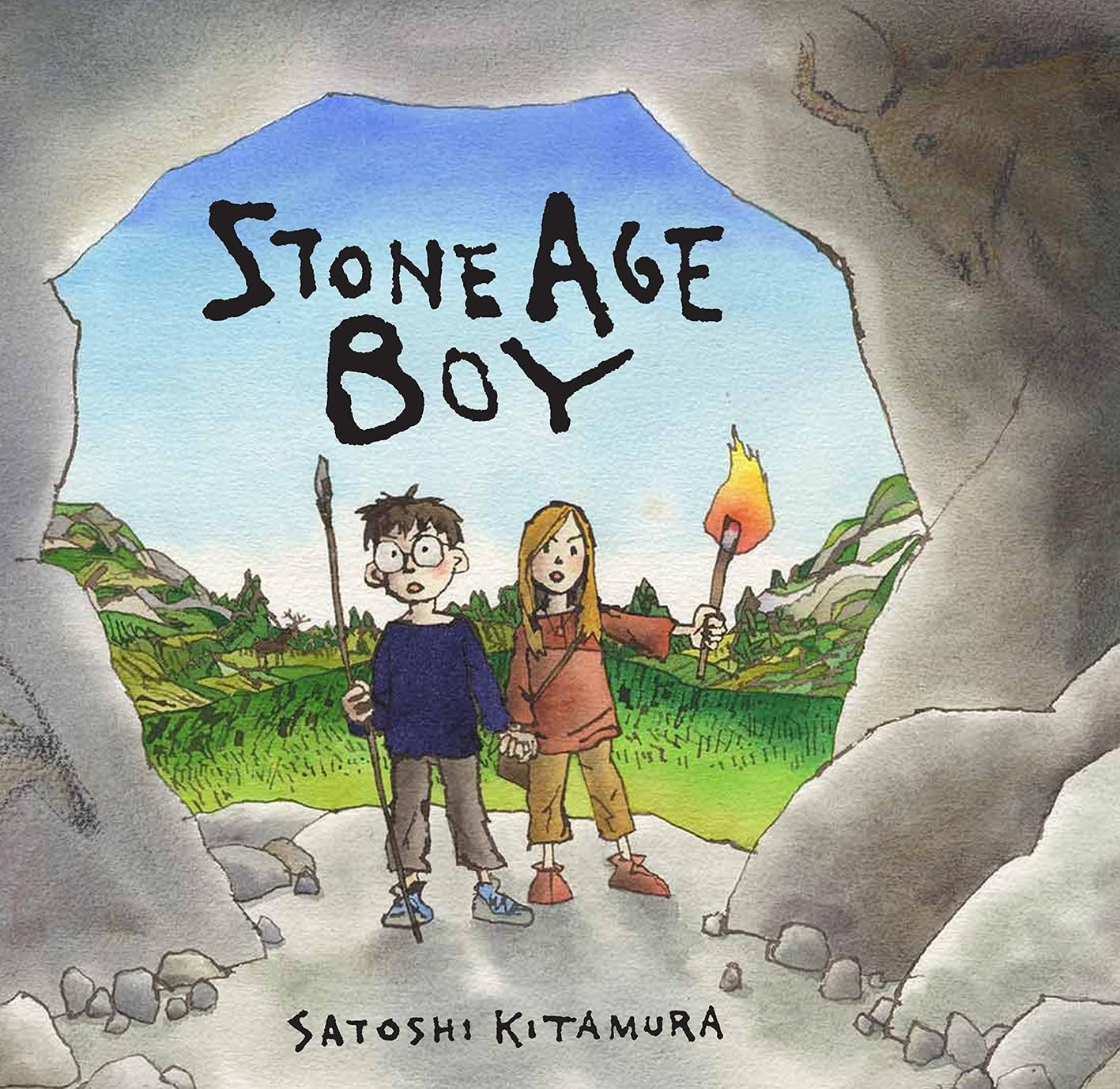
Stone Age Boy
Product ID: 355811917
Buy anything from 5,000+ international stores. One checkout price. No surprise fees. Join 2M+ shoppers on Desertcart.
Desertcart purchases this item on your behalf and handles shipping, customs, and support to Slovakia.
Travel 20,000 years into the past and discover what life as a caveman was like in this prehistoric picture book by a prodigiously talented artist. Review: One-time read - Very nice way of presenting to kids how people used to do things a long long time ago, when they didn’t have forks or plates, or any plastic things (all things kids now take for granted as part of their daily routines). My kids followed in wonder as we went through it. It conveyed the message well. They got it. And moved on. It’s not the kind of book that kids want to read over and over again. I understand other reviewers who described it as boring. I would say, for homeschooling purposes, when you are looking to convey a piece of the evolution story with a nice book (i couldn’t have explained it better myself !), it works very well. Just don't expect an all-time favourite bedtime story. Review: Time travel with Satoshi Kitamura - This is a deceptively modest, simple little picture book by a brilliant writer & illustrator for children. Read it with your child. A boy falls down a sort of rabbit hole in a forest - oblique reminder of Alice here - is this perhaps a dream? - and finds himself alone in another era of the world. Until he finds a new friend, who brings him to her family! I can't imagine a better introduction to the idea of prehistoric times, to people long ago very like us, living very differently from us. I'm a grown up and I learned about a few stone age cultural techniques - so you can too. You will learn about hunting, celebrating, family life, crafts and arts - and cave paintings. The illustrations are detailed & accurate depictions - advice was taken from the Ashmolean Museum in Oxford - but they are not insistently didactic, not like instructive illustrations for a children's encyclopedia. There's emotion and imaginative intensity in Kitamura's picture story telling, always. The child of the modern world bonds easily with our ancestors Unsurprising then to find this boy back in our world years later, working as an archaeologist, seeking traces of his former friends and driven by a deep sense of connection that derives from his early absorption in their long ago lives. (This suggestion makes sense to a generation whose earliest acquaintance with history was emotional identification. Children of 7 might be asked to imagine a day in the life of Hugh the Norman page.) Always, looking at Kitamura's picture stories, with their apparently artless, minimal narratives, I'm reminded of the richness of children's inner stories, often hidden to adult eyes. The simplicity of the text contrasts with the glorious adventure and joy of the inner world. "What if..." and "Let's pretend..." are never far away. "In The Attic" is a startling evocation of the distance between that childish stream of consciousness, the flow of rich imagery and imaginings running parallel to our adult perceptions of everyday experience. Story telling, children are making sense of the world even long before verbal invention appears. So read this slowly with your child, taking all the time in the world to talk about the pictures. Later, read Stig of the Dump together. Similar mood but time travel from the past into the future. A stone age boy lives resourcefully on the margins of our civilization and brings his child friend back - briefly, hauntingly- to the times of Stonehenge.
| Best Sellers Rank | #182,793 in Books ( See Top 100 in Books ) #12 in Children's Books on Archaeology #29 in Children's Books on Prehistoric Times #114 in Children's Books on How Things Work |
| Customer Reviews | 4.7 out of 5 stars 1,156 Reviews |
M**T
One-time read
Very nice way of presenting to kids how people used to do things a long long time ago, when they didn’t have forks or plates, or any plastic things (all things kids now take for granted as part of their daily routines). My kids followed in wonder as we went through it. It conveyed the message well. They got it. And moved on. It’s not the kind of book that kids want to read over and over again. I understand other reviewers who described it as boring. I would say, for homeschooling purposes, when you are looking to convey a piece of the evolution story with a nice book (i couldn’t have explained it better myself !), it works very well. Just don't expect an all-time favourite bedtime story.
S**M
Time travel with Satoshi Kitamura
This is a deceptively modest, simple little picture book by a brilliant writer & illustrator for children. Read it with your child. A boy falls down a sort of rabbit hole in a forest - oblique reminder of Alice here - is this perhaps a dream? - and finds himself alone in another era of the world. Until he finds a new friend, who brings him to her family! I can't imagine a better introduction to the idea of prehistoric times, to people long ago very like us, living very differently from us. I'm a grown up and I learned about a few stone age cultural techniques - so you can too. You will learn about hunting, celebrating, family life, crafts and arts - and cave paintings. The illustrations are detailed & accurate depictions - advice was taken from the Ashmolean Museum in Oxford - but they are not insistently didactic, not like instructive illustrations for a children's encyclopedia. There's emotion and imaginative intensity in Kitamura's picture story telling, always. The child of the modern world bonds easily with our ancestors Unsurprising then to find this boy back in our world years later, working as an archaeologist, seeking traces of his former friends and driven by a deep sense of connection that derives from his early absorption in their long ago lives. (This suggestion makes sense to a generation whose earliest acquaintance with history was emotional identification. Children of 7 might be asked to imagine a day in the life of Hugh the Norman page.) Always, looking at Kitamura's picture stories, with their apparently artless, minimal narratives, I'm reminded of the richness of children's inner stories, often hidden to adult eyes. The simplicity of the text contrasts with the glorious adventure and joy of the inner world. "What if..." and "Let's pretend..." are never far away. "In The Attic" is a startling evocation of the distance between that childish stream of consciousness, the flow of rich imagery and imaginings running parallel to our adult perceptions of everyday experience. Story telling, children are making sense of the world even long before verbal invention appears. So read this slowly with your child, taking all the time in the world to talk about the pictures. Later, read Stig of the Dump together. Similar mood but time travel from the past into the future. A stone age boy lives resourcefully on the margins of our civilization and brings his child friend back - briefly, hauntingly- to the times of Stonehenge.
D**A
Great story for Y3 English
We were studying Stig of the Dump but used Stone Age Boy for a shorter narrative for pupils to base their narratives on. It was perfect. It is a lovely story and beautifully illustrated. We particularly liked the sections that detailed Stone Age life - so useful for history lessons! Definitely recommend.
A**R
Un cuento sobre la edad de piedra
Un cuento muy bonito
C**N
My two boys love this
I picked this up by chance at the library. My 5 & 7 yr old boys absolutely love this book, as do I! It is about a boy who trips and falls into a hole. He wakes up in the stone age where he meets a little girl the same age. There he learns about how they lived: how to make tools, how they hunted, how they cooked, how they worked as a community. It is filled with information, yet a quick, fun read. The ending is cute, when he wakes up back home he says everyone tells him it was a dream, but then there is a cute little 'clue' the author refers back to to make you wonder...! We have read it so many times, my oldest asked me if we could just go buy our own copy. My youngest has asked to bring it in to share at school. Boy or girl, get this, you really won't be disappointed.
Trustpilot
5 days ago
4 days ago