
DOWNLOAD THE APP


Customer Services
Copyright © 2025 Desertcart Holdings Limited
DOWNLOAD THE APP
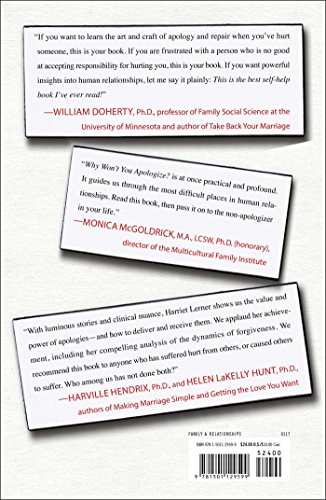
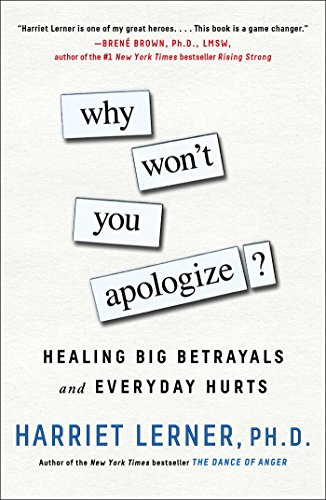


Why Won't You Apologize?: Healing Big Betrayals and Everyday Hurts [Lerner PhD, Harriet] on desertcart.com. *FREE* shipping on qualifying offers. Why Won't You Apologize?: Healing Big Betrayals and Everyday Hurts Review: Probably the Most Validating Books I've Read in Awhile - A great find and very eye-opening. The examples the author presents are relatable. We have this gut feeling when we know an apology doesn't feel quite "right." It's harder to pinpoint why, but the author does a spectacular job of explaining this plainly. In a world where everyone is trying to protect their image and save face, a genuine apology seems like a rare commodity these days. Imagine how many relationships we might save if only we knew how to say sorry in the right way? This should be recommended reading for middle schoolers/high schoolers. This book has made me believe apologizing is a skill and we can all learn how to do it well. Review: Great book - I haven't finished it yet, I'm maybe halfway done, but it's been incredibly helpful. I was not expecting a book on apologies to make me cry as much as I have. After I'm done reading it, I'm going to send it to my brother (not that I think he'll actually apologize, as he should).
| Best Sellers Rank | #882,552 in Books ( See Top 100 in Books ) #77 in Conflict Management #165 in Interpersonal Relations (Books) #252 in Marriage |
| Customer Reviews | 4.6 4.6 out of 5 stars (1,453) |
| Dimensions | 5.5 x 0.9 x 8.38 inches |
| ISBN-10 | 1501129597 |
| ISBN-13 | 978-1501129599 |
| Item Weight | 10.9 ounces |
| Language | English |
| Print length | 208 pages |
| Publication date | January 10, 2017 |
| Publisher | Gallery Books |
M**H
Probably the Most Validating Books I've Read in Awhile
A great find and very eye-opening. The examples the author presents are relatable. We have this gut feeling when we know an apology doesn't feel quite "right." It's harder to pinpoint why, but the author does a spectacular job of explaining this plainly. In a world where everyone is trying to protect their image and save face, a genuine apology seems like a rare commodity these days. Imagine how many relationships we might save if only we knew how to say sorry in the right way? This should be recommended reading for middle schoolers/high schoolers. This book has made me believe apologizing is a skill and we can all learn how to do it well.
B**E
Great book
I haven't finished it yet, I'm maybe halfway done, but it's been incredibly helpful. I was not expecting a book on apologies to make me cry as much as I have. After I'm done reading it, I'm going to send it to my brother (not that I think he'll actually apologize, as he should).
M**E
Helping my self
I read on 2 week , really friendly writing . Understanding with examples was good ( help me to see the views) Each was interesting and I take time to acknowledge the each paragraphs. Really good, I buy sorry sorry sorry too I think the both is good to read together for my opinion. I recommend.
M**N
We tolerate abuse and mistreatment in the name of love with the belief that having someone and something is ...
I'm sure we all can agree that relationships are a core focus for humans. Connection and long lasting relationships are something of grand significance and are a essential and conspicuous priority. - Subsequently we go over and beyond to ensure they last, sometimes in a negative aspect and other times in a positive one. We tolerate abuse and mistreatment in the name of love with the belief that having someone and something is better than nothing. On the other hand we broadcast unconditional love, and compassion. Further, sometimes it's a friend, family member, or spouse that surprises us with a wrongdoing, incurring damage to us and the relationship. - "We are hardwired to seek justice and fairness (however we see it), so the need to receive a sincere apology that’s due is deeply felt. We are also imperfect human beings and prone to error and defensiveness, so the challenge of offering a heartfelt apology permeates almost every relationship." - We try so hard to receive an apology, to make the other aware of our pain and hurt, while at the same time, ironically it is fairly difficult for us to give a genuine apology. - Sometimes we don't apologize correctly and wonder why our relationships aren't moving forward. - "It doesn’t matter if the statement you make after the “but” is true—it makes the apology false. It says, in effect, “Given the whole situation, my rudeness (or lateness, or sarcastic tone, or what-have-you) is pretty understandable.” - When apologizing we need to take into consideration the other persons feelings and hurt, not ours. To truly understand and repair our relationships we need to come from a place of unselfishness. - "A Good Apology Is Not About You Part of a true apology is staying deeply curious about the hurt person’s experience rather than hijacking it with your own emotionality. A heartfelt apology is not about you. If your intention is to offer a genuine apology, it’s the hurt party’s anger and pain that matters. Save yours for a different conversation." - “We apologize when we accept responsibility for an offence or grievance and express remorse in a direct, personal and unambiguous manner, offering restitution and promising not to do it again.” A good apology includes the words “I’m sorry” without “ifs,” “buts,” or any manner of undoings, obfuscations, and the like. - This book provides us with insight on how to properly receive, give and understand apologies.
K**U
Forgiveness is a process that is unique to each person
Why Won’t You Apologize? by Harriet Lerner is a nice, quick read about navigating forgiveness in relationships, family, and personal growth. It explores forgiving those you’ve hurt, those who’ve hurt you, and yourself. The book is filled with relatable (but repetitive) tales and anecdotes from Lerner’s experience, but it doesn’t give a clear structure or script for making an apology. At first, I found this lack of guidance frustrating, but I realized this is likely the point: forgiveness isn’t a one-size-fits-all concept with a set formula. Instead, it’s an ongoing process that must feel emotionally authentic to each individual, else it falls flat.
C**T
thought provoking
I came to this book with questions and the author definitely delivered. I have some very challenging people in my life and was wondering how to best move forward. If you are wondering how to carve a path forward with people that are unwilling or unable to be accountable for their actions, but you are willing to look at your own self, the. This book will help clarify that path forward.
V**S
Love all her books
Over the years I’ve read many books by Harriet Lerner. Each one not only helps me to better understand relationships, along with a better understanding of how I can be a better person.
R**.
Love the information. Hate the reader!
Love Dr. Lerner's books and tapes, but this time she had someone else read it and I did not like the way she read the book. I found the reader's voice and the way she emphasized the words in the sentences annoying and it made it difficult to concentrate on the information. Dr. Lerner, please don't use her again!
J**E
I liked the book as it covers extensively apology. I was mostly interested in the last part about letting go of anger and need to forgive
A**R
I haven't yet reached the end of this book yet but am rating it 5 stars as I'm finding it a brilliant read- very well-written, positive and extremely helpful in enabling people to understand each other better (whether you are frustrated with someone who won't apologise or need advice making amends with someone you've offended). I also really liked the chapter dealing with "forgiveness" which breaks down the widespread myth that it's essential to forgive someone who hurt you in order to be positive, healthy and happy. While I do think forgiveness is very important when the other party deserves it and if it's a relationship that is important to you, I agree with the author that it is also possible to heal, let go and move on without having to forgive the other party if the transgression was unforgiveable. As a survivor of an abusive relationship that culminated in my ex boyfriend trying to kill me after I broke up with him, I cannot ever forgive him for what he did to me, but I was also able to eventually heal and move on with a positive outlook on life, so I am living proof that Harriet is right! (For me, the old saying that living well is the best revenge is 100% true... life often isn't fair and sometimes people will do terrible things to you and not be adequately punished, but by focusing on yourself and positive growth you can still find happiness. Personally, my brush with death made me appreciate life even more, and I now have a more positive attitude than many other people who have led much easier lives than I have!) However, I wanted to raise a question regarding the case study story of Letty and Kim as I found an aspect of that story disturbing. This is NOT a criticism of the author, it's a question about the laws in the US regarding molestation/paedophilia. I'm not American so I wondered if American readers could answer this question. After Letty discovered that her daughter Kim had been molested at 12 years old by her father, her response was to "get the whole family into therapy". There was no mention in the story of Kim's father being prosecuted for his crime and that really shocked me, especially knowing that the family therapist must have heard the full story. Kim's father had committed a crime, so wasn't that family therapist obliged to notify the police, regardless of Letty not pressing charges? What are the laws in the US regarding this? I found it sickening that while Kim's father received therapy, he faced no legal penalty for abusing his daughter.
N**E
I loved the book. It gave valuable insights on the values of apology, how to give an apology, how to receive an apology and how to be OK if one does not get apology, in any sphere of life. The examples given throughout the book were relatable and the author made it a point to cover as many relationships as possible and give a glimpse of dynamics that underplay in the apology scenario. The book will help someone become a better person. I will recommend the same.
B**N
Great read, no nonsense easy to follow practical examples. Relatable ways we apologize or not. For those who seek understanding of self and others
A**R
Es un buen tratado sobre el difícil arte de perdonar.
Trustpilot
1 day ago
2 weeks ago