
DOWNLOAD THE APP


Customer Services
Copyright © 2025 Desertcart Holdings Limited
DOWNLOAD THE APP



♻️ Trap the buzz before it’s too late — your outdoor peacekeeper awaits!
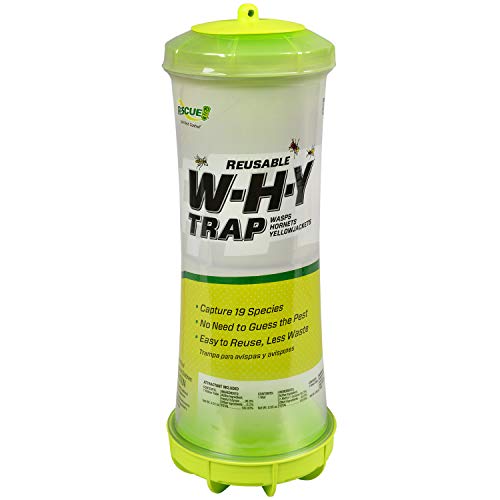
The RESCUE! WHY Trap is a durable, dual-chambered wasp, hornet, and yellowjacket trap that uses three attractants to target 19 species without requiring insect identification. Designed for reuse across multiple seasons, it offers season-long protection by catching queens in spring and workers through fall. Made in the USA, it combines eco-conscious design with effective pest control for professional-grade outdoor comfort.


| ASIN | B001H1GRPI |
| Best Sellers Rank | 250,098 in Garden ( See Top 100 in Garden ) 377 in Bee, Wasp & Hornet Control |
| Customer Reviews | 3.3 3.3 out of 5 stars (3,660) |
| Date First Available | 17 April 2012 |
| Department | Teak |
| Item display height | 13 inches |
| Item display length | 18 inches |
| Item display weight | 272 g |
| Item display width | 10 inches |
| Item model number | WHYTR |
| Manufacturer | RESCUE! |
| Material type | Plastic |
| Part number | WHYTR |
| Power source type | Manual |
| Product Dimensions | 10.16 x 12.19 x 30.48 cm; 0.28 g |
F**M
High Hopes!
Item arrived quickly (comes from USA) and was easy to put together. Sadly after two weeks it only had one wasp in it and I am still getting them out of the house on a daily basis. I will get some more liquid and try one more time though.
R**.
Attention ! Ne fonctionne pas sur les frelons/guêpes européens ! Très déçu donc... Testé en france : aucune capture ! (Un autre piège maison (sirop/bière) placé à même distance du nid en a par contre attrapé une vingtaines...)
V**N
NO ME LLEGARON, LAS COMPRE DESPUES ME LAS TRAJO MI HERMANA, Y NO FUNCIONAN CON ABEJAS. 1 1 1 1 1
M**G
Updated September 16, 2020. The Rescue WHY trap is still performing well. I use unfiltered apple juice, high sugar soda pop, sugar melted in warm water or old honey mixed with water in the upper compartment. The liquid that Rescue provides for the upper liquid compartment of the WHY trap is not very effective. I do use the liquid attractant in small yellow packet AND lunch meat above cone. Or better yet some canned cat food pate wrapped in a small part of a paper towel soaked with any liquids above. Use disposable gloves and prepare this in kitchen with hood fans on because it stinks and if you prepare this outside yellowjackets will be all over you before you finish preparing. I just bought two more today! It is us against the yellowjackets. I have not gotten wasps consistently. Those have to be sprayed at their nests. Good luck and you know your mission should you decide to accept it!! 2018 review: We have had over 4 months of extended hot weather for Portland Oregon area so the conditions are ripe for a large yellowjacket population and this is the worst year I've seen in 18 years I have lived here. I also have many wasps but I have not mastered how to catch wasps yet. We have a 6 acre farm with 200 fruit trees and hundreds of berry plants as well as grapes. I have four Rescue WHY traps and about 7-8 old style Rescue yellowjacket traps. Both of the pictures above were hung on a tree about 3-4' off the ground. You dont want to put them too high because the yellowjacket scouts skimming above the ground might not smell the bait. Inside all traps are a bait bag with low quality inexpensive raw beef on sale as well as canned catfood (I think its Friskies Grill mate). I put on disposable yellow gloves and make these bait bags in the kitchen under the hood fan above the range with the fans on high because catfood is stinky. The picture of the WHY trap has the attractant provided by Rescue in the lower section and apple juice in the upper section. The picture of the old style has only the catfood/steak bait bag described above because I ran out of the attractant. Catfood alone is very effective and I would guess there are about 300 bees in the old style and maybe 500-500 bees in the WHY trap--both were set 48 hours ago! The new WHY trap is higher quality than the original Rescue style yellowjacket trap. It has thicker plastic, larger compartments and the half liquid and half bee attractant is quite versatile. In the top compartment, I have tried apple cider or Coors Beer. It looks like the Coors beer has more bees but that is a different location so that is not scientific data that proves beer is better. It is a lot cheaper than apple juice/cider. I have also made homemade yellow jacket traps because I like to work with my hands and its a lot cheaper. With homemade ones I use gallon size or half gallon clear juice bottles. You can use plastic gallons for liquid laundry detergent or vinegar but I like to see through them and see how many are accumulating and what bait or style is performing better. With the homemade ones, i like to use black rotten bananas that we save in the spring and freeze them on traps cut in thirds with skin. Add maybe a couple tablespoons of sugar, 1/2 cup of vinegar and water. Then dangle these bait bags from the top just slightly above the liquid. I drill holes the same size as the Rescue traps in the cap. Use monofilament or that new thin braided spectra line so the bees cannot crawl up a string or twine and escape. I realize this is a lot of information and most people wont be willing to do what we have done but yellowjackets wiped out our honey bee families so I've declared war on the yellowjackets. And its kind of fun. In the last week or so I've got maybe 10,000 yellowjackets in 12 Rescue yellowjacket traps. Eight were old style and 4 are new WHY traps. One more thing, the liquid attractant provided in the WHY traps was not effective, it killed about 8 bees. I cannot tell if the bees in the top compartment are wasps or yellowjackets but at first glance it looks like mostly yellows with some flies and really large black bees with a little yellow. An occasional black bumble bee and no honey bees go inside any of these traps from Rescue or homemade. Good luck to you all and I will post some photos in a couple days of homemade traps. Oh, one more thing (as Lt. Columbo used to say), I have about 50 homemade traps with the recipe above and they usually get 2,000 each by October 1st. Last thing, really this time, make sure you wash out the trap and cone each time you empty the dead bees and rebait. I don't wash the lower screw on cap that holds the attractant because i think that smell is still good to attract bees. I hope this helps you.
S**K
This trap broke my heart. I hired it to do one job, but I might as well have paid for it to sit around asking when dinner is. The WHY trap is super lazy and only talks to me when he needs something. But all he does throughout the day is sit outside sunning himself and CATCHING. ZERO. WASPS. I'm currently saying the name of the brand over and over because I'm constantly asking myself WHY did I invite this trap into my home. We have wasps buzzing all over the yard and yes, inside our house. And yet he does nothing except stare at them blankly. The only reason this product is a trap is because it convinced me to send my money to the company and that money will never return. It doesn't trap wasps, hornets, or yellowjackets if that's what you want to know. I saw a hornet fly by the WHY trap the other day and I'm pretty sure I overheard the trap saying "Yo find another spot in the yard, this spot is taken." Because the hornet looked the trap aghast, and huffed off to another part of my roof where it then took up residence and now is the proud father of 20 baby hornets. They've asked us to be the god-parents but I'm not sure if I want to encourage them. Bottom line, in all seriousness, DO NOT waste your money on this trap. Instead, buy a large flip-flop and kill the wasps yourself.
S**I
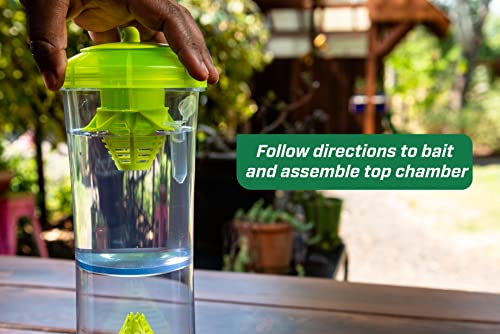
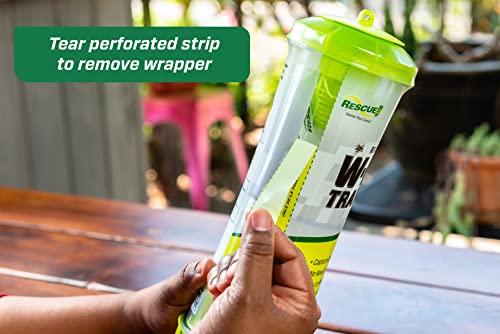
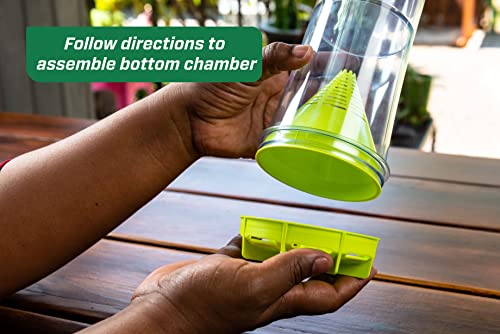
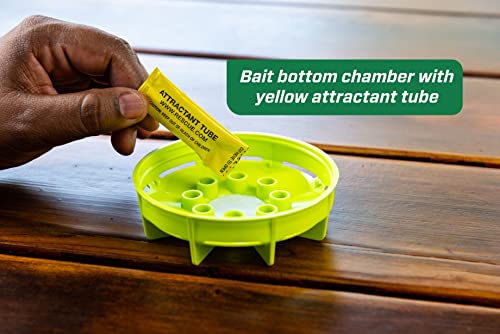
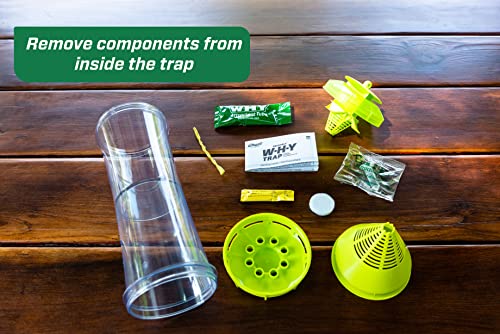
We are on our second year of having three of these outdoor W-H-Y traps with one on our front porch and two on opposite ends of our back patio/outdoor living area. Setup: If you are setting up multiple traps, I would suggest having a flat workspace. Bring along a water pitcher or watering can and smaller, sharp scissors or [box] knife. I have found that it is easiest to disassemble the whole trap, rinse/wash out the upper section and inspect for any cracks, refill the upper section with water (to the marked line), cut open & add the attractant, open the small vial of attractant and clip into the lid before screwing it onto the top, and then cut open & add the smaller attractant to the felt in the base before screwing it onto the bottom. Finish it off by rehanging wherever you feel that it will get the most "traffic." Review after the first year: What I did not realize/account for in that first year, is that these traps require a full reload every month. After reading through the included literature that first time, I set them up and then had to go back online to buy additional refill kits for the coming summer months. I also "discovered" that getting them setup early in the spring is arguably the most important, as that is when the wasps, hornets, and yellowjackets are first out looking for places to setup homes. Subsequent reloading of the traps may help pick up some stragglers, but those first couple of months is your best bet at helping to prevent these pests from setting up homes on your property. In light of the above, these traps are not very effective at eliminating any "established" wasps, hornets, and yellowjackets that may already exist around your home. Those pests have already found a safe place to setup camp, and they are not as likely to be enticed into the traps. For "established" pests, I found that I pretty much still had to find their homes and deal with them with a foaming or instant kill type spray. So, for their preventative properties, I will begrudgingly give them four stars for the time being. They are not very effective at dealing with pests that fly through/by your yard or established pests on your property, and for that they permanently lose a star in the ratings. For the initial cost & maintenance (refill kit) costs, I am tempted to remove another star, as they yield what seems to be lackluster results. I am only gifting that 4th star in my rating due to a combination of what I feel is my lack of understanding of wasp, hornet, and yellowjacket behavior and my possibly unrealistic expectation that they would attract, trap, and kill more pests.
Trustpilot
2 months ago
2 months ago