
DOWNLOAD THE APP


Customer Services
Copyright © 2025 Desertcart Holdings Limited
DOWNLOAD THE APP
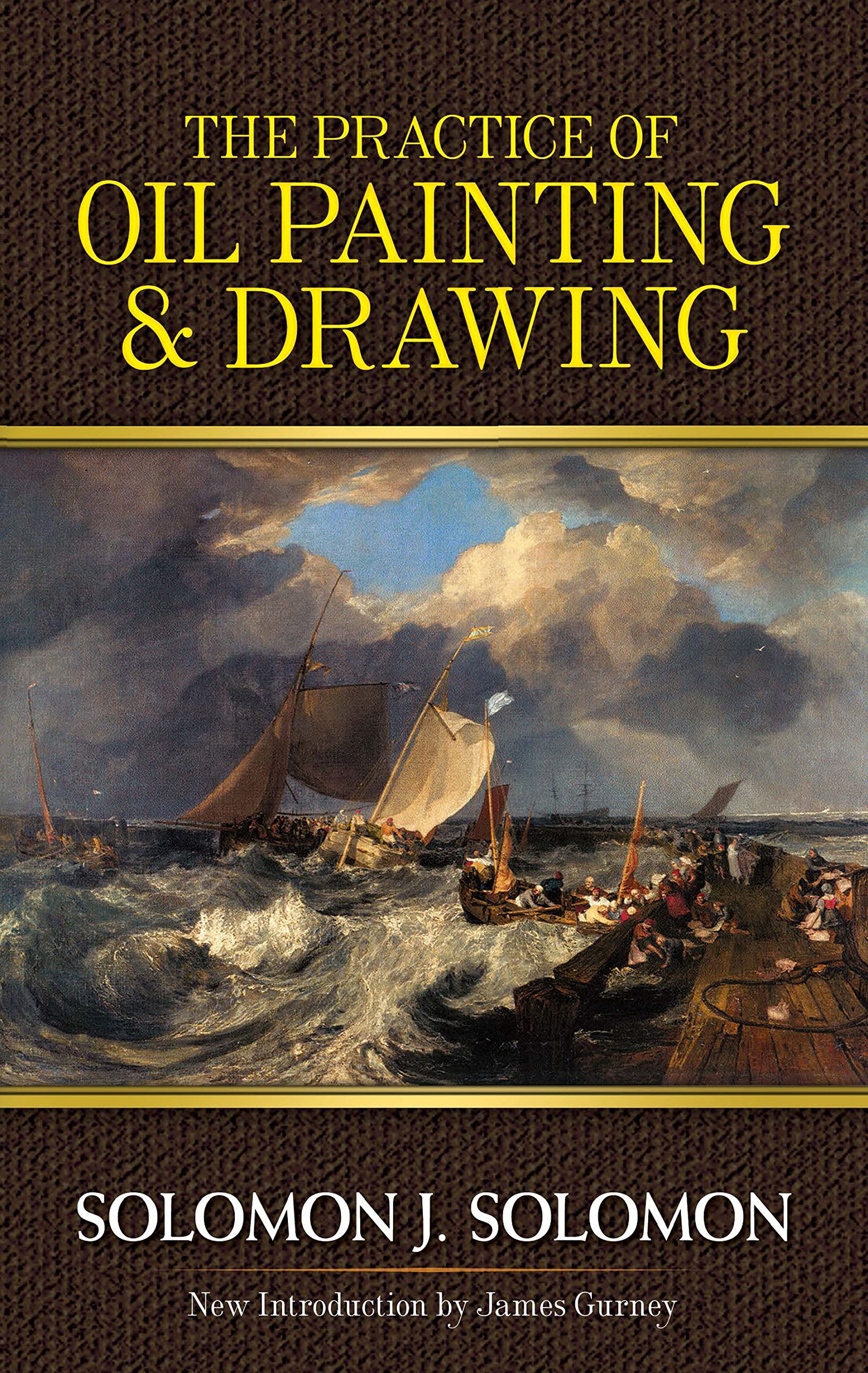
🎨 Elevate your art game with the ultimate classic guide!
Practice of Oil Painting and Drawing by Solomon J. Solomon is a revered Dover Art Instruction re-issue offering a clear, logical approach to mastering classical oil painting and drawing. Featuring practical methods like 'drawing by the masses' and insightful breakdowns of old masters’ techniques, this book is a must-have for artists seeking authentic atelier training. With a 4.3-star rating and enhanced color plates, it bridges traditional wisdom with modern accessibility.
| Customer Reviews | 4.3 out of 5 stars 109 Reviews |
A**P
A timely re-issue of an indispensable guide for artists
* N.B. the one-star previously given by another reviewer in 2010 pertains to a very different, poorly made edition without images, NOT the one issued recently (oct 2012) by Dover books, at which you are most likely looking now. Amazon unfortunately merged the reviews for the other, poorly OCR'd edition with this one. * * * As for this new edition, re-issued by Dover books and with a foreword by James Gurney - it is a gem of a book. A wealth of drawing and painting wisdom awaits within its pages. Victorian master painter Solomon J. Solomon shows you how to start drawing and slowly progress to successful painting. His methods are, it seems to me, logical, easy to understand and his advice and guidelines eye-openers. Solomon gives an overview on how one should practice and progress in drawing and painting (most of which was really eye-opening for me) in the first part of the book, with some practical methods and steps to consider in both drawing and using color. I particularly liked his tried-and-tested method of "drawing by the masses" (in short, measuring form by the negative shapes). This method, which he outlines with practical examples instantly appealed to me. It's very intuitive and it may be one of those things that you were already doing, subconsciously, but now that you're aware of it, can nurture it and develop it into a great skill. The second and largest part of the book is a vast study of some of the greatest paintings by the old masters. He breaks it down, discusses their techniques, colors, etc. - it's a real treat. Recently there have been a few books that have been trying to fill the void of study material for academic or classical atelier painting and drawing. I'm thinking of the books by Juliette Aristides (both Classical Drawing Atelier and Classical Painting Atelier) and for example Figure Drawing by Anthony Ryder. I own all these and think they are good books, filled with useful information and methods. But Solomon's book just stands out for its clarity, logical methods, and concise information. I believe he has managed to say much more with fewer words. Studying Solomon's book feels like really coming close to the very essence of classical atelier training, a tradition that goes back to the Renaissance. To conclude, it's one of the few books out there that are really valuable for professional artists and hobbyists alike. No matter what level you are, there's something in here for you. My only complaint - if any - would be that the size does not accommodate for large images, so that some of the larger paintings reproduced are a bit too small to get all the detail. But that would be criticism towards the publisher, not the author. Still, this doesn't take away anything of the book's content value. I would give this 10 stars if possible. Very recommended.
A**E
Before art education lost its way.
I bought this book to replace my rather old and disheveled 1910 version I bought many years ago from a second hand book shop. This new version from Dover is an improvement in that it has colour plates for some of the Old masters paintings which were only monochrome in the original. My only very minor criticism is that the reproductions of some of the illustrations are not as good as the 1910 original and makes it difficult to understand what S.J.S is teaching. Only by referring to my original 1910 book was I able to make total sense of some of his explanations, this is most notable in plates I and II (Horse, Vase) where the dark lines are lost into the dark backgrounds. Any one interested in this excellent book and in a more traditional properly taught art education will probably learn a lot from reading Harold Speed's brilliant 2 books on drawing and painting.
R**S
Good book!
If you want a book that lays out a good solid technical approach using techniques of the masters, this is a good start. It isn't as great as a tutorial where you actually see how the artist does it, but as far as written instruction goes, it's pretty good, full of valuable insights.
J**P
of limited use
The size of a paperback novel. Writing style a bit archaic as you would expect. The author is highly opinionated. Some interesting historical stuff but not a very accessible book. More of a curiosity rather than useful instructional text. Save your money.
M**T
I bought Two copies and am really disappointed.
It is old fashioned and far to technical. I bought Two copies and am really disappointed.
A**R
a very poor edition
This is essentially a download of an out of print book which has been bound in paperback could probably be found free elsewhere. There is no typesetting or even differentiation in paragraphs, and the illustrations only exist on a website to which the book refers you. The information contained in the text is probably very good, but I haven't had a chance to wade through this very cumbersome mess of a book. Don't part with your £14.
G**R
Query
ALP has kindly answered my query (below). The b/w photographs are indeed reprints of the originals from the 1910 edition. This means that a reader can compare them with the colour versions and get some idea of how much paint has been removed since 1910. Further details on the website of ArtwatchUK. I fully agree with ALP's 10 star endorsement of this marvellous book. It may be worth noting that Solomon seems to have been the first to write about drawing by the background shapes ('negative shapes, or spaces' as they are now called). Sickert particularly commended this section in his review of the book when it first came out. Solomon almost certainly was not the originator of this approach to drawing, but I know of no earlier book which expresses this vital idea. I remember reading it when I was a schoolboy and, after an intensive weekend, returning to school being able to draw with a tremendous increase in accuracy. My friends hailed me as a genius, and would not even listen when I told them I had only learned a trick from S J Solomon. _________________________________________________________________________________ This is a question, not a review. I have not yet seen this edition. I have the original printed version of this. It is an excellent book which has inspired me for an entire lifetime. The original illustrations show the paintings as they were in 1919 or earlier, before the National Gallery cleaners had removed much of the paint (for better or worse - worse in my opinion). Does this reprint show these original photographs? Many of Solomon's comments do not apply to the paintings as they are today. Much of the beauty of colouring to which he refers, and which I remember from having seen the paintings decades ago, may no longer be seen. To my eye the Andrea del Sarto, for example, looked perfect in tone, as he describes. It does no longer. If the original photos are reproduced, this could be a valuable document for those seeking to understand what was so good about the paintings when Solomon saw them. Other comparisons may be seen on the ArtWatchUkK website. Not that the photographs are all that much to look at in themselves, but comparing them with photographs of the paintings as they are today gives some idea of how much has been changed. Can any reader tell us whether the original photos are reproduced? The hand in Rembrandt's 'Woman Bathing', for example, is now a few brushstrokes, whereas in Solomon's illustration it was smoothly finished. (Allegedly damage had been repaired by Sir Joshua Reynolds whose brushstrokes have now been removed).
Trustpilot
1 month ago
2 days ago