🚀 Elevate your home network to WiFi 7 speed and beyond!
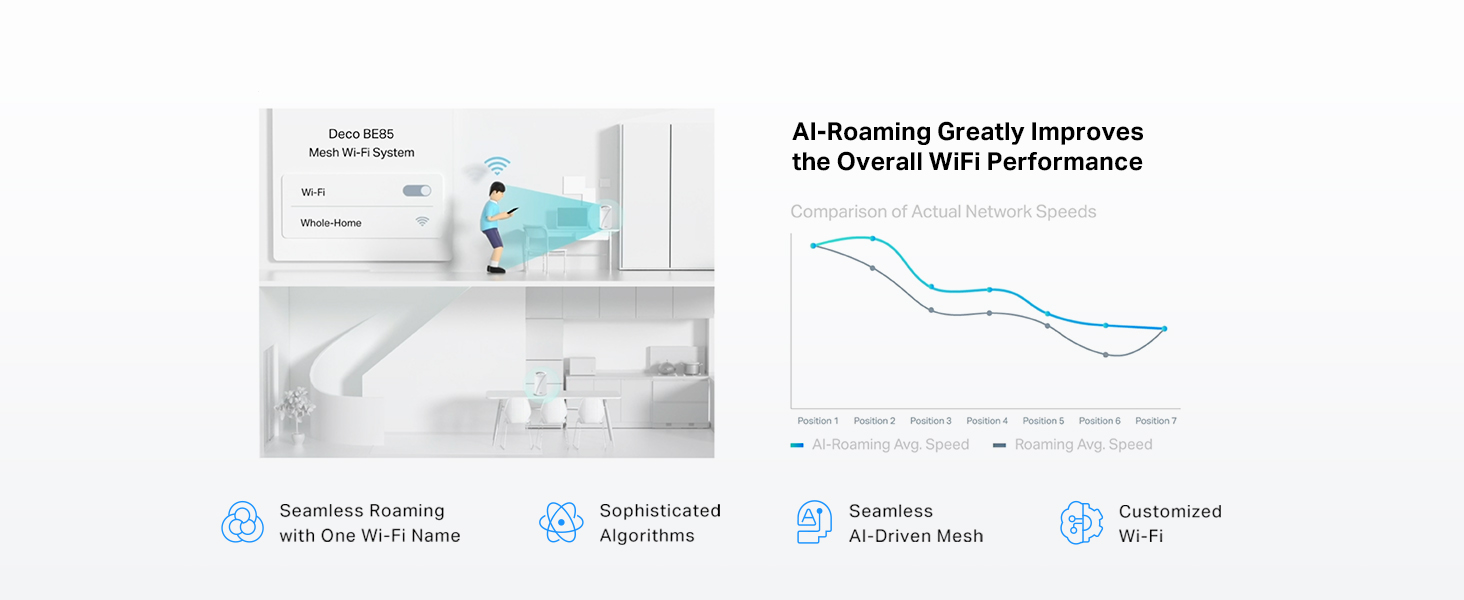
The TP-Link Deco BE85 is a cutting-edge WiFi 7 tri-band mesh system delivering up to 22 Gbps speeds with 12-stream technology. Featuring dual 10G WAN/LAN ports, simultaneous wired and wireless backhaul, AI-powered seamless roaming, and robust HomeShield security, it’s designed to future-proof your home network and support over 200 devices effortlessly.


| ASIN | B0CR5C4RZN |
| Best Sellers Rank | #28,830 in Computers ( See Top 100 in Computers ) #115 in Whole Home & Mesh Wi-Fi Systems |
| Brand | TP-Link |
| Color | White |
| Connectivity Type | Wi-Fi |
| Customer Reviews | 3.9 3.9 out of 5 stars (208) |
| Date First Available | 20 May 2024 |
| Item Weight | 1.46 Kilograms |
| Item model number | Deco BE85(1-Pack) |
| Manufacturer | TP-Link |
| Operating System | TP-Link proprietary firmware |
| Product Dimensions | 12.8 x 12.8 x 23.6 cm; 1.46 kg |
| Series | WiFi 7 Mesh System |
| Wireless Type | 802.11.be, 802.11ac, 802.11ax, 802.11g, 802.11n |
M**I
Very bad
Very bad items and not recommended to buy it
M**D
الجهاز ممتاز من ناحية الأداء، الثبات، وسهولة الإعداد. لكن المنتج مُعلن كـ BE22000، بينما الجهاز الذي وصلني مكتوب على العلبة BE19000. لا يوجد فرق واضح في الاستخدام اليومي، لكن وصف السرعة لا يطابق النسخة الفعلية. يفضّل تصحيح الوصف لتجنب اللبس للمشترين.
P**R
Es un producto realmente impresionante. Mi conexión a Internet es por 700Megas ahora simétrico. MI casa es de 110m cuadrados, pero tenía un WIFI-PowerExtender puesto que la señal inalambrica del modem no llegaba hasta las recamaras al fondo de la casa alrrededor de unos 10-15 metros del router principal y con más de 3 paredes entre ellos. El Wifi PowerExtedner (solución anterior) solo me daba 20 a 26 Megas en las recamaras de atrás como mucho y los aparatos WIFI allá tenian muchas desconexiones, era frustrante. Tiré ese sistema a la basura y puse dos antenas DECO BE22000 y tengo 700MB completos en ambas recamaras atrás y 700 completos en el estudio. Es verdaderamente impresionante que el Streaming e incluso el Playstation de la recamara funcionan como si estuvieran conectados directos por cable al router de salida. RECOMENDADO AMPLIAMENTE!
M**F
Este fue el primer set de routers que me permitió tener internet de alta velocidad en mi casa de 2 pisos. Probé otros routers de la misma marca y no tienen la misma potencia que este. Excelente producto!
R**N
As a current owner of a 2nd-generation Eero mesh system, I have been very happy with the brand. It has consistently delivered reliable wireless internet across my home with no issues whatsoever. However, the WiFi 5 technology is now 6 years old and I had set my sights on upgrading and future-proofing my wireless mesh network. For months, I waited for the TP-LINK BE85 or BE95 to go on sale. Despite the mixed reviews these mesh units have received online, I thought it would be worth the gamble to see if it improved my home network. On Amazon Prime Day, the price of the BE85 3-pack dropped to $799, which was the perfect opportunity for me to finally grab these. Within 10 hours, I set up and then returned the TP-LINK BE85 mesh system THE GOOD Installation was a breeze and took under 15 minutes for all three units. The app does a great job of guiding you through the setup. As soon as you have the main unit connected, the other two are already programmed to connect. Essentially, they become plug-and-play. Each Deco unit is rock solid in construction. It has 2x10Gbps and 2x2.5Gbps ports. This is great to have should I ever consider upgrading to a 2GB Internet service, which is not likely, but still futureproofing. The Decos also has a USB port to connect and network an external drive, which I found to be one of the most compelling features. After installation and network connection, I put the mesh unit in AP mode as two of the units had backhaul ethernet connections. I have a 1GB Internet feed I was elated to see significant wireless speed increases across my entire home with no dead spots. My speed increased to an average of 200mbps per location I tested. When I was within 6 feet of one of the wired Decos I would get a 600mbps connection (compared to 312mbps with the Eero). Further away from the nodes, I would see wireless speeds of 250mbps (compared to 54mbps with the Eero). I should note here that, according to the Deco app, I believe everything was connected to the 2.4Ghz/5 Ghz network so I don't even know if my devices were taking advantage of WiFi 6 or WiFi 7. Since I used the same SSID and password of my Eero mesh, almost everything immediately connected to the new network. THE BAD My five Nest cameras disconnected. Surprisingly, my Ring cameras remained connected. I am pretty confident I could have manually removed and then added each of the Nest cameras to the new mesh network, but that is a huge hassle given the fact it can't be done through the Nest app. I have to get up on a ladder and rescan the QR code on each camera which is a major, major hassle. I would have done it, however, if not for the next issue... My devices were constantly disconnecting and then reconnecting to the network for 10 hours post-installation. This included my iPhone, my laptops, and my Amazon devices. I did extensive Google research and played around with some recommended changes in the Deco app. This included turning off roaming and manually telling each connected client to disconnect from the mesh network, none of which helped. Mind you, these were all TP-LINK support recommendations. I even updated the firmware, which did nothing. I did come across something that made me decide I needed to return this Deco mesh system... Countless -- and I mean countless complaints on Reddit and other message boards about network instability with many of the TP-LINK Deco mesh systems. Don't believe me? Google, "TP-LINK DECO DISCONNECTS" and you will be horrified with the results that you find. These things are essentially trash. For so many people to have the same mesh network instability that I am currently experiencing, tells me that this is a highly unreliable brand. And, sure, there are many positive reviews on Amazon (as well as bad ones), and generally only people who have issues with their products end up posting a bad review --- but it's still very obvious to me that this is not a reliable product. Many posts I read indicated that customers who returned their TP-LINK looked to move to Eero. CONCLUSION I am back on my old Eero system. Everything is working fine, albeit I'm back to slower wireless speeds, which for the moment, is okay. I would consider upgrading to the Eero Pro 6+ mesh units (at around $300 for a 3-pack on sale), but I am not certain they will give me significant gains as the more powerful Deco units did. Then there's the Eero Pro 7 Max. It will probably come down to $1k for a 3-pack soon, but it's not getting very good reviews. I may just have to suck it up and remain with my 2nd generation Eero mesh system until better hardware gets released.
K**N
The quick rundown is: The house is an approximately 3,500 SF single-level home with many brick-solid doors and twists and turns. The modem is in the center of the house in my office. Wi-Fi without a mesh system would drop off in the back rooms to a crawl. I previously had an ORBI RBS850 for my Cox 1GIG Down / 35 Up plan (they just changed to 100 up before I switched). The ORBI did fine for the last three years I had it. However, even though I would move the satellites around, I would still get reduced speeds in the furthest rooms. Based on ORBI, the RBS850 with two satellites should have been overkill, but it wasn’t. I recently received FIBER and opted for the 1Gig Up/Down. Since the speed is overprovisioned, I’m able to get 1,300 Up/Down. My ORBI was limited to 1 GIG port, so I was limited to around 945 with overhead down and the full upload speeds. Since I do a lot of CAD and video work, I am also considering moving to the 2 or 5-GIG plan in the future. I researched many of the new Wi-Fi 7 mesh systems. Note that I currently do not have any Wi-Fi 7 devices, but I might in the future. I narrowed it down to the new ORBI 970, the Deco BE 95, the Deco BE85, and the Eero Max 7. I chose the Deco BE85 due to its two 10 Gig ports and two 2.5 Gib ports and the price factor. The ORBI was way overpriced, and the BE95 offered me nothing extra. Though the Max 7 was tempting, I ultimately went with the BE85 since I would have wired backhaul on both satellites. My out-of-the-box experience: 1. The Deco comes packaged in a very nice, easy-to-open container. 2. You are presented with three identical Deco units, three power adapters, and a cord for each that can be removed, making it easier to fish power cords for the Deco. 3. I appreciate that the plug-in on the Deco is a normal size and isn’t one of those that take up three or four plug-ins due to its shape/design. 4. I already had my BGW320-500 modem set to bridge mode and the ORBI as the router. 5. I downloaded the TP-Link APP and started to install the Deco BE85 Mesh system. 6. The app asked me to scan the bottom of one of the Decos (it didn’t matter which, as it would become the main). 7. The app did not list a BE85. Maybe it is listed as a BE2200? Nope. 8. I then continue to install but choose Install MANUALLY. 9. I turn off my printers (you will really want to do that) 10. Unplug my BGW320-500 Fiber Modem. 11. I disconnected from all of the ORBIs. 12. I take a photo of the bottom of the Deco I choose to be the Main so I can add the MAC Address 13. I then connect to Deco’s Wi-Fi through my phone. 14. It then tells me that the Deco I chose doesn’t match the one I’m installing. ( I KNOW THAT.) 15. It asks me if I want to change it to the BE85. Of course I do. I say yes and click Next. 16. It tells me to connect the Fiber Ethernet to my Deco and then to my Switch. 17. I connect to the top 10G port on the Deco and then to the switch on the bottom 10G port of the Deco. 18. Since I have a switch with two 10G ports and 6 2.5 G Ports, I connect all the drops to my other rooms to my switch. 19. Deco warns me that only one 10G port can be used and that the bottom is a combo port. For a second, I thought, why give me two ports if I can only use one? Then, it dawned on me that the warning was poorly written. What they mean is you can use the bottom port as a 10G ethernet port by taking out the plug and using the bottom SFP+ port (if needed), but you can’t use both at the same time. 20. I then placed my first Deco satellite Unit in Room 1, connected the wired ethernet drop to the top 10G port, and connected the lower 10G port to my Switch in Room 2. 21. I then plug in the first Deco Satellite, and it connects almost immediately. 22. I do the same thing for Room 2, connecting it the same way as Room 1. 23. I then change the SSID to match my old SSID and password Exactly. 24. Make note that both are case-sensitive. 25. It takes it, and Now I don’t have to change all my Wi-Fi log-ins on 50+ devices. 26. Before I started, I had an Excel spreadsheet with all my devices' MAC addresses. You should do the same if you can. 27. I looked at the Deco app on my iPhone and noticed that most of the devices did not have very good descriptions. I simply went into the app, looked at the connected MAC address, referenced it with my spreadsheet, and copied the name from my spreadsheet into the Deco app. (Note that I had the spreadsheet on Dropbox, so I was able to copy from my iPhone to the Deco app without typing them all out. 28. In about 10 minutes, I had all my devices with good descriptions. 29. I then noticed that there was a section for devices that were not currently online, like TVs, PS5s, etc. I changed the names of these devices, too. 30. I checked everything out and noticed the 6Gz channel had my SSID followed by _6Ghz, I do have some phones that are 6Ghz so I went in and changed the SSID to match my other SSID by removing the _6Ghz at the end of the name. 31. My phones were not connecting to the 6Ghz. 32. I then found a place under Advanced called Fast Roaming. It was off by default. I turned it on, and my phone connected to the 6Ghz channel. NOTE: If you have some older 2.4Ghz devices, this could cause them not to connect, and you will have to turn them off or get updated devices. 33. I then noticed the Deco App had a DARK mode. I changed it, and my eyes thanked me. 34. I noticed in the app that there is a delay, so give it a moment. 35. I downloaded the App on both my personal and work phone, and they synced perfectly, but there was also a delay there. 36. I noticed you can access your network even when your phone is not connected to the network. This can come in handy. 37. I then noticed four devices I had never seen before. After much investigation, I noticed it was showing me the switches connected to it. It was strange because they were TP-Link switches but were showing as Android 1-2,3,4. I corrected those names as well. 38. I then ran the network optimization tool, which lets you know if there is interference with the main unit or a satellite. Moving them slightly or moving something away from them can help. This was actually a handy feature. 39. I tested my speeds, and the connected PCs (all but one connected by ethernet) are 1250-1300 Up/Down. 40. iPhone 15 Max is quite fast in every room. I get speeds of at least 750 Up/Down depending on the room I’m in, and if I’m close to the Main or a satellite, it is even faster. 41. The Web interface for the Deco is…Just use the phone App. 42. The Decos are warmer than my ORBIs, so keep them in a ventilated area. 43. I wish they would come in different colors. 44. If you can, WIRED BACKHAUL is the way to go. 45. My TVs are all Sony Bravias. I got a USB to RJ45 adapter and plugged it into the USB3 port on the TV, then connected that into either the Deco or the switch (same speed on both). As you can see in the photo, 950+ speeds up/down. (I don't know if it will work on other model TV's) 46. If your TV supports it, this is the way to go. It is faster than the 100MB limited switch on the TV and faster than Wi-Fi, even with the satellite sitting right next to the TV. 47. I don’t know how this will work yet, but I set the Deco to check for updates nightly. Hopefully, this will prevent a problem with a rogue firmware update. 48. Set notifications when new devices join the network. 49. I didn’t opt in for their Parent Control. My kids are 34-28 and alone, so there is no need. 50. I didn’t get their protection as I have my own, and they should have included it for free. 51. Crazy thing happened. On an ATT modem set to passthrough, you need to enter the router's Mac address (I had the ORBI entered first, then changed to the Deco when I replaced it). You go to your AT&T status page on the web 192.168.1.254, enter your credentials, and go to Firewall > IP Passthrough. Change Allocation Mode to Passthrough, Passthrough Fixed MAC address you can select from list or enter the entry Manual. The manual is fine. Now, here is the crazy part. I still had my disconnected ORBI as the manual entry, and everything worked fine. I couldn’t see any issues. I changed it to match my Main Deco unit, and all is still fine. I really don’t know how it worked before. 52. Take a photo of the main unit to have it when you change the MAC address. 53. One last thing: when I had my ORBI as the router, all my IP addresses were 172. xxx, and with the Deco as the Router, all my IP addresses changed to 192. xxx. I don’t know why, but everything is working. 54. NOW, back to the printers. If they are off when you get everything connected and then turn them on, they will connect easily. However, depending on the printer model, they may get lost, and everything will be connected except your printers. So, to be on the safe side, turn them off, and once everything is connected, turn them on. 55. Well, I hope this helps someone with their Deco.
Trustpilot
2 days ago
1 day ago