
DOWNLOAD THE APP


Customer Services
Copyright © 2025 Desertcart Holdings Limited
DOWNLOAD THE APP
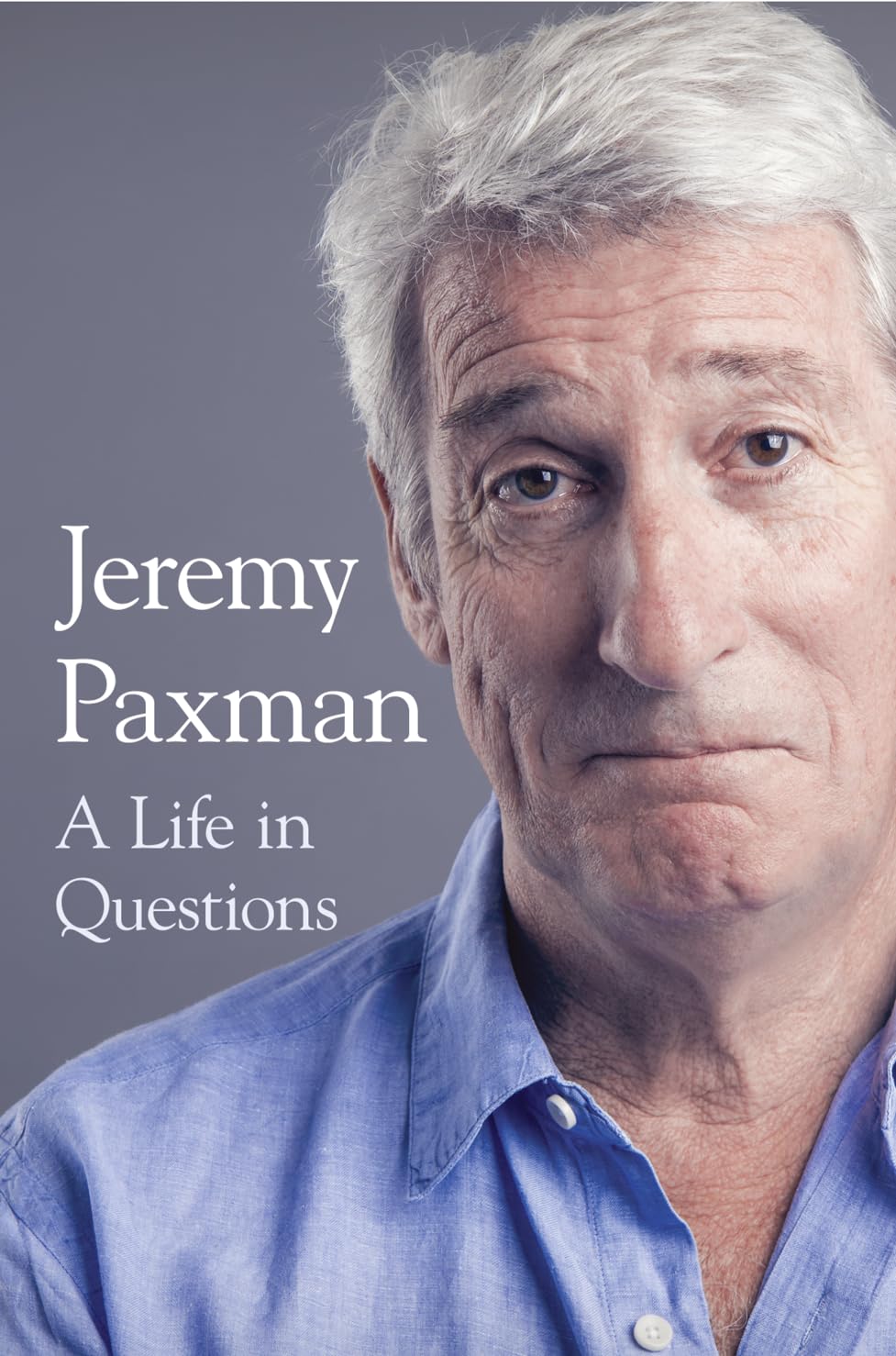
desertcart.in - Buy A Life in Questions book online at best prices in India on desertcart.in. Read A Life in Questions book reviews & author details and more at desertcart.in. Free delivery on qualified orders. Review: Great Read for Paxo fans.... - Well written with great insights on what goes on behind the scenes at the venerable BBC and other places that Jeremy has been associated with. Fantastic command of English, as always Review: Very candid, penetrating comments from highly perceptive ascerbic personality. Witheringly honest and full of scathing humour from a thoroughly likeable person
| ASIN | 0008201536 |
| Customer Reviews | 4.2 4.2 out of 5 stars (779) |
| Dimensions | 15.3 x 2.7 x 23.4 cm |
| ISBN-10 | 9780008201531 |
| ISBN-13 | 978-0008201531 |
| Item Weight | 470 g |
| Language | English |
| Print length | 320 pages |
| Publication date | 31 October 2016 |
| Publisher | William Collins |
V**R
Great Read for Paxo fans....
Well written with great insights on what goes on behind the scenes at the venerable BBC and other places that Jeremy has been associated with. Fantastic command of English, as always
K**R
Very candid, penetrating comments from highly perceptive ascerbic personality. Witheringly honest and full of scathing humour from a thoroughly likeable person
A**A
Gift
B**N
As an admirer of Jeremy Paxman, this was a book I was looking forward to reading and I was not disappointed. It is entirely about his life, from his schoolboy days to the present. There is nothing about his adult family life with his partner and their three children. It starts with a brief, but revealing, account of his early upbringing in a household dominated by his bullying naval officer father, who later left the family and emigrated to Australia and later New Zealand, never to return until his second wife brought his ashes to be buried in England. Paxman makes no comment on the effect on him personally of his father leaving the family, but interestingly in later life he did journey to Australia to have what turned out to be an inconsequential meeting with his father. He then moves on to his school days, initially at a private prep school (“staffed by drunks and pederasts”) and later at the minor public school Malvern. He gives a good account of life in such institutions at that time with their arcane rules, and the peculiar characters of many of the staff that populated them. (The account of an extraordinary address by a visiting Canon from Coventry Cathedral on ‘masturbation as a gift from God’ is priceless.) Paxman clearly despised both his prep school and Malvern and showed little academic promise. But somehow, after repeating his A levels, he managed to get an offer to study English at St. Catherine’s College, one of the less prestigious colleges of Cambridge University. Like his school days, his three years as an undergraduate are passed over rather briefly, although there are some amusing stories concerning his activities on various student newspapers. By p70 the book turns to an important period of his life as a news reporter ‘in the field’, and there are excellent accounts of his time reporting from a number of conflict areas including Lebanon, Uganda, Afghanistan, Nicaragua, Zimbabwe and Northern Ireland. His reports from the latter incurred the fury of the Conservative government, who accused him of siding with the IRA. Again there are interesting stories and anecdotes, but his period as a war correspondent is also treated fairly briefly, and by p127 we arrive at the main theme of the book, his time at the BBC. There is much about his early days there covering a variety of events as a member of teams on various programmes, such as Tonight and Panorama, until he was offered Newsnight, which he presented from 1989 to 2014, and during which he interviewed numerous famous people. He says he saw his job there as simply to ask politicians straightforward questions and to get straightforward answers, which of course they often did not want to give. His abrasive style sometimes veered close to cruelty, for example when at the end of a disastrous interview he asked a hapless junior minister, put up to defend the indefensible, “Do you ever think you’re incompetent?” When Jeremy Paxman left Newsnight, politicians and other public figures throughout the land must have heaved a sigh of relief. No longer would they have to endure the ordeal of an interview/interrogation at the hands of the ‘Paxo’. Viewers, however, in the main looked forward to seeing the ‘victims’ squirming to explain their unjustifiable, incompetent and often self-self-serving actions. (The notorious interview with Michael Howard on the question of whether he did or did not sack someone is recalled here.) Paxman obviously found most of his interviewees unimpressive, and reserves his admiration for very few: for example, Tony Blair for his skill at mastering a brief (even it was ill-informed). His experiences at the BBC are used to discuss his thoughts in general about the roles of the organisation, the TV reporter and many others. Much of the BBC management comes under withering fire (the fiasco surrounding their treatment of the Jimmy Savile affair is explored in detail) as do others lower down the food chain, including news readers, for whom, with few exceptions, he seems to have nothing but contempt. One job he clearly enjoys is being the host of University Challenge, a role he has played for many years. The book ends with his answers to a list of questions he is frequently asked by members of the public, and a final chapter on his views on broadcasting in general and the BBC in particular in the light of competition from modern electronic media. Paxman is often accused of rudeness and arrogance, a fact he is fully aware of, and he admits that sometimes the questions he asked were “unkind”. David Cameron was said to have hated him and tried to avoid being interviewed; John Reid, the then Home Secretary, described him on air as a “government attack dog”. But in this frank account of his life he comes across as an honest man who expresses himself in a sardonic way, particularly when trying to elicit the truth from people who would rather keep it hidden. From the evidence here he is certainly not arrogant. He is critical not only of others, but also of himself, even hypercritical, which may partly account for his frank admission of sometimes suffering from depression and having undergone therapy. On the contrary, he is rather self-deprecating and even a little vulnerable, as he showed when the subject of the programme ‘Who do you think you are?’, where he researched his ancestry. His love of the rather solitary sport of fly-fishing is probably not without significance. Paxman is no saint, as the allegations of his employing Rumanian domestic help at below minimum wages showed, but he has interesting views, strongly but honestly held, which are always worth hearing, even if you disagree with them. The book is full of sound common sense leavened with wit. It is well worth reading.
S**E
Much better than I thought !
A**R
I am not someone who would consider themselves a fan of anything (other than my football club). Jeremy Paxman always struck me as a bruiser - willing to fight the good fight (and sometimes not good, clean fight). What surprised me was that this reflection was both candid and self depricating. He may give out verbal hammerings but he is willing to take them too. Did this change my opinion of him? Yes, a little. Why only four stars - I bought the audio version too and expected them to sync but it doesn't seem possible. So this is a cricism of the product rather than the book.
Trustpilot
5 days ago
3 weeks ago