
DOWNLOAD THE APP


Customer Services
Copyright © 2025 Desertcart Holdings Limited
DOWNLOAD THE APP

🌟 Unlock the secret spice that chefs and wellness pros swear by!
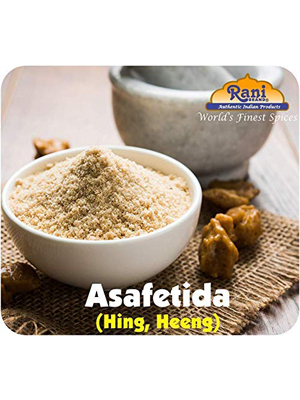
Rani Asafetida (Hing) is a premium, 100% natural Indian spice known for its powerful aroma and unique ability to mimic garlic and onion flavors. Packaged in a convenient 3.75oz PET jar, this non-GMO, salt-free, vegan powder enhances digestion and adds rich depth to Indian and global cuisines. Trusted for centuries, it’s a must-have for health-conscious foodies and culinary trendsetters alike.





| ASIN | B006POH22Y |
| Brand | Rani Brand Authentic Indian Products |
| Country of origin | United States |
| Cuisine | Indian |
| Customer Reviews | 4.5 4.5 out of 5 stars (2,998) |
| Date First Available | 25 November 2021 |
| Format | Powder |
| Manufacturer | Rani Brand |
| Manufacturer reference | 82600 |
| Package Information | Jar |
| Product Dimensions | 6.35 x 5.08 x 8.89 cm; 106.31 g |
| Product Name | Asafetida |
| Serving Recommendation | 1/4 tbsp |
| Special Feature | Vegan |
| Units | 3.75 Grams |
N**.
Wow! Thought it was a bit expensive until I used it. Lovely flavour. You only need a very small amount.
E**S
I'm from Minnesota and had never heard of this spice, but I've battling Lyme and started researching Myrrh (it was good enough for baby Jesus so...). When I first smelled it, I didn't like it - it's very pungent. But then I wanted to smell it again because there's something about it that's so compelling. Used in dishes, it's not pungent, it becomes smooth and hits all the 5 flavor senses. It's addicting. Love it! I'll never be without it again. Per Wikipedia: Asafoetida (/æsəˈfɛtɪdə/; also spelled asafetida)[1] is the dried latex (gum oleoresin) exuded from the rhizome or tap root of several species of Ferula (F. foetida and F. assa-foetida), perennial herbs growing 1 to 1.5 m (3.3 to 4.9 ft) tall. They are part of the celery family, Umbelliferae. Notably, asafoetida is thought to be in the same genus as silphium, a North African plant now believed to be extinct, and was used as a cheaper substitute for that historically important herb from classical antiquity. The species are native to the deserts of Iran and mountains of Afghanistan where substantial amounts are grown. The common modern name for the plant in Iran and Afghanistan, is "badian", meaning: "that of gas or wind", due to its use to relieve stomach gas. Asafoetida has a pungent smell, lending it the trivial name of stinking gum, but in cooked dishes it delivers a smooth flavour reminiscent of leeks or other onion relatives. The odor dissipates upon cooking. Asafoetida is also known variously as "food of the devils", "devil's dung", javoneh-i badian, hing, hengu, inguva, kayam, and ting. Asafoetida comes from Gum Arabic or Myrrh, that was used in the anointing (oil) of Jesus (along with with Cinnamon, Kusa grass, Bay leaf, olive oil, in the ratio, 2:1:1:2:1.8). Its use has been popular throughout centuries since the early 2nd century BC. It was familiar in the early Mediterranean, having come by land across Iran. Though it is generally forgotten now in Europe, it is still widely used in India. It emerged into Europe from an expedition of Alexander the Great, who, after returning from a trip to northeastern ancient Persia, thought they had found a plant almost identical to the famed silphium of Cyrene in North Africa—though less tasty. Dioscorides, in the first century, wrote, "the Cyrenaic kind, even if one just tastes it, at once arouses a humor throughout the body and has a very healthy aroma, so that it is not noticed on the breath, or only a little; but the Median [Iranian] is weaker in power and has a nastier smell." Nevertheless, it could be substituted for silphium in cooking, which was fortunate, because a few decades after Dioscorides' time, the true silphium of Cyrene became extinct, and asafoetida became more popular amongst physicians, as well as cooks. Asafoetida is also mentioned numerous times in Jewish literature, such as the Mishnah. Maimonides also writes in the Mishneh Torah "In the rainy season, one should eat warm food with much spice, but a limited amount of mustard and asafoetida [חִלְתִּית chiltit]." Asafoetida was described by a number of Arab and Islamic scientists and pharmacists. Avicenna discussed the effects of asafoetida on digestion. Ibn al-Baitar and Fakhr al-Din al-Razi described some positive medicinal effects on the respiratory system. After the Roman Empire fell, until the 16th century, asafoetida was rare in Europe, and if ever encountered, it was viewed as a medicine. "If used in cookery, it would ruin every dish because of its dreadful smell" asserted Garcia de Orta's European guest. "Nonsense," Garcia replied, "nothing is more widely used in every part of India, both in medicine and in cookery. All the Hindus add it to their food."During the Italian Renaissance, asafoetida was used as part of the exorcism ritual.
S**.
Very good. I got it because it was recommd by my doctor as an anti inflammatory spice for a Mediterranean/anti inflammatory diet. It tastes like onion.
A**R
Excellent flavour to add to cooking
H**Y
I developed bile reflux, I’m being very careful what I eat & bought this to replace onions & garlic & WOW! to my surprise it does taste like.. guess what.. ‘onion & garlic’ I use it quite a lot but you only need the tiniest amount so although it seems expensive at first it’s going to last me ages. When I’ve nearly run out I will definitely be buying more.
Trustpilot
2 weeks ago
3 weeks ago