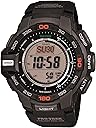

🌄 Own the outdoors with Casio’s solar-powered triple threat!
The Casio Men's Pro Trek PRG-270-1 is a rugged, solar-powered digital sport watch featuring Casio’s advanced Triple Sensor Version 3 technology. It delivers precise altitude, barometric pressure, and compass data with improved sensor size and power efficiency. Designed for the adventurous professional, it offers 100-meter water resistance, low-temperature operation, world time across 31 zones, sunrise/sunset tracking, and a bright auto LED backlight. With up to 9 months of battery life on a full charge and intuitive one-touch controls, this watch is engineered to keep you connected and prepared in any environment.


| Material | Resin |
S**L
Great watch
My review is for the watch face and not the band, because I absolutely cannot stand the polymer wristbands on modern watches, this watch being no exception. Replaced with a canvas band and it's now the best and most comfortable watch I've ever owned. I needed a watch that was waterproof, shock resistant, and that had solar charging. This is the best watch I could find that has those features that was relatively affordable. The additional functions just seemed interesting and were a bonus to me. This review may not stand up for someone who uses this watch for adventuring, and personally I wouldn't want all those functions in a watch vs a dedicated tool if I was trying to accurately judge the weather, altitude, navigation, etc. The functions, as far as I can tell, are accurate. Barometer seems to line up with the weather patterns in my area though I'm not an expert on it and only have some light reading as reference as to what the readings actually mean. I don't climb enough mountains to say if the altimeter works, though it is accurate to the elevation of my home. Compass seems consistent and accurate, which is one of the only functions I actually use regularly, and granted I'm not doing land NAV so I only need a general sense of NSWE. I don't know if I would trust a digital compass for navigation unless it was getting location data from GPS or something but it's accurate enough to find your way back to a main road if you got turned around in the woods. More importantly to me, the time is very accurate. I've had it for several months and it is still accurate down to the second when I initially set it (compared to my phone's clock which gets updated daily). The solar charging works great. I haven't had to leave it exposed to sunlight to charge it like many people online recommend to do; it gets plenty of charge just from me wearing it and whatever ambient light is inside my house. I haven't gone more than a week without having it on outside so your mileage may vary, but I expect even sitting on a dresser is enough to keep it charged. Also something I didn't realize I needed but that comes in extremely handy is the automatic light mode. You just lift the watch to eye level and the light comes on. Working early morning shifts before the sun comes up it's really nice to see the time without having to press the button, which is especially difficult if you're wearing gloves. My only complaint is the learning curve of the buttons on this thing. The 3 buttons on the right side are labeled and the left 2 buttons are not. The left side is what gets me mixed up as it controls additional timer/stopwatch/alarm settings and cycles various data displays on the other modes. With some practice the left side buttons become easier to use but without referring to the manual I struggled for the first week or so remembering how to use half the timing functions on this watch. I still sometimes hold down the wrong button to get back to standard time mode and end up going into the programming mode. Not a big deal because you can just press it again to get out of it but when you're just trying to see the time it can be a little irritating. I think it also reverts back to the time mode after 30-60 seconds for whatever mode you're in so if you REALLY can't figure it out, it will eventually do it for you. If I used the other functions more often I'm sure I would get better with it so I think this is a use case for me, and not necessarily a typical user.
K**S
Great ABC triple sensor watch with a great price
I decided to put this review up as a few reviewers have issues with the accuracy of the altimeter readings, and may not understand the limitations of these watches: Design ====== The PRG270 is smaller than some of the older Protrek models, due to the smaller sensor, and they have moved the sensor location from the 10 o'clock to the 9 o'clock position. The triple sensor makes these watches sometimes called ABC watches as they have Altitude, Barometer & Compass readouts. The smaller design makes it easier to wear everyday, however the face is still relatively busy, with the case having front raised sections (at the 12, 3, 6 & 9) with indents. The sensor at the 9 o'clock position sits higher than the raised section at the 3 o'clock position. The crystal is recessed nicely as usual on Casio G-Shocks and Protreks. I wish the design could look more like the PRW3000, which is cleaner and more stylish IMHO Casio Men's PRW-3000-1ACR Protrek Digital Display Japanese Quartz Black Watch , but is also 3 times more expensive. The display is similar to the other Protreks, divided into three sections. The top section has a dotmatrix display and can show the date, or altitude/barometric graphs, the middle section is the time, and the lower section is the seconds. The watch is light, mine weighs about 67 grams (2.36 ounces), and has 10Bar water resistance, which means it is ok in a rain shower, or shallow swim, but it wouldn't be ok with a scuba dive. I have only had this watch in the rain, and it functions fine. One issue with the PRG270 is the strap uses a 18mm spring lug, so if you wanted to put a wider Nato/Zulu strap, you'd need an adapter. Features ======= - EL backlight, this is nice and bright, and the EL button is still on the front, they have moved the adjust button on older Protreks from the front to the 10 o'clock position. You can still set this for Automatic, and set it for 1 or 3 second display. - Date display - on the Time display, you can change date to Day&Date, or Month&Date, or Barometric Graph only (no date). - Setting time - this is a breeze. when you get the watch is preset to Tokyo time. Changing the Time zone to your location, and checking if Daylight Saving Time (DST) applies, and voila - the time is set and easy to change if you travel. The secondary timezone is set by picking various preset cities. I have not had any issue with the time accuracy so far. - Stopwatch/Countdown TImer (24 hours max)/Alarm - All standard, but the alarm lets you have 5 individual alarms, and the alarm is louder and longer than my Suunto Core watches. - Sunrise/Sunset - this is also a breeze to set. The PRG270 lets you input the longitude and latitude of your location for accurate sunrise/sunset times. Compared with my Suunto Core watches which only lets me choose nearest cities. - Power save - I have set this to on, and the watch will display will go off overnight, or after a period of unuse to conserve battery. You can wake it up by pressing any button. Altimeter/Barometer (This is from my previous reply comment to a review on the altimeter readings) ======= All altimeter watches without GPS embedded will calculate the estimate of altitude by changes in air (barometric) pressure. Air pressure can change due to many things, like change in elevation, change in weather, your physical location and wind. So for example, if you get a low pressure system coming through over night, while you leave your watch on the table, it could appear that you have ascended a few hundred feet in your sleep. Similarly, if you take the watch on a commercial airplane, it will not give you a reading on the actual altitude, but a lower altitude, based on the pressure within the cabin. If you fly in an unpressurized aircraft, it will give you a more accurate altitude reading. I have taken a Suunto Core with me when I've been in a few prop aircraft, and used it as a secondary altimeter in skydiving, and it has been fairly accurate after calibration. I'll take the Casio up next time and see how it goes. Also, I have found that the altimeter and barometer readings tend to vary with temperature, and gives marginally more accurate readings off the wrist especially if I have been hiking and my wrist is warm. I also have a few Suunto Core watches, and the Suunto Core is quite clever in the way it calculates the altitude. If you leave it in altitude logging, it will gain elevation as you physically climb up, as the barometric pressure changes faster than it does when the weather changes, so it realises you are climbing. But once you stop climbing for a while, it realises this and any slight air pressure changes it takes as weather change, and not altitude gain or loss. The Casio doesn't have this feature. For accurate altimeter readings you still need to calibrate your altimeter watch to your reference altitude on a fairly regular basis. I do this when I want to log altitudes before a hike/climb. An easy way to do this is to check Google Earth which gives accurate altitude readings when you put your location. You can then calibrate the barometric pressure from your local meteorology service (I take mine from their website on the day I calibrate). If kept properly calibrated during a day that has fairly stable weather, they should prove to be very accurate overall. In varying weather conditions, you will see some variation. Again, it's essential to know the reference altitude to get back on track. Still, this can vary, and the altimeter watch is not a scientific instrument, but only designed to give you an estimate on current altitude. For example, on a recent trek to Mt Everest Base Camp, I ran a few loggers, including a barometric altimeter, and on the return trek later in the day because I was exhausted, I didn't recalibrate the altimeter at the known peak height, the altimeter log showed an altitude difference of about 10 metres (see here imgur.com/8XrW0iD) So if you are after an altimeter watch for accurate altitude readings at specific location, without daily calibration, the Casio PRG 270 it is not the right tool for you. The accuracy of the altimeter when properly calibrated is pretty close when I've compared it with my Suunto Core watches, Garmin handheld GPSs and altitude markers on trails. I usually the watch strapped to my backpack strap when hiking, so it doesn't get thrown out by my body temperature. Also, I haven't checked how fast the altimeter updates. It seems ok for hiking, but I haven't taken readings and monitored it while bike riding for example. The newer V3 Sensor has reduced the time required to measure altitude from 5 seconds previously to 1 second now, and the altitude measurement unit has been improved from five metres to one metre. The temperature reading in the barometer was pretty accurate, but I've noticed it can get wierd with rapid changes in temperature. For example, if you have left the watch by the window to solar charge, the temperature will be wrong for about half an hour until the watch and sensor cools down, and you get a more accurate measurement. You should only calibrate the temperature when the watch has cooled to normal temperature, and I have done this with a high accuracy thermometer. The temperature reading it gives includes 1 decimal place. In my Suunto Core, it only displayed the nearest degree, but after calibration, both Suunto watches and the PRG270 are pretty accurate on temperature off wrist. Altimeter logs - the watch has enough memory to store 30 logs, and 14 trek logs, but I think the Suunto is better here as it can record more. Compass ======== As with all electronic compasses, it will get interferences from other magnetic sources, and may not be accurate on boats, planes, trains, or even in some buildings where the ferroconcrete magnetism causes inaccurate readings. That said, I have had good experiences with the compass, in those conditions. The magnetic compass can be set for magnetic declination, and you can still display the time in Compass mode. The top section can be set to display the bearing (0°-360°) or the direction (N,S,E,W, etc). You have to have the watch level with the ground to get an accurate compass reading, and it is easy to calibrate by holding the adjust button down. You should only calibrate when way from other magnetic sources. I do this when I'm starting a hike, away from the car, but always carry a real compass and maps if going out bush. If you leave it in compass mode it will stop the compass to save battery. Summary ======= Overall, for the price, this is a very good triple sensor watch that because of the smaller size from previous Protreks you can use for everyday wear. If you understand the limitations of ABC watches (they are not intended as precision instruments), this is a great first ABC watch.
G**Y
Incredible value; great learning 'toy'; wish it had one more feature
This is my third ABC watch; I also have the original 'Pathfinder' and a Suunto Vector. Here's a few reasons why which might help you make your decision to buy this: - This watch is just the right size; big enough to operate with heavy winter gloves but not comically large. - The response time from button push to readout is very quick with this third generation sensor, about a second. - Unlike my other ABCs, I'm not concerned with draining the battery by taking frequent readings because this one is solar powered. - The battery life is estimated by Casio at 6 years, based on # of charging cycles and battery 'memory'. - The auto-light which activates when I flick my wrist is nice for one handed viewing at night. I don't find it too bright. User can select 1/5 or 3 seconds. - I like having the Sunrise/Sunset data one button push away (bottom right button while in time mode). I find myself checking it every few days to observe how that cycle is changing. - Like other ABCs, it shows pressure trends so basic forecasting can be done (assuming true altitude has been relatively constant) - The altimeter is more sensitive and precise than my other ABCs. Like some other reviewers have mentioned I can raise the watch and watch the altitude readout change by ONE meter, then back down again. The altimeter is 'precise', but to be 'accurate' you must tell it the current altitude before you start your climb. These watches interpolate altitude from a pressure/altitude lapse rate formula. The readout will track that ratio perfectly accurately, but that lapse rate (m/milibar) is only accurate in a NOAA 'standard atmosphere', which is a nominal average. Real world lapse rates vary and so will your indicated altitude for various reasons (which are all interesting to learn about). For example on a colder than standard day it will read high, and on a hotter than standard day it will read low. This watch IMO would be a great tool for a child or anyone who wants to studying many interesting subjects, lapse rates, adiabatic cooling, pressure effects on weather, and so on. Calibrating the altitude is simple, press the set button and increment the readout to your current known altitude. Having to tell an ABC watch the altitude is not absurd, and works as follows: on a recent climb of Fuji my group started from the station 5 bus terminal which we knew to be 2,300m. The summit is at 3776m and there are huts every few hundred meters of elevation. It was nice to know how 'far' until the next hut, especially the one we slept at, and then how far to the summit. A simple calculation using the altitude and time from the watch such as 'the previous 100m took one hour' gave a rough estimate of ETA; which helped to keep the group motivated. After years of using these watches, I wish Casio would incorporate one feature which I call 'altitude lock' or 'base-camp lock'. If the user knows his/her true altitude will not change for several hours, he should be able to lock the altitude readout at its current value. Any attempt to use the altimeter would show "LOCK". Then, when the climb resumed the next morning, the indicated altitude would NOT have drifted up or down due to weather changes over the past several hours; it would not be any less accurate than it was the moment the watch was locked. The new Suunto Core might have this. But one can't have it all for about $100. For what I paid, $104.99, this watch is an incredible deal; especially since I won't be spending valuable time and real money on batteries for several years.
W**R
Overall, very good watch.
I got this watch as a replacement for a G-shock that only lasted me about 6 months before it quit on me. So far it's proven to be a very nice watch. To be honest, I don't use the watch to its full potential. I have no need for some of the functions, such as the altimeter and barometer, so I can't comment on those. It's a good size for me personally, kind of a medium sized watch face. Not the biggest I've seen, at the same time, I certainly wouldn't call it small. The thermometer works as expected. When worn, it reads a few degrees higher, because of the heat you're body is putting off. It usually gets the temperature close enough to what I use it for. If you need a more accurate reading, just take it off and let it sit on a table top for a few minutes, and it should be pretty spot on. I can't really comment on the accuracy of the compass on this watch, as I've never tested it with an actual compass. The one downfall I think this watch has is that when the battery starts to die, there really isn't a long period of time from when it tells you that it's low, to when it actually dies. Not a huge issue, however if you don't have a chance to get it into some sunlight to charge back up, the watch may die, and render the watch useless until you can charge it. Over all, a great watch. Durable, functional, comfortable, and I think it looks pretty good too!
R**.
Vast improvements from the older sensor watches from a decade ago!
I bought this knowing I did not have an atomic receiver in it, but its my first watch with solar. After one week, I must say the new engine provides better precision on your altimeter functions, in 5' increments vs in the past my older one I believe was 20 foot. now going in, new users must understand, the barometer needs to be set for the stationary location and will remain accurate until location (elevation changes), and altimeter is only accurate when set at the start of your journey with reference elevation and remains accurate for a few hours depending on on quickly the weather pressure is changing. (essentially you use one or the other as one will go inaccurate once the other parameter changes) The thermometer you can set to be accurate while either on your hand or off (by calibration)(but take in account it takes several minutes to adjust if you change the environment it is in) But is accurate when done following its limitations. The display is large, solar has worked great so far (too early to tell longevity, but from what I ready, and a watch with a lot of sensors like this) it should be welcomed feature. Has world time so I can easily switch to UTC and see also local time, easy to change time zones while traveling, oh a great feature if with your known latitude longitude down to one decimal degree it tells you sunrise and sunset!! and you can see it for future or past dates!! I like this. 12 and 24 hour time countdown time that can do hours and minutes, and stopwatch. Those are nice feature that work as advertised. nice easy to read display, larger then some of the g-shocks i initially were shopping for. I am happy to have the sensor features if I need them at any point I can activate their usefulness, oh I forgot, the compass!! it works really well after calibration!!! This you can use anytime (calibrate if you change >200 mi. locations on the earth as magnetic deviation changes) shows you N, E, S, W on rotating display.
R**M
Great, Rugged, Multi-function Watch.
I bought this as an exact replacement for my old watch. Replacement bands are expensive. For me it was worth it to just replace it. I have to charge the old one more often now and the band is cracking in 3 different places. It's been through a lot between different environments, exposure to chemicals and taking a physical beating. It is a bit bulky, so you may need to remove it to get your arm in tight spaces. I don't use the compass/altimeter/barometer enough to speak on the accuracy of each. I used to check the barometric pressure when I'd get a migraine. I bought it for the multiple alarms/snooze, dual time/zones, backlight (makes a great low light flash light) and ruggedness. I sleep a lot better when I have an early flight and I can have 3 alarms set, plus a snooze. Hard to hear the alarm if you arm is under your pillow (set it on a nightstand or other). Dual time zones makes it easier to keep track of time when your in multiple zones. Temperature is fairly accurate if you take it off your wrist and let it sit awhile. If we were in a creek or lake, I'd let it sit in the water and check the temperature. It's been a long time, but I used to take it to the community pool with my son and we'd toss it into the different depths to see what it would read. I had the old one for probably 4 years and it still works. I had a problem with the original where you had to tilt at an angle to see the screen. I considered it my privacy glass. No one could look and tell the time with out me angling it for them (funny to me). This one is clear as can be. It arrived on medium charge and is working fine. I don't know how well it charges under office lights, as the old one would never return to full unless I left it on the dash of my truck to charge in direct sun light. I wear short sleeves year round, but the only way to charge it back to full is about 8 hours of full sun . That would keep it on high for a few months, maybe 3. As it got older I might leave it out there 2 days in a row (about 16 hours). I haven't been able to leave the new one outside as we haven't had direct sun in the last 5 days. Yay New York! Just an update: it's been well over a year now and have only charged the new watch one time. It was on medium when I pulled it out of the box. I set it in the sun for a bit and haven't seen medium since.
2**E
Very happy
Well, at least so far. If this keeps working I'll be REAL happy since it has all the criteria I wanted for a watch. Altimeter is sensitive to a 5 foot change in elevation. Like sitting down..standing up? Almost! Now, measuring altimeter accuracy is another matter..but it looks pretty good. Barometer ok..again, how do I tell. I might be able to ascertain that with a little more experience. Watch was 2 seconds off (WWVB) when I got it. This does NOT have WWVB reception but tolerance is supposed to be 15 seconds a month. That's fine. Compass. Despite what people say, the compass is very accurate as long as you understand the limitations of ANY compass. You get near ferrous metal and you're done. Menus: I thought there would be a lot of digging around to find/set what I wanted. But you can download a really good manual at http://support.casio.com/storage/en/manual/pdf/EN/009/qw3415.pdf If you try to read that little tiny manual you'll go mad. Just get the PDF. The light is not fluorescent but appears to be a side lit LED. Works fine although this might be a power hog. My watch has been on MEDIUM charge since I received it a week ago. I should leave it in a window sill for a day to get to a full charge. But I'm busy so let's see how it goes. Comfort: Surprisingly comfortable. It is a big watch but they're really stuffing things in there so I'm okay with that. It's light weight but size aside, it's comfortable--fits on the wrist perfectly. Lots of adjustment in the band. Sunrise/sunset is on the money (this is easy to do though..handy!) I thought the price point on this watch was a little better than the one that receives the atomic standard from WWVB. Maybe next time..hopefully in 10 years...?
M**S
Nice To Know - Where You Are, Where Your Going, Your Altitude, The Temp, Weather - Thank You!
Love the Casio Brand. Have three of them and two are solar. Wow, what a difference! Have cheaper watches with supposedly the same functions, but this beats them all in ease of use, accuracy and quality. Very much worth the difference in cost. Works great in all functions, with easy to understand and easy to use instructions. If you can get your hands on the .pdf user manual it's much easier to use than the small printed one that's provided, but the small one is better than nothing. Hard to believe this has been out since 2013. Where have I been all that time? But finally it's mine!
Trustpilot
2 weeks ago
1 week ago