We remain fully operational. Our teams are working around the clock to ensure your deliveries continue safely.

DOWNLOAD THE APP


Customer Services
Copyright © 2025 Desertcart Holdings Limited
DOWNLOAD THE APP
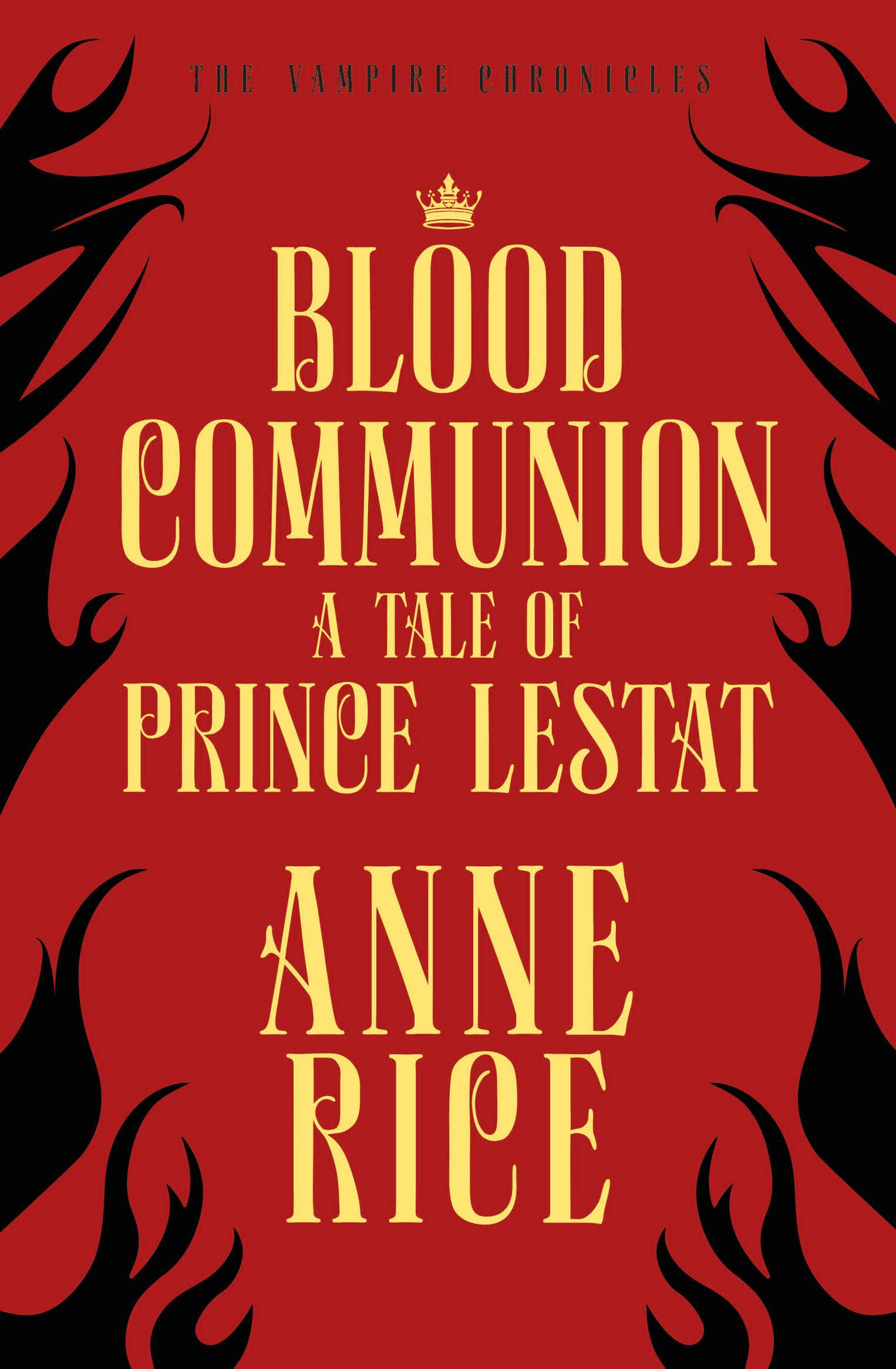
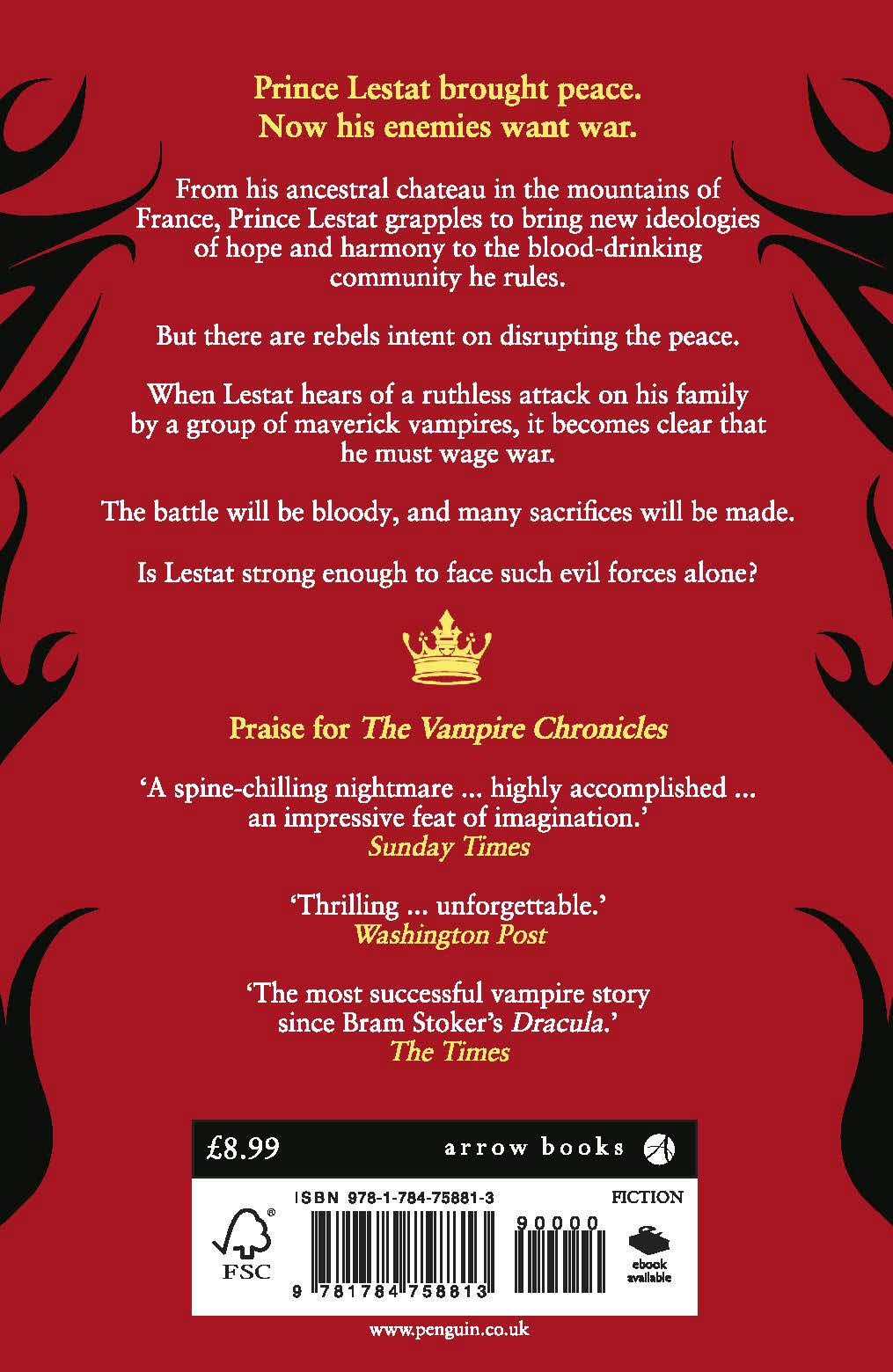
🧛♂️ Sink your teeth into the legendary finale of vampire lore!
Blood Communion: A Tale of Prince Lestat is the 13th book in Anne Rice’s acclaimed Vampire Chronicles series, delivering a fresh new stock of the epic conclusion where Prince Lestat finds peace and love after decades of darkness.
| Best Sellers Rank | 149,734 in Books ( See Top 100 in Books ) 44 in Zombies, Werewolves & Vampires 319 in Horror Fantasy 1,288 in Urban |
| Book 13 of 13 | Vampire Chronicles |
| Customer reviews | 4.6 4.6 out of 5 stars (4,263) |
| Dimensions | 13 x 1.9 x 19.8 cm |
| Edition | 1st |
| ISBN-10 | 1784758817 |
| ISBN-13 | 978-1784758813 |
| Item weight | 222 g |
| Language | English |
| Print length | 272 pages |
| Publication date | 3 Oct. 2019 |
| Publisher | Arrow |
S**A
Sharona
Great read, love all of The Vampire Chronicles
M**O
Fantastic
I absolutely loved this , I thought it was a great way to end the Vampire Chronicles with Lestat at peace & finally surrounded by people who love him , he deserved a happy ending after all he's been through & I hope Louis & Lestat live happily ever after!
K**S
A greàt last chronicle
This is a return to the vampire Lestat tales of old which I preferred to the likes of prince lestat and, the realms of Atlantis. I do like the way the chronicles are always told in the first person, it makes me get through them quicker although this one has a slow start but overall its a good last entry for the vampire chronicles from the queen of Vampire fiction. I became hooked on these books after seeing the film version of Interview with the vampire, which isn't a patch on the book. This book is worthy of being adapted in part.Over all this is a good last chronicle from Anne Rice, but it is not a patch on the tale of the Body Theif. After a slow start with Lestat talking about architecture the story excells itself to being a great story having a bad guy not seen since the likes of Memnoch the devil. I The third portion of the book trails off again.I don't like to give spoilers but will tell , all your friends are present. . IWill miss your work Anne, R.I.P.
L**M
Coming of age!
No spoilers .... How does Anne Rice grow Lestat and his beloved tribe from book to book so strongly? I adored her brat prince hero from her 2nd vc book and have cared more and more for him book after, sometimes obscure, book. I love him even more at the end of book 13. Anne brings us anguish and triumph and love in common. Thank you beloved author!
I**N
Another great book
Waited eagerly for this book and wasn't disappointed. Yes it was quite short and just hope Anne Rice continues on with more. Like most fans I have come to be very invested in all the characters and want more of their adventures. I've had to start reading the whole series right from the beginning again !
M**M
I enjoyed this book within the vampire chronicles.
I am a big fan of Anne Rice's vampire chronicles. I was excited to read the latest instalment in the series. I very much enjoyed reading this novel. I love Anne's writing style and the characters in her books. Especially Lestat!
A**S
A Tale
I enjoyed the book and managed to read it all in one day. I felt it was very much a "tale," not necessarily as full and detailed as any of the previous novels in the series, and possibly more interesting for long-term fans, or those who have read 'Prince Lestat' and 'Realms of Atlantis' already. I wouldn't start with this one if you're new to the series, but it's a good add-on. Good to know what the Brat Prince and his courtiers are up to, and interesting to see more insights into their system of government, and how they hope to bring the vampire 'tribe' together in the modern age, with an abundance of wealth, compassion, justice, and a leader who finds mesmeric beauty in all walks of life. I always respect and appreciate Anne Rice's work, as she experiments with ideas, perhaps beginning with a line or an event, without knowing exactly how it's going to pan out. It is a joy to read this discovery, as much as I imagine it would have been to write it. That said, there were a few things that niggled me. Firstly, the character of Rhoshamandes: he is quite a perplexing mystery, and I can't seem to get a grasp on his motives. If he has a split personality, I'm surprised that wasn't made more of a feature. I'm really not sure what to make of him; there seem so many loose ends and conflicting theories. But, such is life on occasion, and I'm sure the afterlife is no different, in having its share of frustrating enigmas? Secondly, if vampire science is now so highly evolved, why aren't certain 'deaths' able to be verified? Thirdly, what has happened to poor Pandora? She is barely a shadow of her former self (it's kind of depressing). There are so many new characters now - which is lovely - but means one is left craving for more than an outline of each of them, and likewise, it's hard to hear the more familiar characters 'thinking,' which was what I loved so much about past Chronicles. But. Perhaps this is yet to come. I did, however, enjoy the focus on Armand, and Gregory. The writing style has changed a lot, generally becoming less descriptive and more chatty, which may or may not work for you. I've read all of the main books (excluding the ones with the Mayfair witches, and Vittorio) and was impressed by the predecessor to this one; 'Prince Lestat and the Realms of Atlantis,' and this one is ok. Things happen and there is dancing throughout. There are some dark moments, but it is not a tale of woe. In one respect, one wonders whether reading about characters pushing through a life of struggle, and trying to maintain a glimpse of the light at the end of the tunnel, may feel more rewarding, and like it has more substance, but, I think it's equally bold to write about characters who, on the surface, have all the wealth and popularity they desire, and where do they go next? What about when the old dark starts to creep in? What are the responsibilities of someone who doesn't need to fight to survive? Such are the challenges of the new Lestat. The book gives a flicker of a promising new direction if you look out for it. It also contains philosophies one could read more deeply into, but on the whole they are referenced so delicately, the story is a very easy read, with some lovely visuals to finish it off. I've only given it 3 stars, as it was a bit predictable, and not my favourite of the series, but I'm glad to have been brought into the vampire world once again.
A**R
What a fantastic read again
What an amazing book I have enjoyed each of the vampire chronicles in different ways.They have gripped me right from the start and can't put the book down,this book was no different a triumph from beginning to the end.
B**R
BLOOD COMMUNION, Anne Rice’s new addition to her beloved series of Vampire Chronicle novels, includes some of the most powerful, lucid, and effective storytelling prose she has ever produced. I respect her suggestion that readers not read reviews of this book that contain spoilers. In the following I describe no specific plot line or what happens to characters. I’ll keep my discussion to the broad implications, which are indeed profound. [NO SPOILERS FOLLOW.] This is a tightly-constructed, fast-moving, vividly alive and sometimes deeply disturbing narrative, exclusively told in first person by Lestat de Lioncourt. The narrator wrestles with what his role has truly become as the Prince of the Vampires on a global scale in today’s world—though not every single member of that tribe accepts his authority, which is a crucial point. As always, the fascinating realm into which Anne takes us, and the seductive voice of the narrator, which makes the tale irresistible, entertain lavishly with prose so vivid, while streamlined, that it seems already like a fabulous film or television series to the mind’s eye. Also consistent in all of the Chronicles are the profound philosophical and spiritual underpinnings, though these elements never intrude on the pure entertainment value. Consider this: predators are not evil in Nature itself, in fact they are necessary to the health and well-being of prey populations, in the broader sense, as they tend to cull weaker individuals that are young, injured or sick, and elderly. In Anne’s world here, where mortal humans like us and post-human vampires inhabit the same world that we, the readers do. The only actual evil apparently stems directly from human nature, and its post-human form is basically the same, with the ability to choose behaviors. This evil is ultimately no more than a determined appetite for revenge, vengeance, and a willingness to destroy lives, to destroy beautiful accomplishments, a lack of compassion, simple cruelty, and even a hateful will to cause suffering. Anne’s vampires are not inherently evil because they are vampires—these creations of her limitlessly fertile imagination are far too complex and fascinating to enact “evil for evil’s sake,” as we sometimes see in lesser fantasies. The moral complexity at work in the Vampire Chronicles is every bit as frightening as the “real world” human evils we now face in everyday life. I’m also inspired to consider: if humans lack natural predators that seriously threaten us now, are our populations becoming mediocre? Are human evils such as endless wars, on a deeper level our species acting as our own predators? Further, the possibility of redemption, of acceptance of a healthier balance between predatory instincts and the purposes of a prey population develops as never before in Anne’s new offering: BLOOD COMMUNION. From the very beginning of these Chronicles, which remain unique in modern literature despite countless imitators, the theme of conscious predation—to kill by choice, not only from hunger, with the option to kill only the evil-doer, has been explored. These vampires can read minds, and have exquisitely intense sensitivity, so they know a bad apple: the rapist, serial killer, sadist and unregenerate destroyer of others. Because these remarkably vibrant, complex, evolving characters truly seem to have a “life of their own,” I’m not sure if the author will agree with the following theory of mine. My feeling is that beginning in the first novel of the series, INTERVIEW WITH THE VAMPIRE, Lestat’s beloved Louis de Pointe du Lac not only helped him enter the modern world of the 19th century. Despite Lestat’s later disclaimer in THE VAMPIRE LESTAT, I feel he actually was becoming jaded and quite monstrous in his predation upon mortals before he met Louis. It seems to me that Louis’s initial distaste for taking human life actually re-awakened the human heart within Lestat, whose struggle with his conscience continues ever since through the series. What Lestat at first viewed as Louis’s weakness, Lestat himself eventually embraced as a virtue. These two are powerfully bonded by love, and at the same time have most often found it difficult to co-exist. In these last few novels, they are accepting their interdependence. Now with BLOODCOMMUNION, Lestat resumes full first-person control in his distinct voice with a story particularly concise, suspenseful, filled with intense action and dramatic changes. The primary theme is how Lestat deals with and comes to accept his position as Prince of his Tribe. He no longer houses the collective “core” of the Vampire Tribe, as The Queen of the Damned, Akasha, then Mekare, and he himself did, until the volume before this one: PRINCE LESTAT AND THE REALMS OF ATLANTIS. Yet now Lestat is still hailed by most of his kind, as their leader, due perhaps partly to his sheer charisma, as well as the fact of his original mortal family’s old noble, if not royal blood. The vampires are presently dwindled in numbers, due to numerous incinerations by Akasha and then Amel, and many recognize the need for a leader with understanding for recent fledglings in the Dark Gift, as well as the extremely ancient ones who continue to emerge. There are a few who reject his authority, and from among them, the major challenge of this story arises. Also, all along Lestat has expressed a certain ambiguity and uncertainty about this role. Initially he stated that he refused to be called “The Prince of the Damned,” though doubtless some of the veneration pleases his vanity. At the same time, the matter of conscious predation returns as an important theme this time around. Yes, these vampires are driven to drink mortal blood, and even to kill, simply to survive, though the older they are and the more ancient the blood they have consumed, the less they need to survive on. In their nature, there is a kind of thirst for blood, not at all unlike the human lust for erotic pleasure—still, these are conscious beings, and they have the choice of what victims they feed upon or kill. This actually produces an ingenious dilemma also timely for mortals, in different ways. This theme of predator and prey gains even more depth here, when Lestat—as he has for the last few novels—periodically fights his own urge to drink of “innocent blood.” Though his conscience urges him otherwise, some mysterious compulsion within him seeks this, as if the quality of the victim influences how the blood affects him in deeper ways. Does he seek to regain more of his own original innocence this way? We certainly know that to drink the blood of ancient vampires, who sometimes willingly share it, renders a younger vampire more powerful. We’ve known for some time, since the last novel at least, that Prince Lestat intends to eventually rule as something like a constitutional monarch, rather than an absolute ruler. His gifted friend and mentor Marius, we are told, is working on drafting a constitution to govern the Children of Darkness. Most likely this will include such issues as principles that relate to vampires killing their own kind (a taboo that led to Claudia’s death in the first book, even though she only attempted it) and shedding the blood of innocent mortals, as well as confining or enslaving other varieties of non-mortal beings. Probably a sort of council or parliament will administer such principles. None of these difficult issues are likely to be subject to simple and absolute “laws,” but given the brilliance of these immortals, the actual text would prove both eloquent and wise—at least within the parameters of the nature and needs of these Blood Drinkers. Perhaps something that lies ahead of these characters beyond the end of BLOOD COMMUNION, is this matter of governance: is democracy subject to abuses actually better than a benign monarchy? Clearly a wise and enlightened monarch is far better than a corrupt president. And yet how do you deal with a corrupt and tyrannical monarch? Please don’t get the impression this is a philosophical novel, despite my discussion. I’m a philosopher by nature, but BLOOD COMMUNION is riveting entertainment, plus a fine work of literary art. I suggest you sink your fangs into this marvelous book and savor its flavors! — Bruce P. Grether
S**O
The last of the Vampire series. Great one. Hopefully not the last one she will write.
P**O
Consegna veloce, libro perfetto
S**E
👍👍👍👍👍
A**R
As sad as I am that I reached the last book of the Vampire Chronicles but what a book it is.
Trustpilot
2 weeks ago
2 weeks ago